



LNG fuelled engines may be the future, but what about today?
The rising cost of energy and increased concerns about the environment have resulted in significant changes in the industry. Regulatory bodies in different states are working to introduce Emission Control Areas (ECAs). Current such areas are in the Nordic region and the Baltic Sea, the English Channel, North America and some islands in the Caribbean.
Earlier this year, the EU published a consultation document which considered a number of options for curbing emissions which may either take the form of a market-based mechanism that would apply to ships’ emissions in Eurozone waters or a “compensation fund” that would requires owners to make payments to offset damages caused by carbon emissions. At the same time, bunkering prices have tripled over the last three years and most analysts agree that prices will continue to rise for some time.
Next generation engines
According to Trond Skaufel, Managing Director of Pon Power in Scandinavia, these changes have lead to a rising demand for more fuel-efficient engines that help lower emissions. “LNG as fuel for ships an attractive option, but until a global network of LNG bunkering terminals is established, LNG-fuelled vessels will be limited to coastal trades where a LNG bunkering network exists,” he says. “In the meantime, engine manufacturers are busy developing a new generation of diesel engines optimised to reduce fuel consumption and corresponding emissions.”
Skaufel says that Pon Power is seeing rising demand for new more efficient engine types and related tools to manage new regulations. “Quality engines, operational reliability and good service remain critical to our success,” he says. “But with pressure on owners to reduce fuel costs and comply with new regulations, we have to be able to work with other stakeholders to provide the right solutions, today.”
Pioneering innovation
Skaufel notes that as a distributor for Cat and MaK Engines to the maritime and offshore segment, Pon Power has access to innovative engine technology. For example, Cat continues to develop ACERT™ technology, which enables the combustion process to be shaped and managed with an extremely high degree of precision, resulting in an engine that meets or exceeds emerging emissions requirements. At the same time, Mak has announced the development of the MaK M 46 DF, a new marine dual-fuel engine platform. Pon Power also offers a full range of NOx reduction kits to improve the performance of existing engines.
Partnering for success
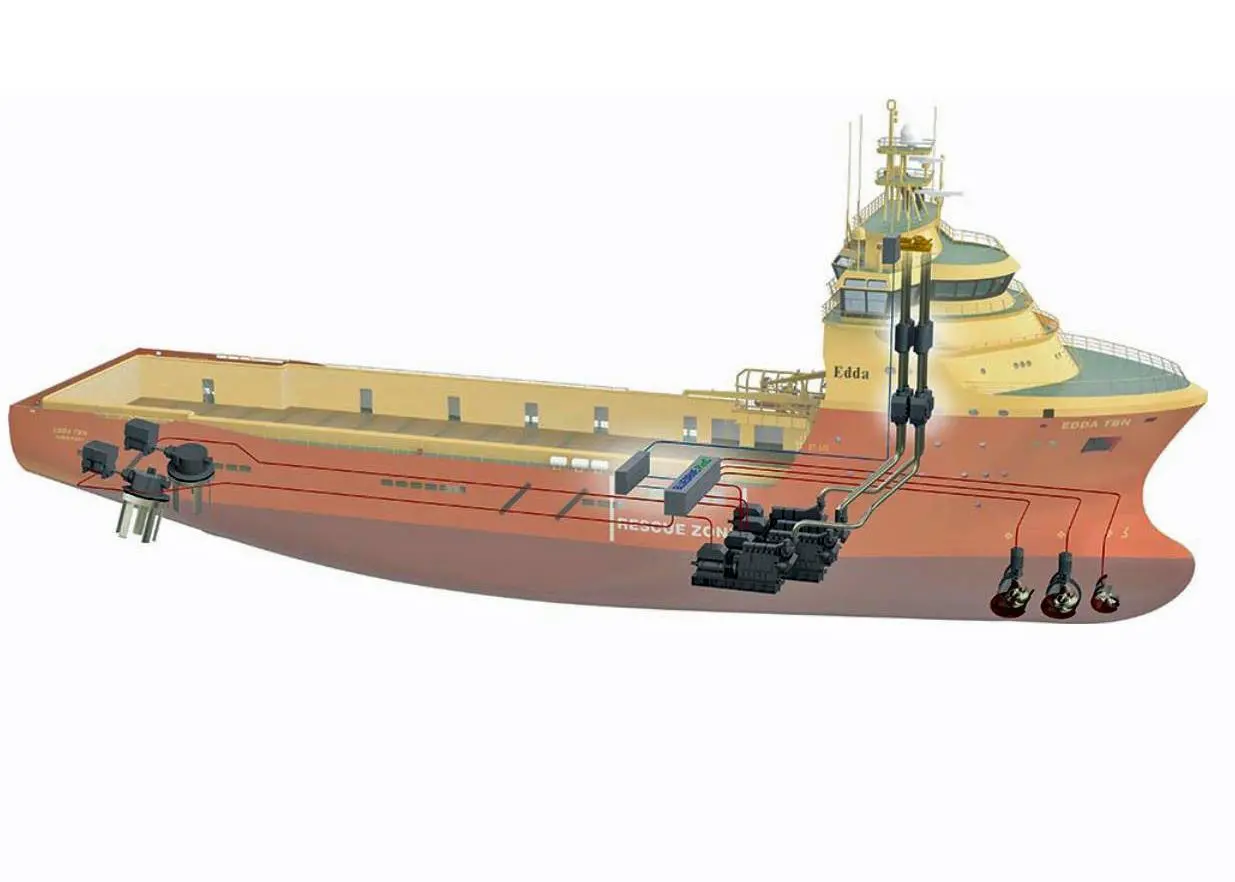
More recently, Pon Power was approached by Siemens to supply a specially modified propulsion package to be used in a new offshore supply vessel owned by Østensjø Rederi, which operates a large fleet of OSVs, tugs and towage vessels. The technology is built around an innovative variable drive propulsion system, known as the Bluedrive PlusC, which reduces fuel consumption and includes an SCR catalyst that can operate over the load range of 6% – 100%, resulting in significant reductions in both NOx and CO2.
According to Ketil Aagesen, sales manager for Siemens, the company had been working on variable drive systems for some years at the company’s technology centre in Trondheim, Norway. “While we had to design new components and control systems, everything in the Bluedrive PlusC is based on proven technology,” he says. “It is how we integrated different components that makes the difference.”
Optimising engine performance
In terms of emissions and fuel efficiency performance, the Bluedrive PlusC is claimed to be equal, if not better, than LNG fuelled engines, and also more affordable. “While the Bluedrive PlusC is optimised for the OSV segment, we are working to develop the technology to apply to larger vessels and different engines – including dual fuel,” says Aagesen. “We have launched the concept in the US and Asia, and so far, we are pleased with the response.”
To implement the project, Siemens and the owner spoke to a number of engine manufacturers before selecting MaK. “We were looking for a reliable engine with the right design parameters and good technical support,” he says. “MaK and Pon Power fit the bill.” Together with the MaK factory in Germany, technicians at Pon Power have modified two MaK 6M25C and two MaK 9M25C propulsion engines to function with the new Siemens variable drive frequency concept.
“This technology represents a genuine innovation in engine efficiency,” says Skaufel. “And by pairing Bluedrive PlusC with our existing propulsion systems, we are confident we can better support our customers efforts to improve fuel and environmental performance.”
Skaufel acknowledges that Pon Power can’t deliver a whole engine room, but says that the company’s technical competence, customer network in Scandinavia and support from Cat and MaK make Pon Power a strong partner in the region. “The industry’s renewed focus on sustainability has lead to a more cooperative approach between stakeholders, and we remain open to collaborations in the future.”
Working together to achieve common goals
In 2008, the Ulstein shipyard together with NTNU, Norway’s leading technical university and Marintek, the Norwegian Marine Technology Research Institute launched an initiative to improve strategic and operational aspects of production systems. “Ulstein was seeking a new way of working with suppliers to streamline the build process and create a more modular approach to production,” says Skaufel. “NTNU invited a number of suppliers, including Pon Power, to help sponsor a long-term research and development project to optimize maritime production.”
Known as IGLO Maritime Production 2020, the programme brought together NTNU, Marintek, Pon Power, Ulstein, Siemens and Fiskerstrand shipyard to strengthen and improve the competitive capabilities of the Norwegian maritime industry through a number of work packages. The initiative produced a number of scholarly publications on a broad range of issues, from CSR to innovation, sustainability to maritime supply chain networks. “While not every topic covered by IGLO has been relevant to Pon Power, we have gained a better understanding of yards and how we fit into the overall value chain.”
Related Articles
 PROPULSION
 GENERAL NEWS
 GENERAL NEWS