



Germans stay afloat with offshore repair
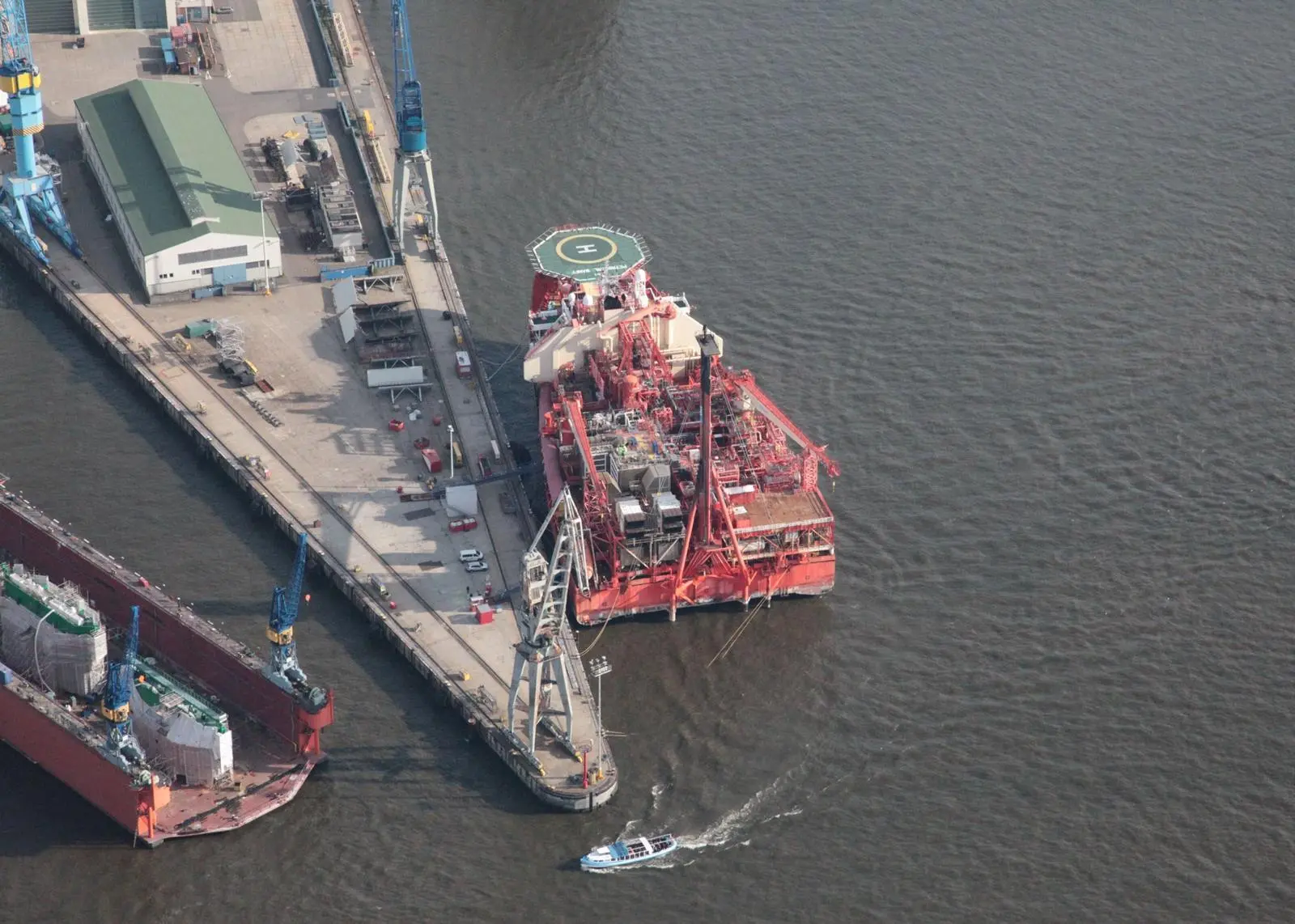
The 20,800dwt FPSO Petrojarl Banff was at Blohm + Voss Repair in Hamburg until about May. She arrived in September and joined the 92,000dwt FPSO EnQuest Producer which arrived last July and is at the yard until about mid 2013 for life extension.
Petrojarl Banff is 120m long, 53.8m wide and was undergoing turret modification while a new bilge keel and anchor winch were being installed. Her flare tower and other structures were being reinforced, her blast wall extended and her process and mechanical plant completed. During the docking, she was also undergoing class work and general repairs.
The offshore jobs come after a year in which B+V was probably the busiest repair yard in Germany in terms of ships and tonnage docked. More than 30 mainly big ships called in 2012.
Late-year cruise ships included the 61.849gt Rotterdam, docked in December for cleaning, hull conservation, general repairs and class work. She followed the 54,763gt Thomson Dream, for very similar work.
Before that, HLKF’s 9,570gt Bremen docked for maintenance and repairs. B+V reported cleaning, general repairs and class work, but an HLKF statement also spoke of repairs to her propeller, a Kawasaki unit. The shaft was drawn and shaft and rudder bearings were renewed.
HLKF said the 28,890gt Europa and the 8,378gt Hanseatic were now also due for overhaul in 2013, but where they will go was not known late year.
B+V Repair also docked no fewer than seven big Hapag-Lloyd Express series container ships from August on. The latest were the 104,015dwt Prague Express and the 103,662dwt Budapest Express, which called for inwater survey. A third, the 54,157dwt Dublin Express docked for cleaning, hull painting, repair and class work.
They followed the 54,157gt Glasgow Express, docked for cleaning and external hull conservation, general repairs and class work, the 103,995dwt Frankfurt Express and the 104,007dwt Sofia Express, both for inspection.
Finally the 54,155dwt Liverpool Express docked for hull cleaning and coating, repairs and class work. The yard also docked the 12,744dwt cargo ship Alina for overhaul of shaft sealings and the 97,220dwt oil tanker Katja in the giant Elbe Dock 17 for grounding damage repair.
Lloyd Werft Bremerhaven (LWB) also went into the New Year with an offshore conversion to keep it busy and with the likelihood of a second.
MD Rüdiger Pallentin said the conversion of the 4,600dwt Island Offshore oil platform supply ship Island Centurion into a North Sea well-services vessel for charterer Schlumberger was a “costly and complex contract” and would be completed by mid 2013.
Schlumberger told this correspondent earlier that two chartered sister newbuilds were to be converted at LWB, but there was no word on the second, believed to be Island Captain, as The Motorship went to press.
Mr Pallentin said in November LWB was “experiencing a welcome end-of-year rush of business” but noted this was pretty normal. The yard, like many others, books seasonal cruise and other ship overhaul. Three cruise ships were booked in late year. Two of them, the 24,344gt Braemar and the 43,537gt Balmoral, are among Fred Olsen ships which usually dock at B+V Repair in Hamburg.
LWB said Rüdiger Pallentin was “particularly pleased the yard had acquired a new customer, one perhaps better known until now on the Elbe. He was even happier because Fred Olsen had sent a second ship to Bremerhaven straight after the first”, the yard reported.
Balmoral was booked in December for class work, work on lifeboats and davits, the installation of a catwalk, the overhaul of shafts including the replacement of bearings on all main engines and the dismantling, overhaul and re-assembly of rudders. Pipes were renewed and external blasting and painting carried out.
The “comprehensive” repair and overhaul of Braemar in November was similar in scope to that on Balmoral. It covered the complete overhaul of stabilisers, bow thrusters, shafts and the dismantling of both rudders as well as the doubling of the funnel deck’s size. Other work included class work, work on life boats and davits, various tank steel work and blasting and painting. Mr Pallentin said “the time-table for this extensive package of work was a tight one, but that’s nothing new for us”.
The third late-year cruise ship at LWB was the 24,492gt Saga Ruby booked until early December in the big Kaiser Dock for work costing €5 million. Reports said it could be her last big overhaul since Saga has said she will leave service in 2014.
LWB reported “a comprehensive catalogue of class, repair and maintenance work” on Saga Ruby and said her repairs in particular “will take up a lot of time”. They included pipe renewal, pump, valve and fire equipment maintenance, steel repairs and crack removal in superstructure supports and windows. Other tasks were the cleaning of 16 tanks, the exchange of a generator and hull cleaning and conservation.
Finally there was a hint that LWB might be in the running for repairs to the fire-damaged 75,590gt container ship Flaminia. The yard was, late year, providing salvage and repair assistance on the ship, berthed at the new JadeWeser Port in Wilhelmshaven. LWB said nearly 20 of its personnel were on board and “making her ready for the journey to a repair yard”.
The yard’s neighbour, Motorenwerke Bremerhaven (MWB), recently used LWB’s Dock 111 MWB leased Dock 111 to convert the 100.2m trailing suction hopper dredger Hein. MWB owner Dieter Petram is also the majority shareholder in LWB and both yards have leased each other’s docks. Mr Pallentin said earlier the practice was “working quite well”.
Hein was given a new bow and a raised main deck to increase freeboard. MWB also overhauled the DFDS ro-ro ship Flandria Seaways. Reports said that job included bow thruster work and painting.
At another neighbouring yard, Bremerhavener Dock (BREDO), Dirk Harms told The Motorship in November that “the current market situation is quite tough” and reported no ships of note booked in December or January.
Mr Harms said very few container, feeder or general cargo vessels were on the market for docking, a category which has been a major business segment for BREDO in the past. He added: “what few general cargo ships there are… need very little yard work carried out on them”. He noted however “in such a situation BREDO is glad of its good reputation for technical competence and flexibility in nearly all work sectors and with all ship types”.
Among the wide range of ships at BREDO late year for routine work was the 104m long and 89m wide cutter-suction-dredger PIRAT X, which is driven by two Caterpillar Diesels. Gear and engine damage repair was carried out on the 65m tug Janus, powered by four MaK Diesels, and the 100.6m naval tender Donau docked for routine maintenance.
The Donau work was carried out in co-operation with Elsflether Schiffswerft, which regularly leases BREDO docks. That was also the case recently with the 82.2m German Navy sail training ship Gorch Fock, a hull restoration saga lasting a year and which has now been completed at Elsflether at a reported cost of nearly €10 million.
Elsflether Schiffswerft also completed the modernisation of the 50-year-old, self-propelled Bundesmarine floating crane Hiev, the biggest crane of its kind on the German Baltic. The 52.9x22m unit spent two years in Elsfleth.
Its bridge was widened and its propulsion plant, consisting of three MWM Diesels and three Voith-Schneider propellers, was re-equipped for watch-free operation. The crane is also used for lock gate work in Kiel-Holtenau on the Kiel Canal.
Also on that canal, the spotlight has fallen increasingly of late on Abu Dhabi Mar’s Nobiskrug Werft in Rendsburg and her sister yard ADM Kiel just along the waterway. Once subsidiary and parent company, the roles now appear to be reversing.
Docked in Kiel for Nobiskrug until early March is the 130m navy frigate Lübeck for routine overhaul. The last time Nobiskrug bagged frigate work was in 2010 when it overhauled Mecklenburg-Vorpommern. Reports noted the latest job was a departure from tradition: North Sea yards in Hamburg, Wilhelmshaven or Bremerhaven usually get the work.
Lübeck is in ADM Kiel’s covered and heated Dock 7 – a facility mainly used these days for the mega yachts built there by Nobiskrug. A statement said the Lübeck work included the exchange of two unidentified Diesel drive units and two auxiliary gensets as well as the overhaul of ship operational equipment and work on corrosion. Lübeck has a CODOG propulsion system of two GE LM2500 gas turbines and two MTU 20 V 956 TB 92 Diesels.
Hull and superstructure conservation was also being renewed and “extensive” replacement of deck coverings carried out.
The Lübeck work follows the significant overhaul in Rendsburg of the 69.2m multi-purpose workship Arkona, which included the exchange of her port Schottel SEP 2 pod and the overhaul of the starboard EP. Like German Navy ships, Arkona, run by the Waterways and Shipping Administration, rotates her overhauls around the yards. She was last at Nobiskrug in 2009.
More than usual attention has been paid to Nobiskrug of late because it is reportedly keen to buy Lindenau Schiffswerft up the road in Kiel. That’s what IG Metall trade union official Peter Seeger in Kiel told The Motorship in Autumn. He also confirmed reports that Nobiskrug’s top managers had visited Lindenau.
There was no official confirmation of this by either yard before this issue of The Motorship went to press. But such a take-over could be good for Lindenau, an experienced newbuilder but in receivership since 2008, unable to attract further newbuilding and scratching a living from repair. It would create a new ADM newbuilding and repair entity in the Kiel area grouping Nobiskrug, ADM Kiel and Lindenau.
Among recent repair customers at Lindenau has been the 37,500dwt Seychelles Pioneer completed by Lindenau itself in 2005 when the yard was Germany’s leading builder of innovative tankers. Other bigger ships at Lindenau of late for repair or maintenance have been the 130m German Navy oiler Spessart and the 90m cargo ships Christoph M and Jürgen K.
Further optimism in the repair sector was also evident at the other end of the German Baltic late year at another insolvent group – P+S Werften. The developments there in 2012 make any forecast on the future of newbuilding hazardous. However the prospects for repair and conversion were hopeful.
What appeared probable as The Motorship went to press, was that Peene- Werft in Wolgast, the smaller of the two yards in the P+S Group, would be sold early as the receivers hoped. It has a well-established reputation for the repair and overhaul of workboats, special ships and smaller naval surface vessels and interest in it was already being reported last autumn.
By the time this report appears, a new investor may well have emerged for Peene. Indeed the yard may already have been sold. The sale of newbuild sister Volkswerft, however, is likely to take longer.
Despite P+S insolvency, orders for naval vessel conversion and maintenance at Peene continue as planned and the yard is busy in that sector until April this year. By then the last of four 100.6m Bundesmarine supply tenders will have left the yard after nine-month refits. Work has included underwater fixture maintenance and repairs to crankshafts and anchor equipment. P+S also said, without elaboration, that Peene “expects to be awarded more orders – especially from the naval sector”.
Finally another ferry ship conversion is keeping the small Schiffswerft Diedrich in Oldersum busy until the end of January or early February.
Modernisation of the 36.3m shallow-draught excursion ferry FRISIA X began in October and follows the conversion of the 32m ferry Batrum 11, whose KHD engines were swapped for new Scania Diesels. The latest conversion does not include an engine swap, but does involve overhaul of FRISIA X’s two Volvo Penta TAMD 163 main engines.
Related Articles
 EMISSIONS REDUCTION TECHNOLOGY
 ALTERNATIVE FUELS & LUBRICANTS
 ALTERNATIVE FUELS & LUBRICANTS