



Surface drive principles applied to large ships
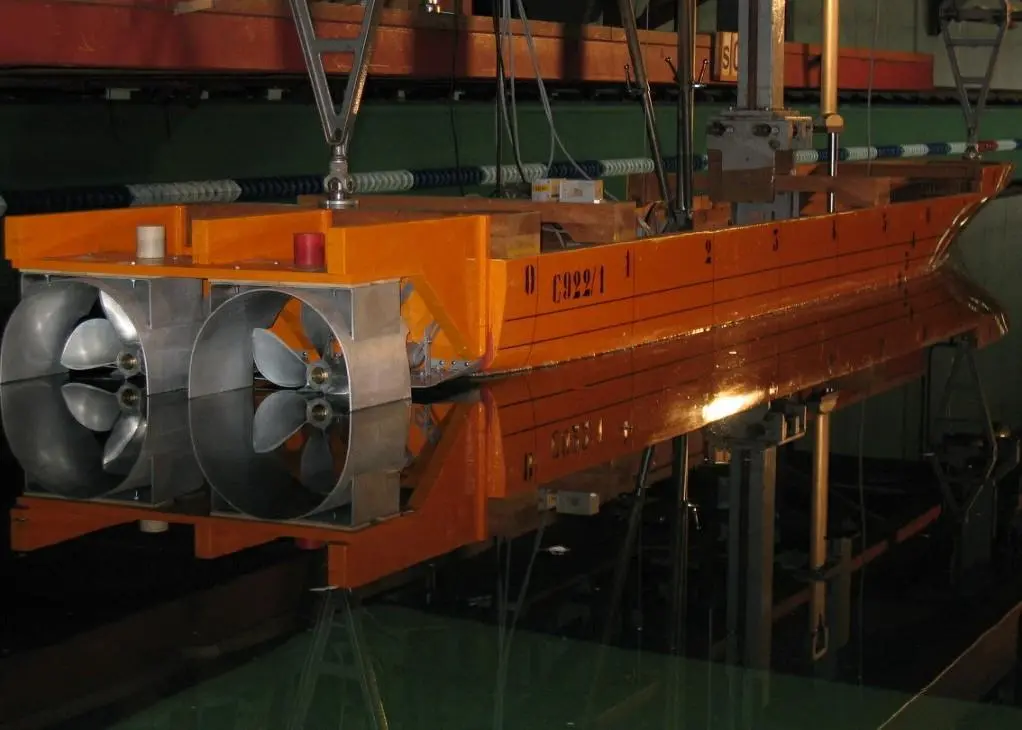
An Italian design studio has developed ideas for a propulsion system for ships that uses surface propellers. The concept is not new, a Mississippi steam boat was built back in the late 1800s with a surface propeller but the system developed by Flexitab is showing promising results after tank testing.
Flexitab is familiar with the principle of surface propulsion, as it markets surface drive systems for high performance small craft. The company has adapted its system, which features a height adjustable propeller shaft, for slower vessels in smaller sizes. However, recently the opportunity arose to carry out tank testing on a model of a larger ship in conjunction with the Universities of Genoa and Naples.
In Genoa, the system was tested in the cavitation tunnel of the University’s Department of Naval Engineering using three sets of propellers that were designed by surface propulsion pioneer Sonny Levi. These tests were started back in 2006 and showed promising results. The tests were carried over a displacement speed range and the surface propellers proved superior to conventional submerged propellers and had a remarkably smooth transition throughout the speed range. The propeller efficiency was measured at a 13% increase over the submerged propeller systems and such was the increase in efficiency that the selected propellers proved to be under-pitched for the performance because of this efficiency gain.
Further research took place in the towing tank in Naples where a comparison was carried out with model of a 97m feeder container vessel, which had previously been tested using fully submerged propellers. This vessel had actually been built in that form, so that the test results with the submerged propellers could be verified to provide a direct comparison.
The model was fitted with the twin surface piercing propeller system and further testing was carried out to verify the cavitation tunnel testing. Once again the efficiency was shown to increase by over 13% at a ship speed of 19 knots. The reduction in propulsive power required at this speed was measured at 13.8%. The improvements in efficiency were still evident at speeds as low as 11 knots and it has been calculated that with the optimisation of the propeller design and further developments, increases of up to 20% are possible.
The reason why surface propellers are more efficient is that with the waterline located around the hub of the propeller, only the bottom blades of the propeller are in the water and doing useful work, with the top blades of the propeller running in air. This arrangement means that there is a considerable reduction in appendage drag from the propeller shaft and its supports, and also from any skegs. In addition, the flow resistance from the propeller hub is much lower.
Previous experience with planing vessels running at speeds of between 30 and 40 knots shows that an increase in speed of around 8 knots is typical when using surface propellers rather than fully submerged propellers. At lower speeds, with a displacement hull, the improvements in performance will be less because the drag factor from the appendages is lower. However these tanks tests show that a significant improvement is possible. Five-bladed propellers were used for these tests with three different blade profiles tested, including skewed propellers. Surface propellers normally use an odd number of blades because this helps to smooth the transition from submerged to non-submerged operation and reduces vibration created by the constant loading and unloading of the propeller blades. During the testing, a flow control plate was fitted between the transom and the propeller in order to help control the propeller submergence. This proved effective, and could be employed on large ships to helping the surface propellers cope with varying draught levels. Flexitab’s drive is envisaged with a cowl over the propeller to help contain the spray.
Flexitab has called this propeller system its K-Drive, and is expecting this new propulsion system to prove particularly effective on displacement-hull ships where higher speeds are required and where the draught of the ship does not vary a great deal. This could include large and medium sized container ships, ro-ro and ro-pax ships and cruise ships. Cruise ships would be particularly well suited, because their typical transom overhang would lend itself to the K-Drive installation.
Flexitab sees the initial thrust of this development as being towards its installation on existing designs, but major improvements could be expected when it is used on vessels that have been specifically designed around the system. This would allow the hull to be fully optimised for the propulsion system. The transmission systems in the vessel would need to be adapted to the surface propulsion because it is anticipated that this surface propulsion would have higher vibration and stress levels which would need to be factored in. One side benefit of the system is that propeller maintenance and repair could, quite possibly, be carried out with the vessel afloat.
The principal of Flexitab is Brunello Acampora who was trained at Southampton University. He established Victory Design in 1989 and his propulsion research company Flexitab in 1999. In an effort to gain European Union funding for further research, Flexitab has teamed up with Interprogetti in Genoa, which is a pioneer in surface propulsion, having designed a 5,000t displacement livestock carrier Alnilam that has an early system fitted.
Mr Acampora is convinced that there is a future for surface propulsion in the commercial sector with larger ships and the research continues into new propeller designs to meet this requirement, and into new hull designs to match.
Related Articles
 PROPULSION
 GENERAL NEWS
 GENERAL NEWS