



Propeller repair keeps ships out of drydock
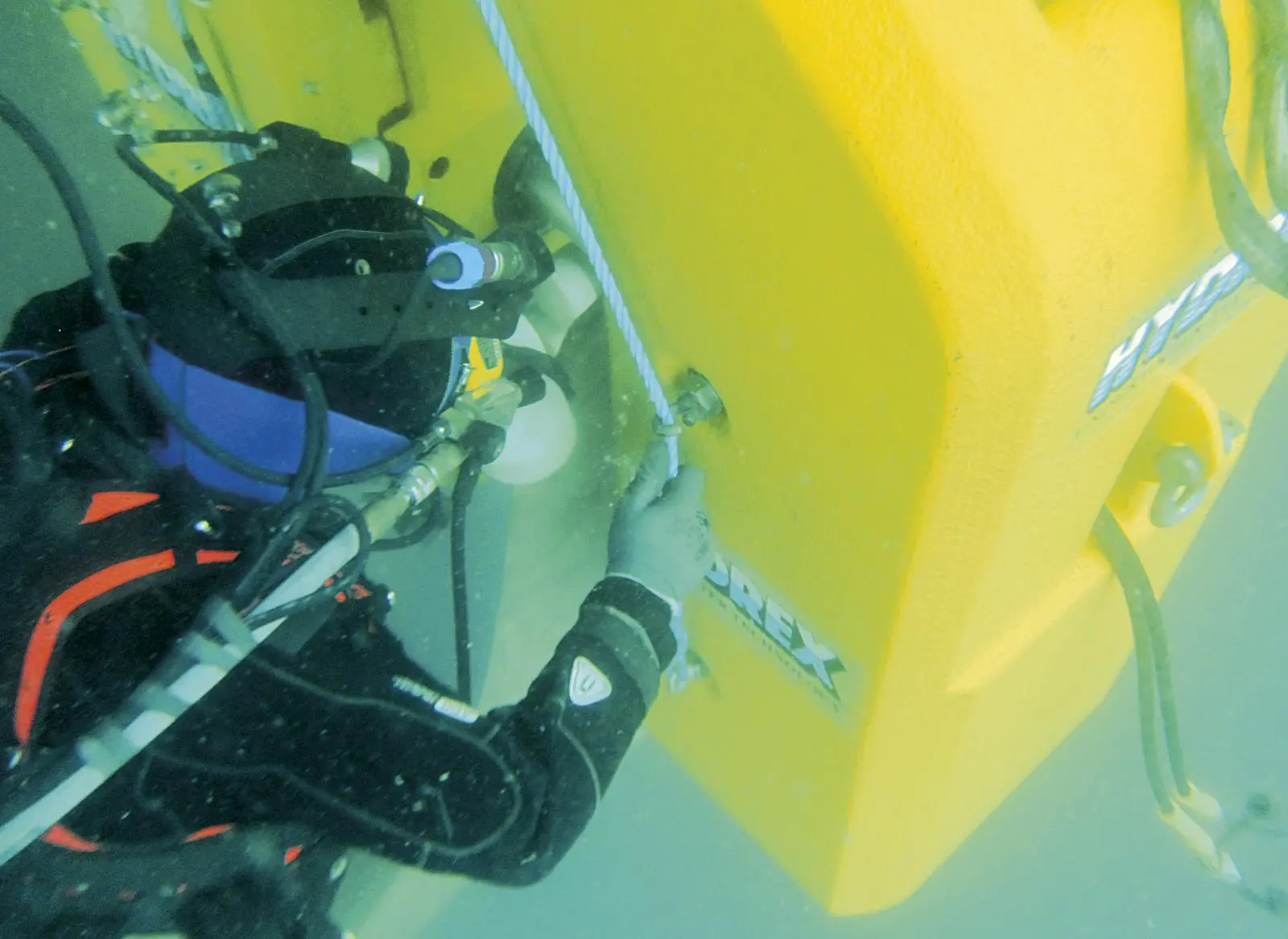
Recently Hydrex teams carried out a wide range of underwater propeller operations on tankers around the world. Among them a spinner cone (Propeller Boss Cap Fin –PBCF) replacement on a 110-meter vessel in Singapore, a propeller blade straightening on a 248-meter ship in Algeciras, Spain, and a blade cropping on a 183-meter vessel in Flushing, the Netherlands.
The company was contacted to install two new propeller boss cap fins (PBCF) during a LPG tanker’s scheduled stop in Singapore. After the team arrived at the location of the 110m vessel, both propellers were fully inspected. Next the diver/technicians removed the port side PBCF and hoisted it on board. After cleaning the area under the PBCF, the team lowered the new part into the water and positioned it on the propeller. When this was done, grease was inserted in the space underneath the propeller cone for lubrication and the bolts were torque tightened and secured with wire, finishing the replacement of the first PBCF. The procedure was repeated for the starboard propeller.
The PBCF alignment was monitored on an underwater CCTV camera and supervised by the maker’s specialist on the diving boat. The maker informed Hydrex that as far as it was aware, this was the first installation of a PBCF underwater. The Hydrex team worked around the clock to complete the task in time; no gas free operations were required for this work, which Hydrex says represented a significant time saving time for the gas tanker’s owners.
With three of the four blades of its propeller severely bent, a 248m tanker needed a fast, on-site solution to restore the propeller’s balance and efficiency. Hydrex says that its diver/technicians are trained to carry out repairs underwater in the shortest possible time frame. A team was rapidly mobilised to the ship’s location close to the Hydrex office in Algeciras, Spain, to perform a cold straightening of the blades.
Operating from a Hydrex workboat, the team started the underwater operation with a detailed underwater survey of the damaged blades. The inspection revealed that the three blades had suffered deformations along the trailing edges.
The team then carefully positioned the straightening machine over the bends of the trailing edges of the first blade and, in close communication with the team leader on the work boat, applied pressure to return the bent blade to its original state. This procedure was then successfully repeated for the other damaged blades, restoring the propeller’s efficiency.
Additionally, Hydrex mobilised a diver/technician team to carry out a detailed inspection and necessary repair to the damaged propeller blades of a 183m tanker during the ship’s stop in Vlissingen, the Netherlands.
The team performed an underwater inspection to assess the extent of the damage. This showed damage to all four blades. The affected areas of the blades needed to be cropped to restore the propeller’s balance. From the inspection data, the team calculated the correct measurements needed to modify the trailing edges of the propeller blades. The area to be cropped was marked out on the four blades and verified. Next the divers cropped the blades one by one and ground the edges to obtain the correct radius. When the cropping was complete, the Hydrex technicians polished the blades to make sure that any remaining loss of efficiency would be minimal.
Hydrex points out that damage to blades means that the propeller performance will be adversely affected. The engine will thus have a higher work load, resulting in increased fuel consumption and added stress. The company’s in-house developed cold straightening technique allows damaged blades to be straightened underwater and optimum efficiency of the propellers can be restored. If straightening is not an option, the affected area on the blade can be cropped to restore the hydrodynamic balance. This will enable the ship to once again operate efficiently. Cropping is carried out using propeller blade cutting equipment developed by the Hydrex research department. Both straightening and cropping can be carried out on-site and underwater, allowing the ship to return to commercial operations without the need to drydock.
Related Articles
 EMISSIONS REDUCTION TECHNOLOGY
 ALTERNATIVE FUELS & LUBRICANTS
 ALTERNATIVE FUELS & LUBRICANTS