



Compact electric drive for Dutch tourist craft
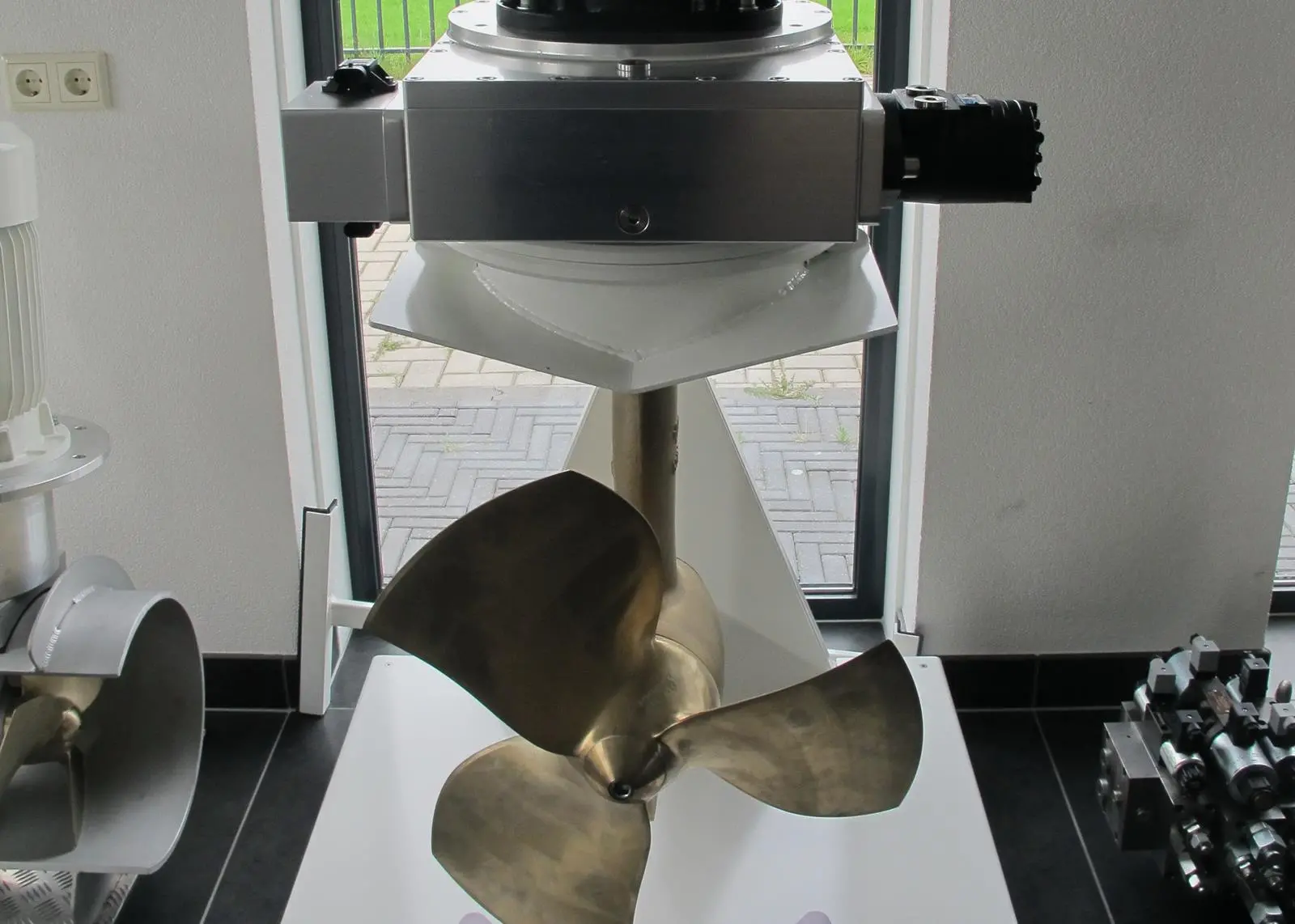
The unit, claimed to be the most compact of its type available, owes its small size to high voltage operation. It has been developed by Hydrosta, based in Zwartsluis. Hydrosta produces a range of systems, mostly hydraulically operated, including thrusters and propulsion units. One system is known as the PM drive, a form of rudder-propeller where the hydraulic motor is attached to the vertical shaft of the drive and mounted inside the vessel. The drive unit can be rotated through 180° so that it gives good manoeuvrability as well as high drive thrust. Many of these PM drive units have been supplied for Amsterdam tourist boats. With the expectation that these vessels will, in future, use electric propulsion in order to minimise emissions, Hydrosta was motivated to develop an electrically-driven version.
The company tried to source a compact electric motor that could occupy a similar space to the hydraulic motor used on the propulsion units. Conventional electric motors producing the required 100kW proved to be both bulky and heavy but eventually a motor was sourced from a German company, AMK. This motor operated on a high voltage that enabled a more compact design. The next stage was to develop a control and battery system that could be used to operate at the high voltage of 410V AC that was required for the motor. Higher-voltage AC motors use a permanent magnet, allowing the speed to be controlled by varying the AC frequency rather than the input voltage, and resulting in a smaller, lighter package.
Batteries only operate on DC power so the developed system has an input voltage of 750V which can be supplied either from a generator or from a battery bank. The battery bank comprises 60 batteries, each of a nominal 12V DC, offering sufficient capacity to enable the tourist boats to operate for a whole day with the charging process taking place overnight when the boats are not running. Modern electronic systems allow the 750V DC to be converted to 400V AC through a series of inverters.
The battery power can also be used to power a bow thruster and to meet domestic requirements. Leo Stam the owner of Hydrosta commented: “Because of the high voltages required for this system we have had to take extra care with the engineering of the wiring and connections. All of the external cables are sheathed and earthed and the whole system is protected from water ingress”.
To match its drive systems, Hydrosta has developed sensitive vessel control systems. A joystick tiller control is linked to an autopilot and electronic chart navigation systems. The operation of the electric propulsion is largely automatic but the challenge for the Amsterdam operation is to provide the shore charging infrastructure for the anticipated 25 boats which will be converted to electric propulsion once it is mandated that all of the tourist boats must be electrically powered.
Related Articles
 PROPULSION
 GENERAL NEWS
 GENERAL NEWS