



A century of marine gas turbines
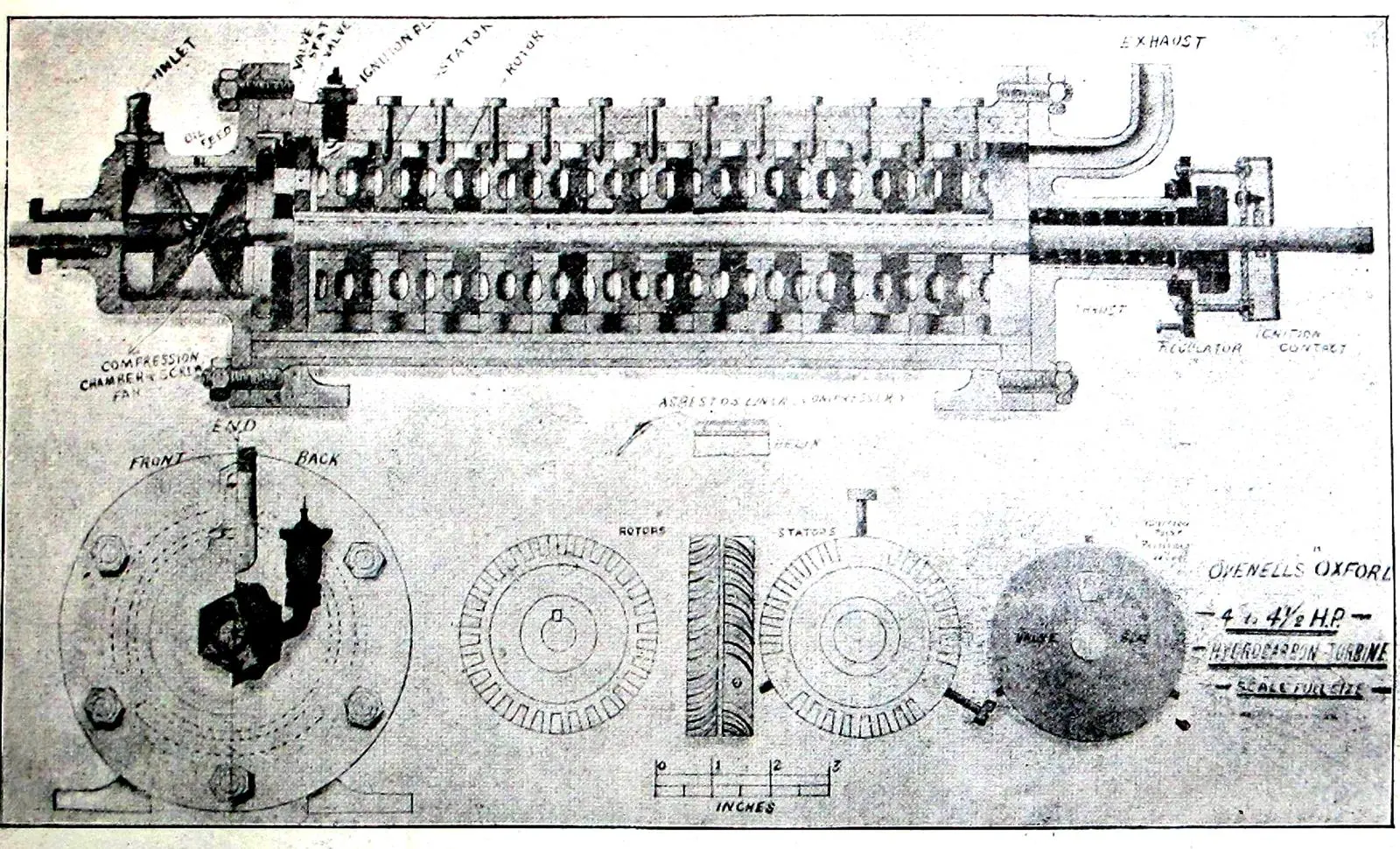
However, back in 1904 a Mr.Ovenell of Oxford, UK, developed a marine turbine which was said to be based on the Parson’s steam turbine but, instead of steam passing through the turbine section, hot exhaust gases were used.
Gas turbines had been developed previously, but suffered from insufficient compression for the turbine to work continuously. Ovenell overcame this by having a multiple threaded screw air compressor at one end of the turbine. A carburettor introduced fuel into this ‘compression chamber’, and the mixture of air and fuel was compressed by the screw compressor. Between this compressor and the turbine section was a revolving plate with ports cut in it, and when these ports matched up to fixed ports on a facing plate the mixture was allowed into the turbine chamber.
Here it was ignited by a spark plug. The resulting gases rapidly expanded and were forced down the turbine chamber, turning the turbine as they went. The turbine chamber was fitted with stator blades as well as the rotating blades on the shaft, and it is reported that these blades were cut from solid metal using a specially developed milling machine.
The turbine chamber was water-cooled and the designer stated that no silencer was needed. A freewheel device was incorporated for starting the turbine without load. From reports it seems that this turbine was actually built and run, and the drawings refer to it as being of 4.5hp output. It was compact in size with an overall length of just 21in (533mm). Contemporary reports in The Yachtsman magazine commented: “Still, he is to be congratulated on his invention which should have a future before it”.
It is thought that the metals available at the time could not cope with the high temperatures involved, a problem that existed for many years before special alloys and turbine design were developed to cope.
Related Articles
 PROPULSION
 GENERAL NEWS
 GENERAL NEWS