



Boost for Hamburg Feeder Barge System
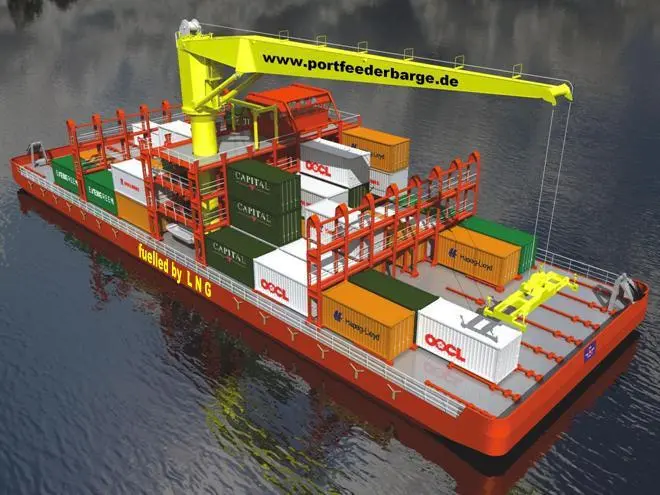
A spokesman for the city parliament (Buergerschaft) told The Motorship the body had voted to refer the issue to a special committee dealing with economic and other issues. Media said the vote was unanimous and encouraging for the concept.
The managing director of Hamburg-based Port Feeder Barge, Professor Ulrich Malchow, told The Motorship the project needed the approval of all port operators before it can be introduced. He said Hamburg’s biggest handler HHLA had initially favoured it but had since withdrawn its support. “All the other handling companies (in the port) favour the project”, he said.
Thomas-Soenke Kluth, whose party and environmental groups are in favour of the barges, was quoted as saying the self-propelled, double-ended and geared feeder barges “open up new possibilities” and were an innovative eco-friendly alternative.
Developed by Port Feeder Barge, the barges will be 63.9m length oa, 21m broad and of about 2,500gt with a maximum draught of 3.1m in port. Initial plans list 2 x 2 Caterpillar diesel-electric 280kW rudder propellers at 7 knots, but Professor Malchow said rudder propeller manufacture was still open.
LNG propulsion is also an option as are other barge versions, one a Wind Feeder unit for offshore turbines. The barges could be built anywhere, Professor Malchow told The Motorship.
GL-classed for container transport, the barges carry up to 168 TEUs per trip, half of them in cell guides. Each barge mounts a single Liebherr CBW 49 (39)/27(29) Litronic crane of 49t capacity at 27m outreach and an automatic telescopic spreader.
Professor Malchow said the new barge would relieve port road congestion and speed up transfers as well as save costs, fuel and reduce reliability on expensive container cranes. They could also be deployed midstream to handle deep-sea container ships or inland as floating terminals where terminal facilities were not available or unsuitable, he said.
Related Articles
 ALTERNATIVE FUELS & LUBRICANTS
 GENERAL NEWS
 GENERAL NEWS