



MTU power for US Coast Guard
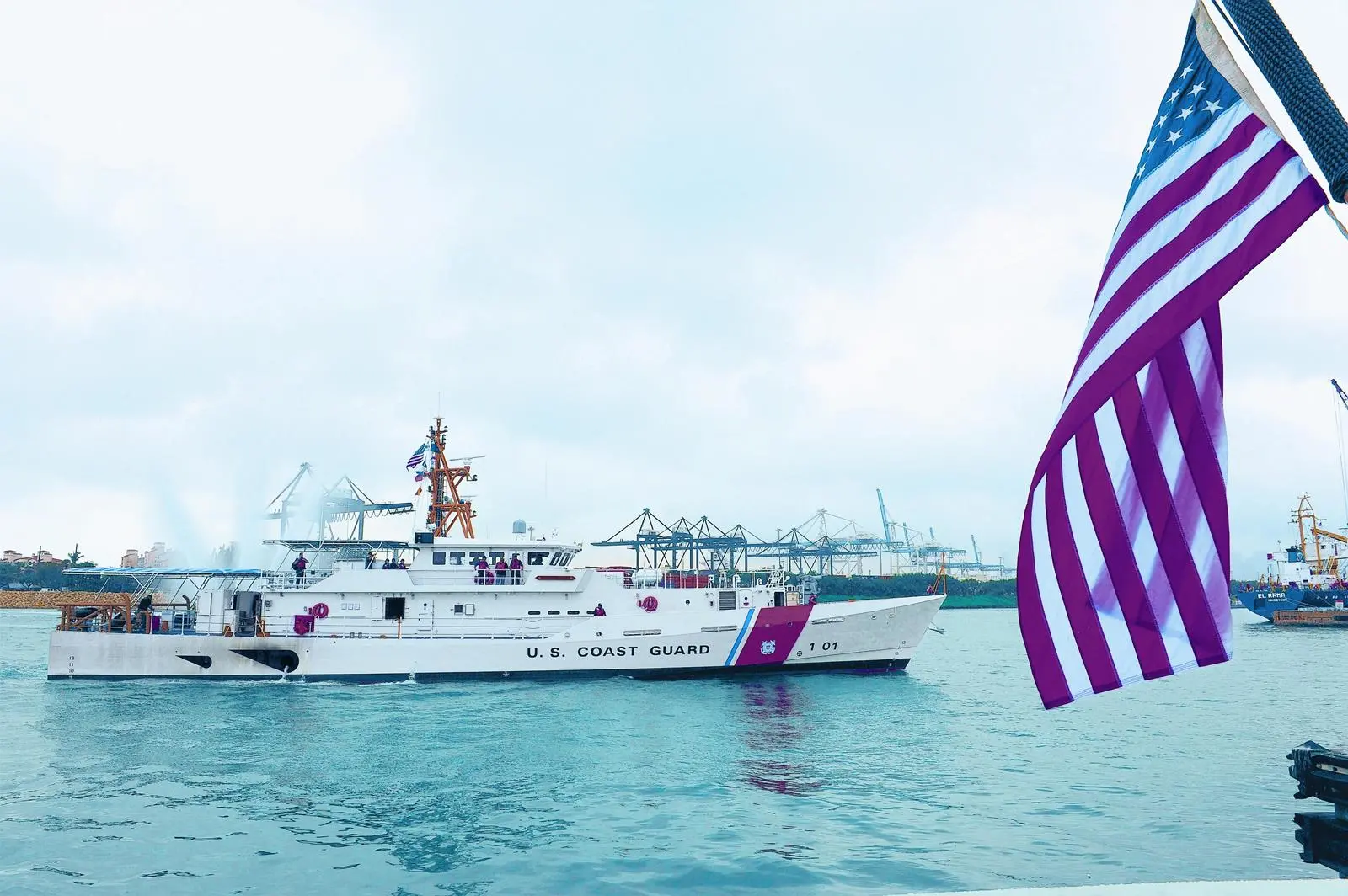
The United States Coast Guard (USCG) cutter Bernard C. Webber is at wide-open throttle making 28 knots through 1.5m-2.2m seas. It’s bigger, faster, more technologically advanced and more robust than any similar previous class of Coast Guard cutter.
The Sentinel class FRC (fast response cutter) was built at Bollinger Shipyards in Lockport, Louisiana, and engineered to ensure rock-solid performance in the stormiest oceans. To achieve this goal, every weld, fastener and steel plate is not merely inspected and tested, but ruthlessly scrutinised. Coast Guard ships are of necessity built to high standards, as described by Bollinger vice president and general manager Scott Theriot.
He says: “The goal is to produce an FRC every eight weeks.” Each FRC makes an 11-week long journey through manufacturing, assembly and testing before it is ready for handover. The 46,500m2 facility houses 600 skilled tradesmen engaged in most of the 14 major stages required to build an FRC. In the early steps of the cellular manufacturing process, a CNC plasma cutter slices raw steel plate into components for superstructures and hulls. Fabrication departments bend, weld and assemble pipe, bulwarks, ladders, mufflers and rails. Later, the individual modules take shape, and, eventually, a new FRC emerges from Bollinger’s paint booth in the USCG’s white and red colour scheme and is craned into the yard’s dock for sea trials.
Unusually, many of the modules are inverted in order to be worked on. “In efficient shipbuilding, gravity is your friend,” Mr Theriot says. “We build, assemble, pipe and wire as many of the largest modules in an upside-down position as possible, mounting the assemblies on movable platforms we designed for the purpose. It’s a lot easier for our craftsmen to work looking down than when looking up.”
Every step in the FRC’s journey through the yard is measured against established metrics in real time by Bollinger’s own software program. “ Building an FRC is a little like building a house, assuming that the house has to last for decades, cruise at 28 knots and function perfectly while getting pounded by 10- to 20ft seas,” says Mr Theriot.
With a billion-dollar investment at stake, failure of any kind is not an option. From materials procurement to production and from builder’s sea trials to each vessel’s commissioning and beyond, everything on an FRC has to work, and as prime contractor, it’s Bollinger’s responsibility to make sure it does.
The propulsion system is at the heart of the ships’ functionality. “The MTUs have the right horsepower-to-weight ratio and the company has a great history of building high-powered, lightweight engines,” says Mr Theriot. He notes the FRC is faster than the ageing 110ft Island class cutter it is replacing, thanks to the FRC’s twin 20V Series 4000 M93L engines, each rated at 5,095bhp.
As first in class, the Bernard C. Webber enjoys the attention of a senior-status, experienced crew which helps shake down the brand new $88 million ship. The 24-person team comprises four officers and 20 enlisted. Among the latter is Senior Chief Engineer Richard Libbey, a 21-year veteran who joined the Coast Guard straight from high school. Now 39, he’s a commanding presence in charge of the ship’s engines. He says he began his career “cleaning bilges on a 378ft Hamilton class cutter.” He has risen through the ranks, moving from ship to ship and relocating from town to town. “It’s the life,” says Mr Libbey, adding that the experiences he’s enjoyed would have been impossible in civilian life. Those experiences include a comprehensive four-week engine training course at Tognum in Friedrichshafen, Germany and later at Tognum America’s Product Training Center in Canton, Michigan.
“The Series 4000s perform really well and are very dependable. They’re way more technical than the older MTU engines on some of our other cutters, like the 87-footers, but they’re still simple to operate,” he says. “We start them up for a patrol by opening all the cooling valves and fuel valves, push a button and the engines start. We idle them for about 30-45 minutes. They’ll run on 10 cylinders first, and then all 20 kick in as the engines warm up. After that, we’re set. We simply monitor their performance during the patrols.”
MTU supplied not only the propulsion engines but also the Callosum ship automation system which continuously controls and monitors all parts and functions of the ship’s mechanical and electrical equipment, aiding the reliability of the onboard systems.
Principal particulars – US Coast Guard Sentinel class FRC
Length oa: 47m (154ft)
Beam: 7.6m (25.4ft)
Draught: 2.9m (9.5ft)
Maximum speed 28 knots
Range: 2,950 naut miles (5,464 km)
Crew: 20 enlisted, 4 officers
Main Propulsion: Two MTU 4,300kW 20V Series 4000 M93L diesel engines, 5,095bhp each
Related Articles
 PROPULSION
 GENERAL NEWS
 GENERAL NEWS