



Niigata adds new gas-burning designs to its range
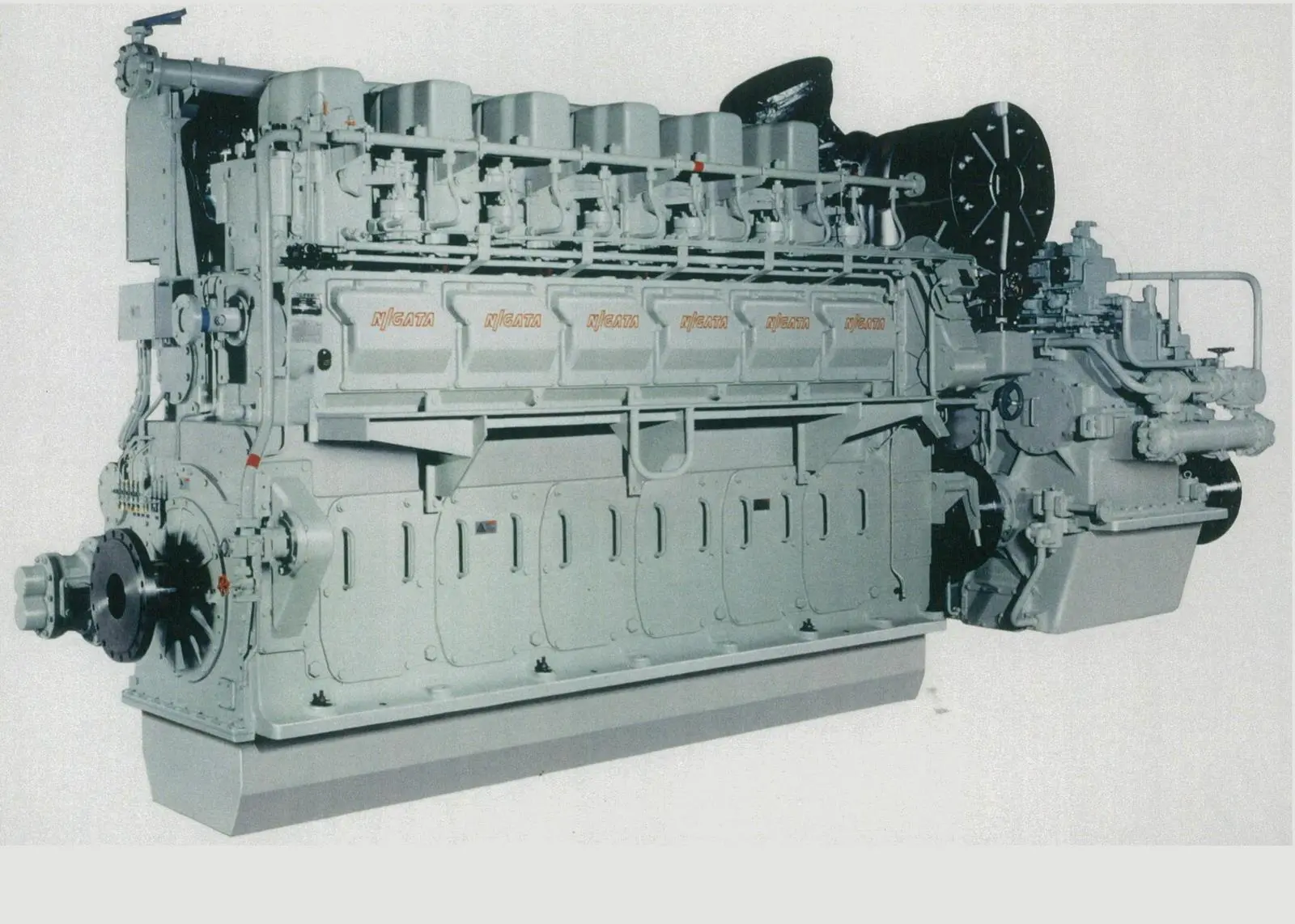
The 28AGS-designated SI engine is targeted primarily at the landside market, and builds on the company’s experience with the successful AG series, introduced about 15 years ago and encapsulating the micro-pilot ignition system. The DF type draws on Niigata’s diesel know-how as well as micro-pilot technology to meet the long-term requirements of marine users with regard to environmental standards and running costs. The DF mechanical drive solution prepared by the Japanese firm caters to the operational load characteristics and needs of harbour tugs, a field in which Niigata has a high profile as a provider of integrated power and propulsion systems. In gas mode, the engine satisfies the upcoming IMO Tier III NOx emissions decree.
In a presentation to the 2013 CIMAC Congress in Shanghai, entitled Advanced development of medium speed gas engine targeting marine and land, Niigata indicated that the rationale for its bolstered commitment to the gas engine field was not only environmental legislation but also prospective economic benefits arising from comparative fuel prices and the increased tapping of gas resources and development of the supply infrastructure.
The DF marine engine will be released in an output range of some 2,000kW to 3,000kW, while the SI series for stationary plant will cover the 2MW-6MW power band. Claimed thermal efficiency of the 6MW model is approximately 47% with low NOx emissions.
Said to be far better suited to the transient, load-following requirements of marine duties than the pure gas engine, the DF variant can switch with equanimity between oil and gaseous fuel in line with operating conditions.
The six-cylinder prototype is rated for 2,000kW with a BMEP of 2MPa, for primary operation on vaporised LNG fuel. Optimised for running in gas mode, the use of marine diesel oil (MDO) is confined to start-up in the micro-pilot ignition, lean-burn combustion system and to stopping, and the DF capability safeguards the vessel in emergency situations. Propulsion redundancy is conferred by the facility to immediately switch to diesel mode in the event of malfunctioning of one of the gas combustor components or the electronic fuel control system, for instance, or due to fuel shortage.
To overcome the shortcomings of mechanical-drive gas engine installations in situations of rapid load change, Niigata has opted for common-rail fuel injection and variable turbine nozzle turbocharger technology, complemented by special control arrangements. The company asserts that it has “succeeded in achieving stable engine operation under low loads and proper load-following capability under rapid load changes.” This is apposite to the sudden acceleration torque and rapid slowdown torque required of a terminal tug when handling a large ship, for example.
The company is developing a gas-burning DF engine optimised for tugs, given the prominent standing of Niigata in supplying medium-speed diesel engines in conjunction with Z-peller azimuth thruster propulsion units to the towage market, and against the backcloth of impending, albeit now possibly postponed, IMO Tier III standards in Emission Control Areas (ECAs).
MAIN PARTICULARS
Niigata 28AGS gas engine
Cylinder bore 295mm
Stroke 400mm
No. of cylinders 6L, 8L, 12V, 16V, 18V
Engine speed 720/750rpm
Power range 2MW-6MW
Brake mean effective pressure (BMEP) 2.0Mpa
Mean piston speed 9.6/10.0m/s
Fuel Natural gas
Ignition method Spark ignition(SI)
Combustion method Pre-combustion chamber
Starting method Air motor
Related Articles
 PROPULSION
 GENERAL NEWS
 GENERAL NEWS