



Cost-effective turbocharger modification for fuel saving and emission control
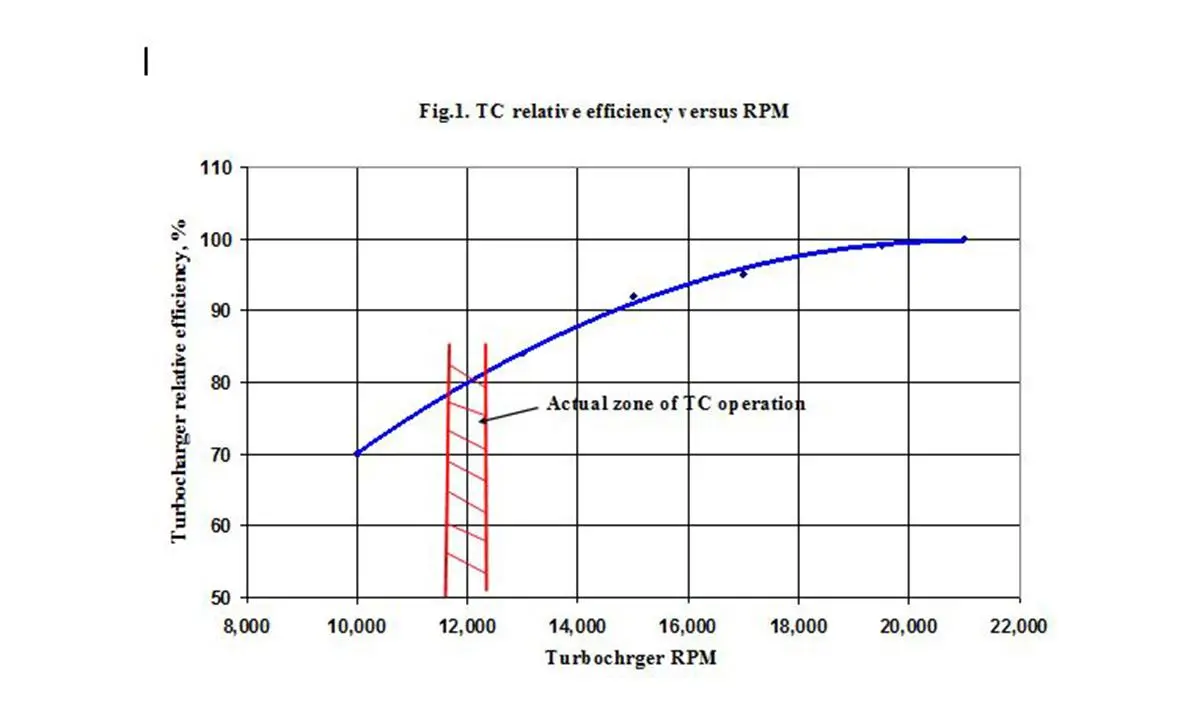
It is a well known fact that turbocharger efficiency significantly influences diesel engine operational performance. For example, a turbocharger efficiency increase of 1% results in the following improvements (under constant engine power):
- Supercharged air pressure increases by 1% – 2%
- Fuel consumption decreased by 0.4% – 0.6%
- NOx emission decreases by 5% – 8%
- Exhaust gas temperature decreases by 2% – 4%
Operational turbocharger maximum efficiency can be achieved by very accurate coordination of turbocharger and diesel cylinder characteristics during the design and test-bed trial stages. This is frequently a time-consuming, complicated and expensive procedure. Usually such coordination is undertaken by engine manufacturers for operation at design point only (for MCR). On the other hand, it is a well known fact that marine turbocharged engines often operate at loads less than MCR. Based on practical experience, we can conclude that main marine engines are generally operated at 70% to 85% MCR and auxiliary engines operated at 50% to 75% of MCR. This means that operational turbocharger rpm is considerably less than optimum rpm.
As is evident from the turbocharger efficiency graph, maximum turbocharger efficiency is achieved at around design rpm (near 20,000rpm). Actual operational turbocharger speed is around 12,000rpm (red zone); here the turbocharger’s efficiency is about 20% compared to the maximum efficiency.
This problem has become more significant with the introduction of ‘slow steaming’ by many shipping companies and marine operators with the purpose of reducing fuel costs. In practice, slow steaming can vary widely across the containership, bulk and tanker fleets (for example, in the containership sector 15.4% are reported to have said they employed slow steaming across more than 50% of their fleet, while the bulk and tanker sector saw more than 26% of respondents employing slow steaming in more than 50% of their fleet). In 2011, MAN Diesel & Turbo conducted a web survey among more than 200 representatives of the global container and bulk shipping industry, and it found that 149 – or nearly 75% – had implemented slow steaming. In broad overview, the study found the following:
1). 38 respondents had already implemented one or more engine retrofit solutions such as slide fuel valves, turbocharger cut-out, or propeller upgrade.
2). The other 111 respondents had not implemented any of the above.
The difference between these two groups of vessels (111 against 38) can be explained by the fact that, for example, turbocharger cut-out can be implemented only on two-stroke engines with multiple turbochargers (and excluding those with impulse type scavenging systems). In general, the MAN Diesel & Turbo study has shown that the problem of slow steaming is not yet solved.
To address this important problem MA TurboEngine has developed turbocharger modification technology to achieve increased turbocharger efficiency when the engine is operating at reduced load. The modification package comprises three aspects: computer program analysis, methods for reducing the area of the turbine’s nozzles, and waste gate arrangement.
The computer program establishes the optimum nozzle ring area (Fopt) for the given engine output and type of turbocharger. Difference between the existing nozzle ring area (F) and Fopt gives the new nozzle ring area required to achieve the improvement in engine performance at reduced load. The computer program determines a new boost air pressure, corresponding to the reduced nozzle ring area. The increase in air pressure is compared with the design boost air pressure at the engine MCR.
To avoid possible surging the new increased air pressure can, under no circumstances, be higher than the design air boost pressure at MCR. To calculate the so-called coefficient of surging (Ks) Sulzer formula is used. The minimum value of Ks is 12%. As a rule, the reduction in nozzle ring area is such that increased scavenging air pressure at operating load is 15% less than the design scavenging air pressure at MCR. That means that any engine with a modified turbo nozzle ring can be loaded, if necessary, at up to 85% of MCR without sacrificing turbocharger reliability.
Turbo nozzle area reduction is achieved by blocking a few nozzles on existing nozzle ring: the nozzles to be blocked are covered by flat stainless steel plates, secured by stainless screws. If the required reduction of nozzle ring area is less than 10%, the area can be reduced simply by bending nozzle blades, making it unnecessary to buy an expensive new nozzle ring.
The method described for reducing the existing nozzle ring area does not generate any additional stresses to the nozzle or rotating blades. On the contrary, thermal stresses are reduced due to lower exhaust gas temperature. Both bending and tensile stresses in the blades are less than at design engine load because the turbocharger rpm remains lower than admissible rpm at MCR. This means that there is no potential danger to normal turbocharger operation.
MA TurboEngine, in cooperation with Vicmar, has implemented this turbo nozzle ring modification on 64 different engines in global operation, including USA, China, Russia, Canada, Norway, South Korea and Poland. Some results attributed to the nozzle ring modifications are shown in the tables. Fuel savings ranged from 2.8% to 5.0%. Simultaneously, the exhaust gas temperature had been reduced significantly as well as NOx emissions.
Actual boost air pressure is considerably less than at MCR point: 62% compared to MCR and only 58% of the full turbocharger capability. Accordingly, the turbocharger can supply more air at reduced load hence reducing exhaust gas temperature and specific fuel consumption.
However, it is obvious that sometimes a main or auxiliary engine will need to be operated at MCR. For these cases MA TurboEngine developed its own waste gate arrangement, with an electronically operated waste gate valve installed before the turbine inlet. This valve receives a signal from either turbocharger’s rpm or scavenging pressure sensors, and will maintain turbo rpm around the optimum efficiency point at any operational load.
The waste gate system was trialled on Wartsila 6R32D and Yanmar 8N280L engines, with the control signal for the valve being taken from turbocharger rpm for the Wartsila 6R32D and from boost pressure for the Yanmar 8N280L engines.
The following benefits are claimed from these turbocharger modifications:
- Reduced operational expenses due to less fuel consumption of up to 5%
- Lower maintenance cost;
- Reduced greenhouse gas emissions;
- Cost for these modifications is three times to five times less than turbocharger replacement;
- With a typical payback period of 12 to 18 months.
Related Articles
 PROPULSION
 GENERAL NEWS
 GENERAL NEWS