



Organic Rankine Cycle heat recovery technology ready for ships
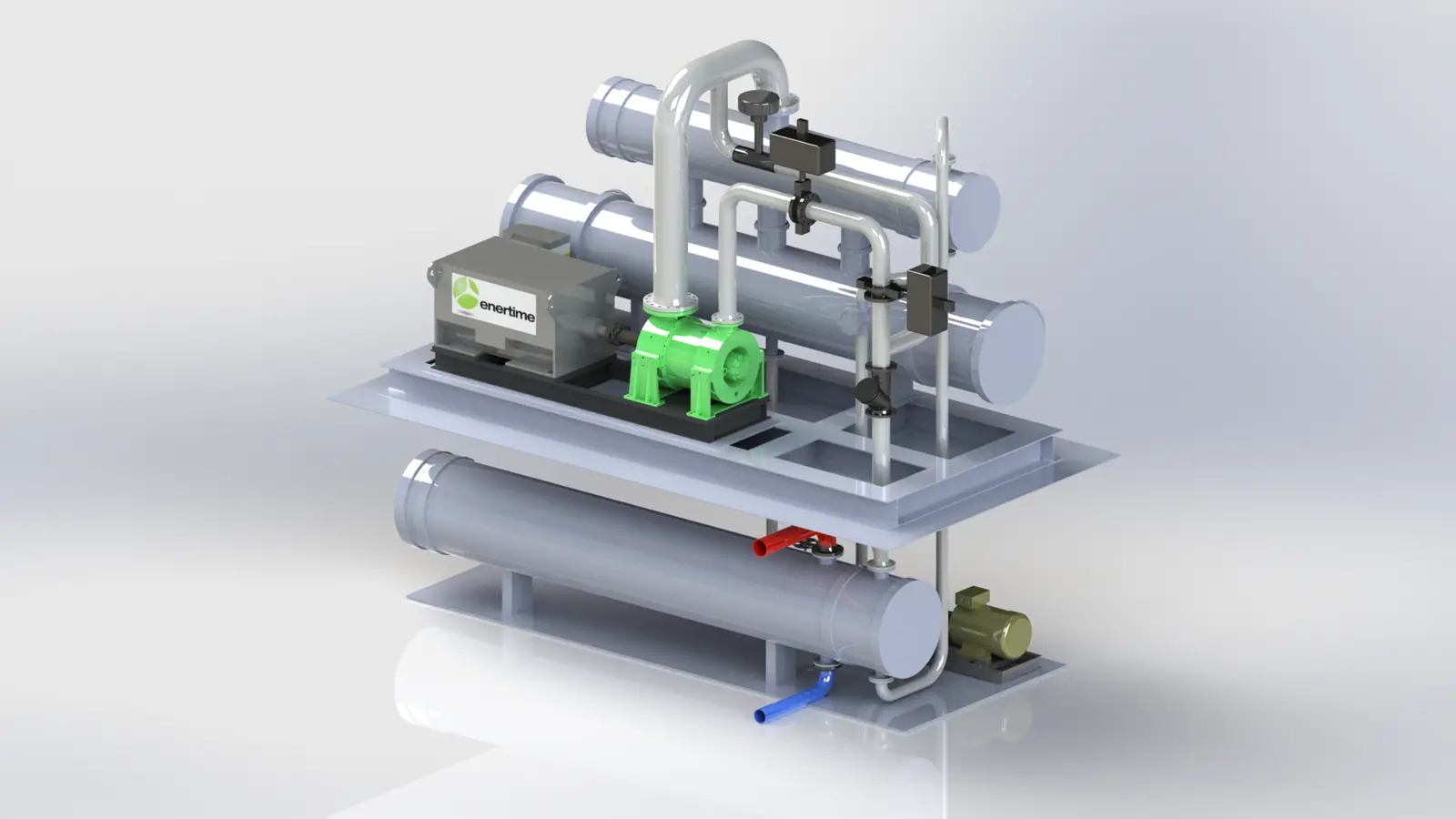
The company has developed a marine Organic Rankine Cycle (ORC) system for waste heat recovery and power generation that could reduce fuel consumption by up to 10%.
As in a steam power cycle, an ORC system uses heat to evaporate a fluid. The produced steam is then expanded into a turbine to produce mechanical energy, then electricity using an alternator. The fluid is then condensed and pumped in a closed cycle. The main difference between ORC and a steam cycle is the use of organic fluids that have a lower boiling point, therefore enabling the use of lower temperature heat sources.
The fluid used by Enertime is HFC-245fa, which is produced worldwide for refrigerant use and is available globally. Handling considerations are the same as for chillers/heat pumps that use the same family of HFC refrigerants. 245fa is not flammable and is kept in a closed loop system, preventing any additional hazards for a ship, says Gilles David, CEO of Enertime.
Machines using ORC have been criticised for their low yield, mainly due to a small difference in temperature between the hot and cold source. An ORC system working at low temperature between a hot source at 150°C and a cold source at 30°C (air) has about 12% efficiency. The ideal efficiency (Carnot efficiency) is, in this case, 23%. The module yield will then be 52%. A cycle using steam would have slightly lower efficiency (10%) and more obvious drawbacks, says Mr David, such as a heavier maintenance requirement due to the steam condensation at the end of the expansion, and higher operational costs (water demineralisation in particular).
Water is a wetting agent so when steam is expanded in the turbine, water drops can form and damage the blades. In contrast, the organic fluids used in ORC are known as ‘dry’ fluids, i.e. the fluid expanded in the turbine is always in a gaseous phase. This means the life of the turbines is increased and operational and maintenance costs are reduced.
Enertime’s ORC system produces between 500kW and 1MW of electrical power depending on the available amount of heat. The unit is based on a tailor-made axial turbine and is specifically designed to work in the marine environment. The development work has involved shipyards, shipowners and a classification society, says Mr David.
“Compared to a steam power cycle, ORC systems need very low maintenance, display good part-load efficiency, high availability and can be operated without permanent monitoring,” he said. “Daily operation and maintenance can be carried out without specific qualification.”
The ORC system can work with any kind of heat source. The unit can recover heat from a number of different sources singly or in combination including low-temperature jacket cooling from engines, steam or thermal oil systems and pressurised hot water. Exhaust gas from engines or auxiliaries is the main available heat on board ships, and it can be collected through an exhaust gas heat exchanger and brought to the ORC unit using steam, pressurised water or thermal oil.
Therefore, it does not matter if the heat comes from two-stroke, four-stroke, dual-fuel engines or auxiliaries. However, the exhaust gas coming from natural gas combustion can often be cooled down at lower temperature so the heat recovery potential may be higher in LNG-fuelled ships.
The system has relatively low power requirements: between 100kWe and 2.5MWe. Sea water is used for direct cooling of the refrigerant. Multiple configurations are possible depending on the available volume and any integration constraints. Each unit has efficient, impenetrable systems for safe operation of the fluid as well as a protection system should the fluid concentration in the air exceed a certain limit.
Enertime has carried out a feasibility study on a new ferry with four dual-fuel engines (total power rating of around 40MW) and electric propulsion. Exhaust gas heat is used to generate between 1MW and 7MW of steam at 8bar (gauge). “Due to the integration constraints and load profile of this particular vessel, Enertime suggested the use of an ORC unit recovering 4MW of thermal power and producing around 700kW of electric power,” said Mr David. “In that case, the size of the ORC unit is: 7.5m x 2.5m x 4m, for a total weight of about 25tons. With the boat sailing only 4,000h per year, the payback time of the system is between five and six years.”
The ORC layout is flexible and the unit can also be installed as a retrofit where it is possible to adapt the layout of the machinery to specific constraints by splitting it on different levels, for example.
“This kind of system would be very interesting for bulk carriers, small to medium size oil tankers, ferry boats, small container ships… with payback time between two to five years,” said Mr David. “For very large boats (>50MW of installed capacity), a steam power cycle may be economically more interesting.”
Enertime has already built a 1MWe ORC unit for waste heat recovery in a foundry in 2012 and has sold another 600kWe unit for combined heat and power that will be commissioned in September 2014. The company is actively looking for a partner to build its first reference in a marine vessel.
Related Articles
 PROPULSION
 GENERAL NEWS
 GENERAL NEWS