



ClassNK approval for crankshaft calculations
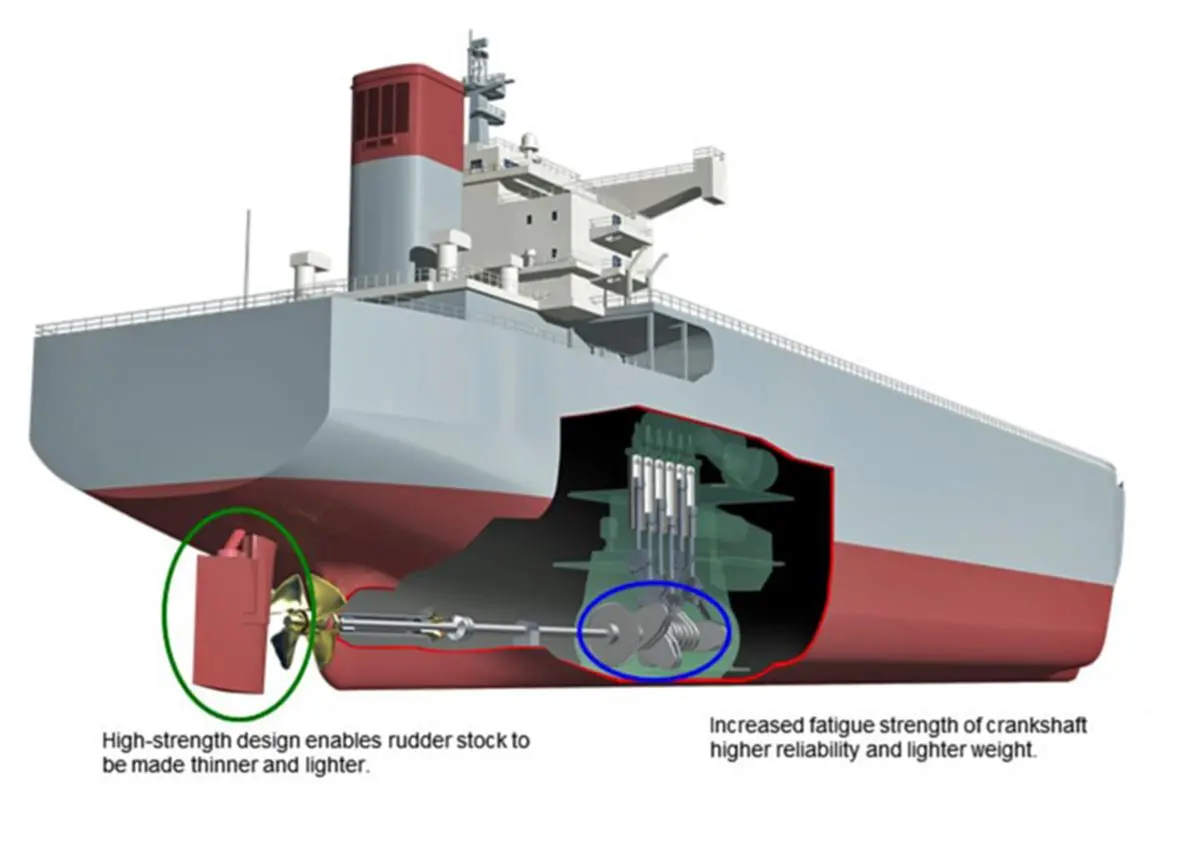
Under the crankshaft design rules of the International Association of Classification Societies (IACS), ClassNK awarded 1.05 as the factor K for the calculation of the fatigue strength, the first time it has been awarded by a classification society.
The ClassNK approval is key because crankshafts are bigger for the current generation of ecoship engines and there needs to be an assurance that they are strong enough. The approval will not only guarantee higher reliability in the crankshaft but also weight-savings contributing to improved fuel consumption.
In engine development, ships are using larger propellers that rotate at slower speeds, driving the need for higher output at the lower rotating speed region. Consequently, long-stroke engines are growing in popularity. When long-stroke engines are used, the crank throws are longer and heavier than conventional ones, leading to higher load stress on the crankshaft and higher bearing loads.
So since last year, Kobe Steel has undertaken trials of its die-forging method that have successfully increased the fatigue strength of the crankshaft material by 20% compared with conventional forging methods.
The company has also been working towards increasing the design strength of steel casting and forging materials for rudder parts by 60%, compared with conventional materials.
These materials enable rudder stock and other casting parts to be made smaller and lighter, thereby increasing vessel speed and improving fuel consumption. These high-strength materials have already received approval from ship classification societies in various countries.
Related Articles
 ALTERNATIVE FUELS & LUBRICANTS
 GENERAL NEWS
 GENERAL NEWS