



New battery technology demonstrated afloat in Switzerland
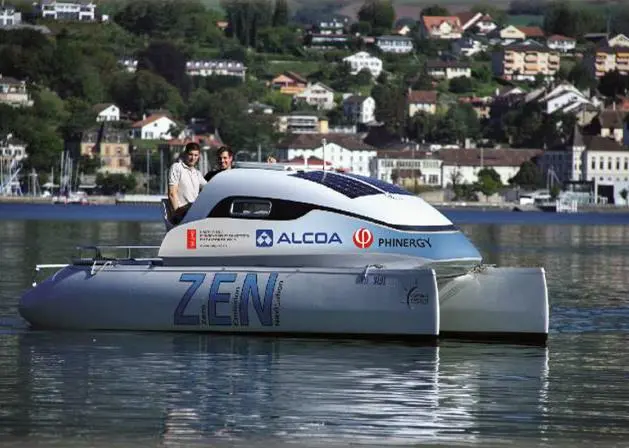
Alcoa and Phinergy had previously announced collaboration on new materials, processes and components to commercialise aluminum-air battery technology for various applications. The aluminum-air battery uses air and water to unlock the energy stored in aluminum. Battery output is about 4kW of electricity per 1kg of aluminum. Claimed benefits of the technology are higher energy density than conventional batteries, and range, capital cost and life-cycle costs which are said to be comparable to fossil-fuel power units.
According to Alcoa, the aluminum-air battery used in the electric boat demonstrator contains 15kg aluminum which provides about 25 hours of additional navigation time, for a given navigation profile. Without the aluminum-air range extender, using the same navigation profile, the range of the vessel would be only 5 hours.
The battery has previously been demonstrated on land, and although considerable upscaling will be required for ship propulsion or auxiliary power, the technology does appear to offer a good fit in proposed marine hybrid systems.
“The use of aluminum as a clean energy source has the potential to help move the global marine navigation market towards electric propulsion,” said Martin Briere, president of Alcoa GPP Canada, Europe and Africa. “When it comes to the harsh marine environment, Alcoa has developed products in special alloys to provide the strength, workability and corrosion resistance that marine applications require. Bringing long range electrical propulsion to the nautical environment opens up a wide range of additional possibilities for marine operators.”
Aviv Tzidon, CEO of Phinergy, said: “With Phinergy’s technology, and Alcoa’s industrial and commercial leadership, we see an exciting opportunity to penetrate this market by proving the required long range.”
Related Articles
 ALTERNATIVE FUELS & LUBRICANTS
 GENERAL NEWS
 GENERAL NEWS