



Efficiency in focus at P&E conference
The day began with an examination of the three options for compliance with new ECA fuel sulphur limits. Niels Bjørn L Mortensen, Director, Regulatory Affairs, Maersk Maritime Technology discussed the shipping giant’s assessment of the most effective means of compliance across a highly varied fleet.
“We have looked at all options with a focus on the maturity of the technology and availability as well as capex and opex,” said Mortensen. The company has focused on fuel switching – a method is has employed in California since 2006, making well over 2,000 switches in that time with virtually no problems. “Fuel switching is not rocket science,” he added.
Mortensen looked to the introduction of a global sulphur cap, highlighting issues of certainty over the date of the measure as well as its enforcement and the availability of fuel. “We probably need 250 million tonnes of distillate by the time it is introduced. But if the harmonisation of flashpoints (between marine diesel and road diesel) is accepted by the IMO, it becomes not a problem of availability but just one of price.”
Tor Øyvind Ask, Fleet Director, Solvang ASA discussed the company’s approach for its recent and imminent newbuild deliveries, with scrubber technology spreading across the fleet. Scrubber implementation has been both effective and unproblematic said Ask: since February 2015 the three Solvang vessels with scrubbers have had an uptime of 99%. By Autumn 2015 Solvang will have six scrubber equipped vessels.
With fellow panellists focusing on the use of scrubbers and fuel switching, Gerd-Michael Wuersig, Segment Director LNG-fuelled Ships, DNV GL presented the case for LNG and explained how the society is working with ship operators to enable use of the clean fuel. DNV GL’s LNG-ready programme helps to prepare ships for retrofitting and, after a pilot programme with United Arab Shipping Company, has resulted in the organisation defining a new vessel class type.
Well-oiled arguments
The second session of day two focused on a different element of efficiency, with a look at how lubrication is affected by – and how lubricant suppliers are responding to the challenges of – SECA compliance. Paul Harrold, Technology Manager, Marine & Energy Lubricants, Castrol set the context, identifying the concern about ash build-up when using high base-number lubricants with low-sulphur fuels. Harrold showed some case studies showing that the incidence of ash was not as great as some had feared. “Everything we’ve seen so far is that the ash concern associated with operating mid-load in ECAs has not appeared,” he concluded. “BN40 oil can be used until we build the full picture.”
Other lubricant companies offered differing solutions. Kenny Park, Technical and Marketing manager, Lukoil Marine Lubricants detailed the company’s new lubrication system, IcoLube, which allows ship operators to mix Navigo 100 MCL with fresh or used system oils to deliver lubrication appropriate to the fuel sulphur content. And Mads Goul Bach, Project Engineer, Hans Jensen Lubricators argued that as well as appropriate lubricant selection, good injection is also important for optimal performance – Hans Jensen’s solution is a combination of the Lubitronic electronically controlled lubricator, which ensures frequent injection, and the patented SIP valve which ensures even distribution of the oil.
In the late morning session the focus shifted to the Energy Efficient Design Index and its implications for ship propulsion systems. Vladimir Shigunov, Senior Engineer, DNV GL explained how the Project SHOPERA team had examined IMO’s guidelines on minimum power requirements in light of EEDI, attempting to further clarify criteria for meeting the guidelines and allowing ship owners more flexibility in meeting them – for example through calculations taking into account the impact of different ship components on power, instead of using a power-to-weight chart.
Battery power could be one answer to lowering ship’s propulsion power, and Trevor Small, CSO, C Rate Solutions explained how using energy storage as spinning reserve had allowed ferries and cruise ships to reduce their reliance on diesel-fuelled gensets in certain situations.
Diverse discussion
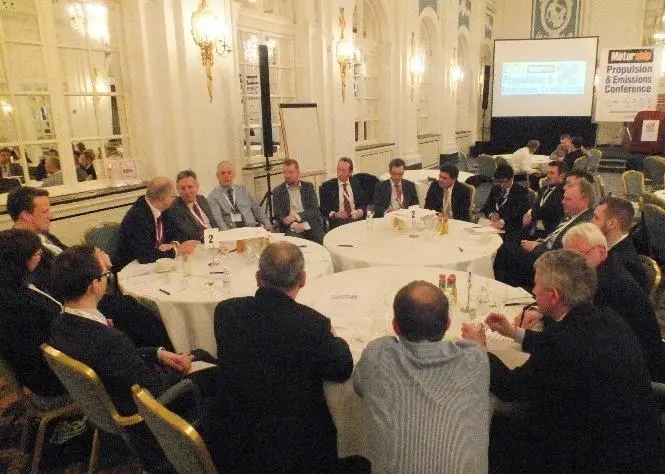
The conference concluded with delegates devolving to three roundtable discussions – on ship financing, future ship propulsion and ECA Tier III compliance. Each presented valuable ideas. On financing (chaired by Alastair Fischbacher, Director, Sustainable Shipping Initiative) a group of ship owners and OEMs discussed the need for a balance of risk and reward between stakeholders investing in efficient technologies – and perhaps even incentivising OEMs to develop efficient machinery in the face of greater development costs.
Delegates discussing future propulsion (chaired by Gavin Allwright, Secretary, International Windship Association) touched on the viability of several alternative fuels – from LNG to wind power to biofuels – but noted that further work was needed beyond fuel and on the modernisation and future form of the entire engine drivetrain.
The ECA compliance roundtable, headed by Jens Bechu, Strategic Industry Manager Combustion Engines & Maritime Applications, Sick AG echoed views from the finance team: ship owners need longer-term charters to allow them to underwrite investment in compliance technologies, Bechu reported. Meanwhile other methods of compliance – including selective catalytic reduction and exhaust gas recirculation – were discussed in detail along with the challenges and advantages of scrubber use, fuel switching and LNG use.
Those separate discussions were continued with fruitful debate in a closing plenary session, moderated by conference chairman Lars Robert Pedersen.
- Click here for our summary of proceedings from day one of the conference.
- Look out for a full report of the conference in The Motorship’s April edition, out next month.
- For more information on the conference – including speaker’s papers and a photo gallery – as well as details of opportunities to speak at, sponsor or attend next year’s event (also in Hamburg), please visit www.propulsionconference.com
Related Articles
 ALTERNATIVE FUELS & LUBRICANTS
 GENERAL NEWS
 GENERAL NEWS