



Simplicity is key, Maersk Supply SALT200
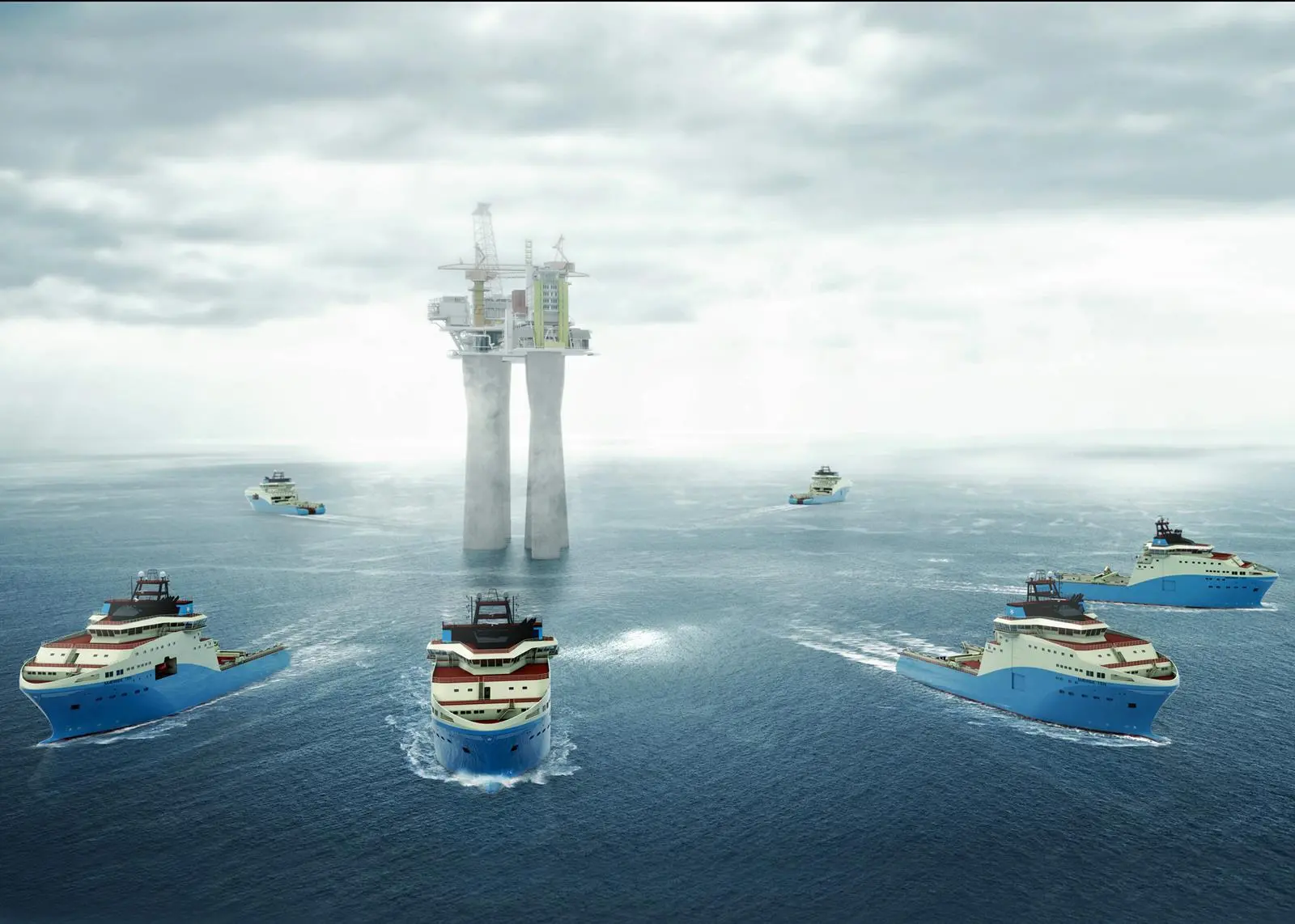
“When we go through the specification and technical details with the yards and suppliers we always have simplification in mind,” he said. It’s not just empty talk, it’s central to the development of these six new 95m SALT 200 Anchor Handling Tug Supply Vessels “and has been behind decisions on a lot of equipment” he added.
For example it’s been reflected in the choice of all the underwater elements for the 4,500dwt vessel: for example the five side thrusters are all fixed pitch, further, the there’s been modifications to the more usual hull design, “which avoids the deep skeg common to large AHTS” says Tor Henning Vestbøstad of SALT Design. “This means lower effective draft of the vessel and easier docking among other advantages.”
The engine set up has also benefited from the ‘simple’ approach. The installed power comes to around 16.9MW in total, coming from two main Wärtsilä 32 medium-speed engines yeilding 4,400kW each and a pair of 3,300kW Wärtsilä 32 gensets, plus a single Wärtsila 20 genset of 1,450kW in a separate and insulated room on the second deck. This gives a meaty 23,000bhp in total.
“There is a reason for having medium speed engines,” adds Mr Sestrup. “A lot of operators are tempted to choose high speed engines because they are a somewhat cheaper, they have a low weight and they are smaller in size, so the shipyards find them easier to install.”
“But – and it’s a large ‘but’ – we are very loyal to environmental concerns and fuel consumption: high speed engines use more fuel than medium speed engines and they are just a little bit less reliable in operation.”
Mr Vestbøstad explains that the propulsion is quite a simple hybrid plant set up: alongside a direct shaft line each engine’s gearbox has a power takeoff so when clutched in it will function as a normal generator, able to work alongside the other gensets.
This gives three modes of operation: diesel-electric running where all the gensets can supply power to a four-way split switchboard arrangement. Then there’s diesel-mechanical running where the main engines engage mechanically with the shafts, leaving the other gensets to feed power to the tunnel thrusters, winches, hotel loads and so on via the switchboard. Lastly there’s boosted power, where the main engines are shaft connected but the gensets also add what they can to the propellers to gain the highest possible bollard pull, a minimum 230 tonnes. “The engine configuration results in flexibility for efficient and safe running in all modes of operation,” adds Mr Vestbøstad.
Engine reliability is definitely in focus on these vessels: “A 100% uptime doesn’t come free that is for sure, we have to invest in it,” says Mr Seistrup. “You can’t just press the reset button on the main engines and say ‘we will now double the time between overhauls’.”
In fact, getting to a long, 48,000 hour maintenance interval has meant cutting a deal with the main engine manufacturers that involves taking the engine apart at regular intervals “to identify where the bottlenecks to reliability are”. It’s followed by some fairly intense discussions about what’s been found to see what kind of upgrade is proposed, “then it’s run up to the next step, maybe 30,000 hours, before being dismantled again to see how things are working.”
So, Maersk Supply expects the time between overhauls on these vessels to be close to 10 years; this should result in two dry dockings without any intervention. This is good for the bottom line in more ways than one: “Our statistics tell us that the period of highest risk for operational problems is shortly after repairs are carried out,” says Mr Seistrup, with an obviously healthy regard for the facts.
Looking above, Mr Vestbøstad points to other developments: for example the ROV hangar is centred as close to midships as possible, a better position compared to the more usual ‘integrated’ garage, as it reduces the effect of the sea’s motion.
As for working deck layout, the design is still being “fine tuned” to optimize for safe and effective operations. Mr Vestbøstad says that rather than the more common pedestal cranes, a Triplex MDH-42 transverse gantry crane gives access to the whole deck area reducing the need of people on deck as a safety measure. An ARF (Anchor Recovery Frame) assists in the critical anchor launch and recovery phase he explains: it lifts the wire to help reduce the angle of the dragging force when the load comes up around the stern roller.
Mr Seistrup adds: “This ARF is actually quite a complex piece of equipment: firstly it can drop the anchors very close to the aft roller, and when it’s not needed it is completely embedded, set flush into the deck so you won’t even notice it until it is activated.”
Last but not least, being willing to invest in high quality vessels has had an impact on the accommodation design which is really top of the range with one man cabins for all 52 personnel onboard. Mr Seistrup adds that while its heavier on space, he also believes that this level of privacy “will be a basic requirement for the future”.
The whole vessel is obviously a result of effective collaboration, but all this requires time, effort and a lot of talking: Mr Vestbøstad explains that from the initial outline it took almost a year of communication with Mærsk’s technical team to ‘tailor’ the design: “There are always compromises to be made during such a process so it is very good to cooperate closely, iterate and check out consequences right away.”
Main specifications
Design: Salt 200
Length: 95 metres
Beam: 25 metres
Deadweight: Approx. 4,500 tonnes
Free deck: 944 sq m deck area in total, 822 sqm open deck area
DP: Class 2
BHP: 23,000
Winch: 500 tonnes, with a three drum configuration
Configured to accommodate 52 persons in single cabins
ROV garage
Stevie Knight
Related Articles
 ALTERNATIVE FUELS & LUBRICANTS
 GENERAL NEWS
 GENERAL NEWS