



Permanent magnets unlock efficiency
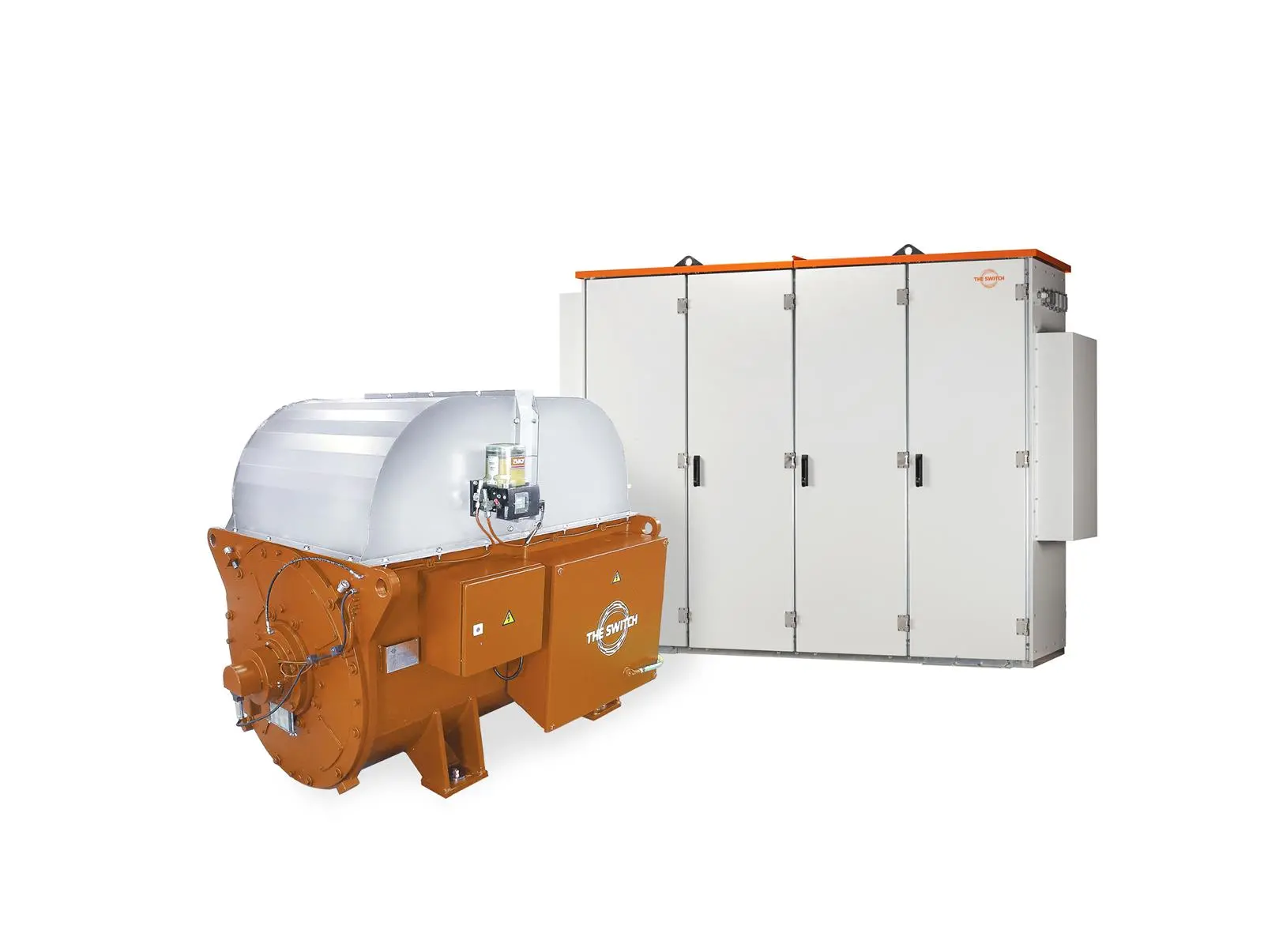
Shaft generators are nothing new. According to Mårten Storbacka, MD of WE Tech Solutions: “The shaft generator system has over the past three decades been successfully employed on board ships worldwide.” The main application has been to use the main engines for electrical power production, thus reducing the running hours of auxiliary generators.
“However,” continues Storbacka, “generating a ship’s electrical power by means of a shaft generator has imposed a great disadvantage: constant speed operation of the propulsion machinery. The WE Drive system removes this need for constant speed operation by utilising variable frequency drive technologies in shaft generator systems.” He describes this application as “the last piece in the puzzle of achieving superior energy efficiency in global shipping.”
The Switch has a background in wind power, developing permanent magnet (PM) machinery and full-power converters for high-power wind turbines generating 1MW to 8MW. The company claims the technology offers superior energy efficiency – alongside lower capital, operational and maintenance costs – and has adapted it to marine and industrial power systems. It says that with the drive towards energy saving at sea, use of shaft generators can significantly cut fuel costs and emissions.
The Switch system has recently completed bench tests and achieved certification by Lloyd’s Register. A pair of PM shaft generators were subject to a rigorous full-power bench test at the company’s base in Vaasa, Finland. These are part of an order for four PM shaft generators, included in a contract for a complete system being delivered by WE Tech Solutions to Swedish shipowner Wallenius Lines. The Switch says that the PMM 1000 direct-drive marine shaft generator is the first of its kind to take advantage of PM technology, allowing ships to gain greater efficiency over the entire speed range. Each machine weighs 18 tonnes without the shaft and features a nominal power of 1.5MW and speed range of up to 100rpm. Nominal speed is 80rpm. The Switch offers PMM 1000 shaft generators in various power ranges from 0.5MW to 7MW at speeds of up to 100rpm.
The PM generator will be located on the shaft between main engine and propeller. The generator rotor is connected to the propeller shaft with a shrink disk-type coupling. The shaft generator will be delivered with a WE Drive variable frequency drive from WE Tech Solutions, which allows ship’s electrical power to be generated with constant efficiency through the full speed range of the main engine.
Outstanding efficiency
“The efficiency performance during testing was an outstanding 97% over the entire speed range, even surpassing our expectations,” says Mika Koli, marine business development manager of The Switch.
Storbacka adds: “Over the past three years, we’ve been developing our solution together with The Switch and other close suppliers. The main advantage of this technology is that it significantly increases marine energy efficiency. Depending on how you calculate it, fuel savings are approximately 20-30%. Since this technology lowers the need for installed power on a ship, energy generation and weight are reduced significantly, thereby lowering fuel consumption and the need for maintenance.”
The system will be installed on a ship of the Wallenius 8000 PCTC class, a post-Panamax high-efficiency ro-ro vessel, one of a series being built in China, and due for completion in late 2015. WE Tech says that it has received similar orders from Terntank Rederi of Denmark and Torvald Klaveness of Norway, while in February 2015, WE Tech and Besiktas Shipyard of Turkey signed a contract for the delivery of two direct drive permanent magnet shaft generator solutions to a series of 15,100dwt asphalt carriers, ordered by the Canadian ship-owner Transport Desgagnés. The contract includes an option for two more vessels.
The permanent magnet rotor of the shaft generator is mounted on the intermediate shaft of the propulsion system between main engine and propeller. According to the company, mass and inertia are very low and thus the impact on propulsion system torsional vibration calculations (TVC) remains minimal. No additional bearings are required. The generator is housed in a compact, foot-mounted stator package, including the rotor and intermediate shaft, positioned on the generator bed in the propeller shaft line and connected via flanges.
WE Tech says that it offers several distinct solutions using PM shaft generators and its electrical drives, all aimed at ships with direct-drive low speed propulsion. The simplest ‘power take out’ system generates power for the ship’s electrical network with the engine able to be operated at optimal duty points throughout the vessel speed range. This solution, says the company, enables shaft generators to be installed with two-stroke main engines and fixed pitch propellers.
Take me home
The next stage offers, in addition to normal shaft generator operation, an auxiliary power drive (APD) option. This solution, says WE Tech, essentially enables ‘take me home’ propulsion operation for product tankers, as well as ensuring a safe return-to-port propulsion for any ship type. Running the WE Drive in power take in (PTI) mode, the auxiliary engines can feed power to the shaft generator which acts as an electric motor, to provide propulsion power. The WE Drive can achieve this simply through its active front end (AFE) drive technology.
The third option is basically similar to the APD solution, but can provide auxiliary power to boost the main engine in demanding situations, such as severe weather or sailing in ice. This solution can also be applied to economical slow steaming with the single main engine in a twin-shaft installation. If this system is designed into a ship from the outset, the main engine size can be optimised for efficient operation under normal conditions, and extra power requirements handled by the auxiliary engines. A smaller main engine represents a significant reduction in capital cost.
The common DC link of the WE Drive can be employed in novel power distribution applications. Large electrical consumers such as thrusters or large compressors can have dedicated inverter units powered directly via the common DC link, which is fed by either the shaft generators or auxiliary gensets, or both together. With the common DC link distributing power to the ship’s electrical network, thrusters, and propulsion machinery, this solution enables more efficient power distribution and controlled short circuit currents, which in turn allows smaller and lighter switchboards. With the DC link distributing electrical power to all consumers, claimed efficiency gains of up to 20% can be realised.
The common DC link can be taken a stage yet further to provide a hybrid propulsion system as well as a ship-wide power distribution system. The WE Tech Hybrid DC Machinery concept includes variable speed auxiliary generators and permanent magnet technologies for the rotating machines. With the ship-wide DC-link power distribution fault currents are kept to a minimum thanks to the precise controls of the dedicated inverter units per consumer. The company adds that large switchboards and bulky transformers can be eliminated, which means savings in space and weight as well as improved total efficiency.
Related Articles
 PROPULSION
 GENERAL NEWS
 GENERAL NEWS