



Efficiency thrust for Azipod
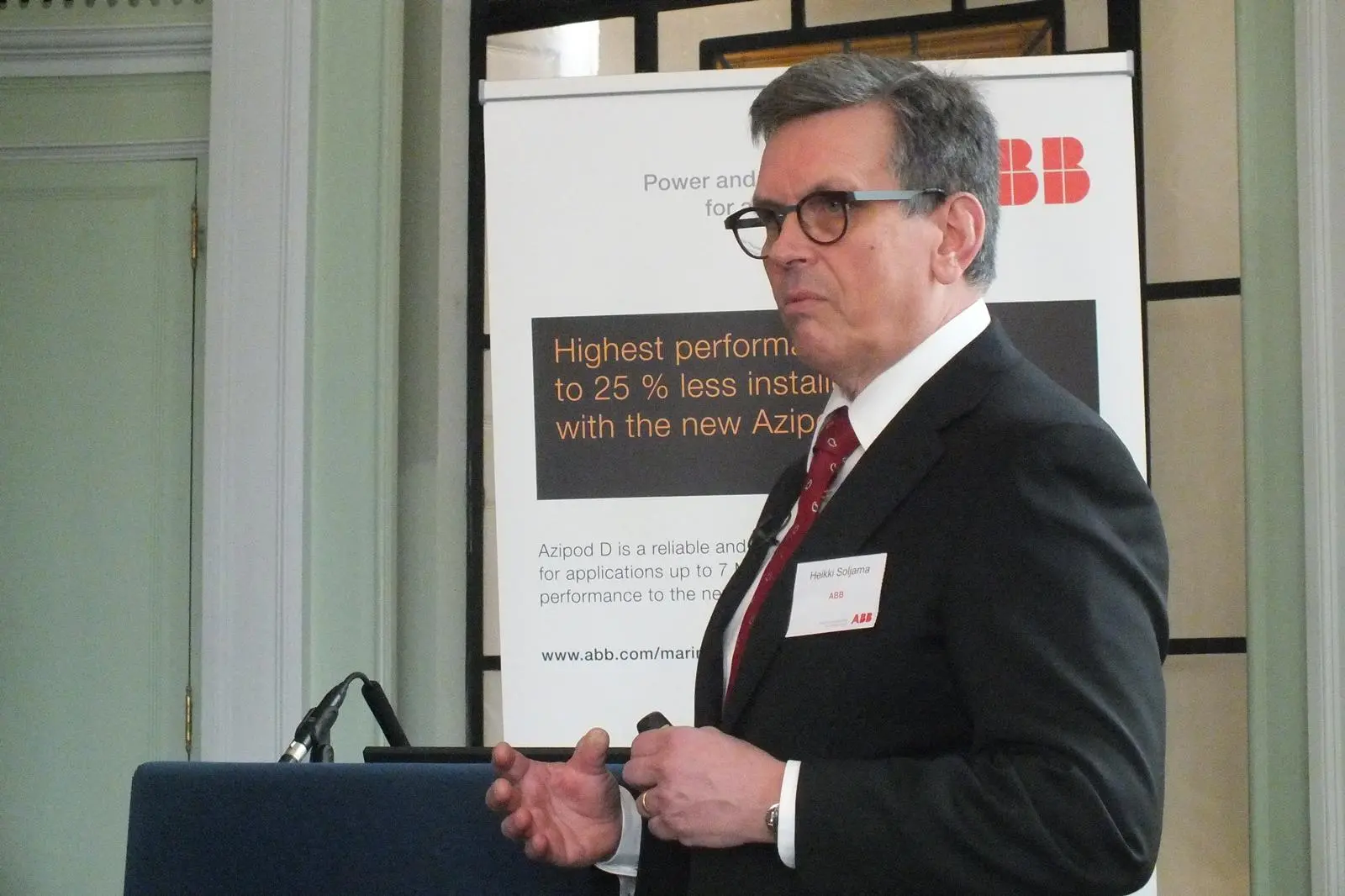
“What type of machinery and fuel is best placed to cope with this volatile market? I think electric propulsion.” A predictable perspective perhaps, coming from the managing director of ABB marine and ports, one of the world’s biggest power and automation companies. But Heikki Soljama has numbers on his side.
The number of ships using electric propulsion has been growing since the 1970s, by around +12% a year on average. And in the last six years, while ship owners have wrestled with wildly fluctuating oil prices and charter rates, there has been a notable upward spike. Today electric propulsion is still relatively niche, although that may change: while ships featuring electric propulsion (including hybrid propulsion systems) represent just two percent of the current global fleet, ABB claims they represent 11% of the global vessels on order.
ABB’s ubiquitous Azipod range of gearless thrusters, launched in 1987, has played its part in the growth of electric propulsion. Jaakko Aho, head of thruster business, ABB cites an impressive track record.
“We are one of the largest thruster makers on the market,” he says. “Azipod systems have operated for around 11 million hours since they were launched, with an on-duty rate of 99.9%. Estimated fuel savings across the Azipod fleet, totalling more than 4GW of installed power, are about 10% on average [compared to equivalent diesel propulsion using HMO], resulting in around 400MW less installed power onboard. And last year the company received orders for Azipod systems worth US$800 million.”
To that impressive pedigree, ABB has added its latest line extension, Azipod D. Through that launch the company intends to secure further success with a unit designed expressly for today’s challenging environment.
Unveiling the new thruster to gathered press in March, Soljama cited flexibility, better dynamic response and the potential of software (both in monitoring and managing propulsion systems) as key advantages of electric propulsion in general.
“Market cycles demand flexible ships,” he said. “Electric propulsion provides the flexibility to adapt to changing market conditions. For example it is much easier to realign electric systems by using flexible cables, than by relaying pipes [in diesel systems]. In addition, it offers reliability, space savings, energy efficiency and redundancy.”
With the Azipod D, the company has striven to place an even greater focus on efficiency – both in energy consumption and lifecycle cost – within that list. Aho explains: “The industry is demanding advanced technology at a cost comparable to or lower than the systems of today. We’ve done that with the Azipod D with a focus on reliability, total cost, efficiency and serviceability. The Azipod technology is proven, the innovation is in combining those technologies in an efficient way.”
In terms of installed propulsion power Azipod D, at 1-7MW, its nestled between the 2-4.7MW Azipod C and the 7-22MW Azipod X. But power is not the prime consideration here. A variety of technologies combine to increase torque by around 45% compared to the existing Azipod devices, which translates to a reduction in installed power required of up to 25%.
One such technology is a hybrid cooling system. Previous Azipods have used either water cooling or air cooling to keep the motor temperature in check. In Azipod D, a new hybrid system makes use of both water and air, allowing ABB to ramp up the torque from a similar installed power. Without cooling, the thruster can operate at around 70% of its installed power.
Key features of the thruster unit include a gearless power train, meaning that the motor is next to the propeller with less critical components. The Azipod D motor is either a heavy bore, asynchronous induction motor (as opposed to the synchronous motors used elsewhere in the line) or, as with its counterparts in the range, a permanent magnet motor for the highest output applications.
The thruster’s adjustable strut height is another example of how simplicity and innovation can bring energy efficiencies. That flexibility allows ship builders to optimise hull forms by minimising the resistance caused by water flowing around the thruster headbox.
Electric steering features four redundancy configurations, while shaftline technology includes a redundant seal and online monitoring of bearings. Again, simplicity is key in reducing cost, keeping maintenance times low and enhancing serviceability. Overhaul of the shaftline can be completed in two days in a dry dock, without the need to send the unit for servicing, while a complete exchange of the thruster can also be completed in two days. Aho explains that the ease of service contributed to lifecycle costs of up to 30% less than other thrusters. Serviceability is further enhanced by ABB’s commitment to long-term, fixed maintenance contracts, and the wide availability of its technical support, with marine service centres in 20 countries.
The system also features enhanced condition monitoring, allowing for greater predictability and risk management by enabling remote diagnostics. He added that the simplicity of the system meant that installation costs were up to 20% lower than for other thruster systems.
Fuel efficiency is also critical, and according to Aho the Azipod D is “designed for the market’s lowest fuel consumption”. By way of an example Aho describes the power requirements of a typical 80m PSV, at 15 knots with a sea margin of 15%. The installation needed for a competitive mechanical thruster system would be 2 x 2.22-2.5MW; for the Azipod D it is 2 x 2MW – equating to 25% less installed power.
ABB notes that the new system would extend Azipod’s target markets to include offshore drilling, construction and support vessels as well as ferries. “The characteristics of Azipod propulsion make it particularly appealing to the offshore shipping segments where most vessels operate in dynamic positioning mode and require highest reliability,” the company claims in its launch literature.
There is little doubting the emergence of electric propulsion, or the key role that Azipod has played in it. As Soljama notes when asked about competition from traditional engine manufacturers in the thruster business. “We are delighted to see other entrants as it proves the value in our market, and that we are doing is the right way to go. But I think they may find that it is not easy to gain the electrical competence that is needed.” ABB’s latest launch once again highlights its leading position in electric propulsion. And with a new focus on the efficiency so sought after amongst ship owners, the Azipod D is likely to play a big role in the future of the electric market.
Related Articles
 PROPULSION
 GENERAL NEWS
 GENERAL NEWS