



Rolls-Royce extends PM portfolio
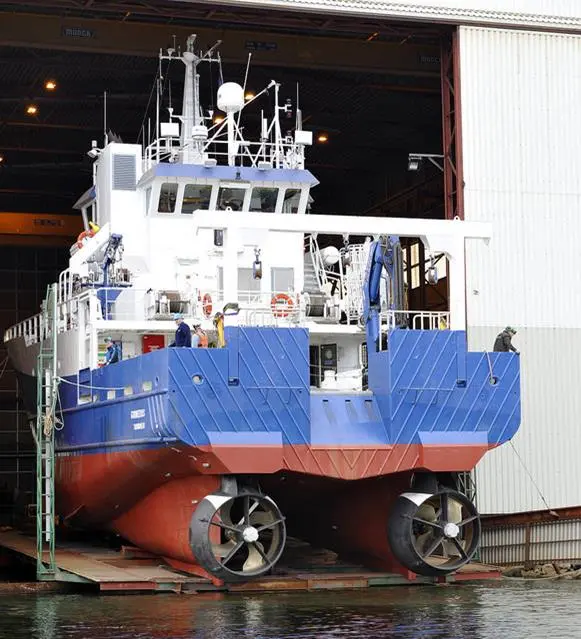
According to Rolls-Royce head of electrical systems research & technology Gunnar Johnsen the company is examining how to bring the units into commercial production after encouraging early results. “Although it has been in operation for just two weeks, some of the benefits are already clear,” he says. Among the advantages claimed over conventional thrusters are improved efficiency, low vibration and noise, good manoeuvrability and quick response in both azimuthing and speed.
The azimuth trials follow Rolls-Royce’s roll out of PM tunnel thrusters, which were ordered for Norwegian Cruise Lines’ vessel Norwegian Epic earlier this year. The azimuth unit – like its tunnel counterpart – operates on the rim drive principle, with the PM motor surrounding the propeller blades in a slim ring. A stator carries electromagnetic windings fed by a frequency converter to create a sinus waveform. Together with permanent magnets on the rotor they create a rotating magnetic field that cause the propeller to turn.
Preliminary results onboard Gunnerus – adjusted to correct for increased displacement after a hull conversion – indicate power savings of 13% at 8.8 knots, 11% at 10.5 knots and 7% at 11.5 knots compared with the previous propulsion system. Power output is said to be 25% greater than traditional non-PM thrusters with the same propeller size, without the efficiency-sapping slipping or sucking effects associated with induction motors. There is no propeller tip loss as the propeller and rim are joined and rotate together, reducing loss of power as well as excess noise and vibration caused by cavitation.
The compact unit – with only the slip ring and variable frequency steering motors housed in the hull – also allows for thrusters to be positioned with greater flexibility, for example further towards the bow or stern of a vessel. The PMTT2000 unit – featuring a 2m diameter propeller as opposed to the 1.6m propeller on the PMTT1600 – is 3.1m, compared with 4.6m for its conventional counterpart.
Noise tests of Rolls-Royce’s PM tunnel thruster onboard anchor handling vessel Olympic Octopus and quay-side tests conducted by Rolls-Royce and DNV GL showed reductions to airborne noise (cut by 4-8dB), structure-borne noise (6-12dB) and seaborne noise (5-6dB).
Research vessel overhaul
Gunnerus’s diesel-electric twin-screw arrangement was overhauled to accommodate two PMZAM1900 prototype azimuth thrusters, retaining the original high-speed diesel generator sets. Control and monitoring systems were also installed, while hull modifications (designed by Polarconsult) were made to accept the thruster mounts and feed propulsion forces into the structure. Conversion work was carried out by Moen Marin in Kolvereid.
Innovative designs for the propeller, nozzle and stays also improve hydrodynamic performance, contributing to the overall efficiency gains of the thruster. Johnsen noted that none of those enhancements would have been possible without the introduction of permanent magnet motor technology, which allows for a more robust thruster design with the propeller as the only moving part.
The thrusters incorporate proprietary technology from Rolls-Royce to fix the magnets within the rotor. Fully-owned subsidiary Smartmotor also contributed to the development.
Johnsen noted that any vessel type currently using thrusters would benefit from the new PM motor-driven units. The technology will be at its most effective when integrated into the design of a newbuild vessel rather than retrofitted, he added, as the hull needs to be optimised for best performance with the thruster.
In related news, Rolls-Royce is also trialling a winch that employs a PM motor. The XT140 winch has completed initial tests and class qualification at the company’s anchor handling & supply test facility in Brattvåg. From November this year the equipment will be tested at sea onboard newbuild fishing vessel Langøy, operated by Prestfjord Havfiske.
Johnsen said: “Arctic area operators among others are requesting alternative pollution-free solutions. Conventional AC operation systems are one alternative, but the dynamic functions are very poor. Permanent magnet motors compare well with hydraulic systems and offer high torque and dynamic performance.”
Academic cooperation
The development of permanent magnet technology and its various marine applications is just one of several fields in which Rolls-Royce has enlisted its network of university technology centres (UTCs). The UTC scheme was established 25 years ago and today Rolls-Royce works with 31 universities across marine and aeronautical research. Those relationships account for some 8% of patents filed by the company each year, drawing on the knowledge of around 450 doctoral students each year, plus faculty and staff.
The company’s relationship with the Norwegian University of Science and Technology (NTNU) and the Marintek Research Centre – where hydrodynamics research towards the permanent magnet thrusters, as well as sea trials onboard shared vessel Gunnerus, were conducted – goes back ten years. And last month the parties renewed their cooperation, pledging to continue to develop high-tech solutions for the maritime sector, focusing on improving ship performance in rough seas.
The research centre at NTNU – employing seven researchers and four PhD candidates – follows the UTC model that Rolls-Royce has developed with universities worldwide. It is the only centre of its kind in Norway, and one of two in the Nordic region. The second Nordic UTC, in collaboration with the Chalmers University of Technology in Gothenburg, Sweden, is also focused on marine technology.
Depending on the number of ongoing projects, Rolls-Royce meets 25-40 per cent of the Norwegian centre’s funding requirement. The partnership also receives substantial support from the Research Council of Norway. Rolls-Royce plays an active role in the research effort itself and the centre’s work contributes real value for the maritime industry, one of Norway’s most important industries.
Rune Garen, director of propulsion research & technology, Rolls-Royce, says: “This is a very close collaboration between industry and academia, where we as a company not only contribute funds, but also take part in the research effort.
“It is also an exceptionally good example of how R&D contributes to the development of strong business clusters. The aim of the collaboration in Trondheim is to boost research in areas that are strategically important for Rolls-Royce and that have the potential for commercialisation.”
Ric Parker, director of research & technology at Rolls-Royce adds: “Rolls-Royce has a proud history of innovation and continues to develop its Marine business with cutting edge products and services. The Trondheim UTC makes a significant contribution to our understanding of the behaviour of ships and propulsion systems in extreme sea conditions, feeding into our award-winning designs. Trondheim is a key member of our strategic academic network of 31 UTCs worldwide and we are happy to be extending this successful partnership.”
Depending on the number of ongoing projects, Rolls-Royce meets 25%-40% of the Norwegian centre’s funding requirement. The partnership also receives substantial support from the Research Council of Norway. Rolls-Royce plays an active role in the research effort itself and the centre’s work contributes real value for the maritime industry, one of Norway’s most important industries.
Azimuth anniversary
While the permanent magnet technology employed in the new thruster range is new, Rolls-Royce has a long heritage in the thruster market – in fact it was 50 years ago in May that the company delivered its first azimuthing thruster. Today the product range is one of the group’s most successful marine products, powering and positioning some of the world’s largest floating structures.
Mark the occasion at an event in Rauma, Finland, John Rishton, chief executive, Rolls-Royce and Mikael Makinen, president – marine, Rolls-Royce, joined employees in celebration.
John Rishton said: “Today marks a hugely significant milestone for our marine business and particularly the team here in Rauma, our centre of excellence for large thruster production.
“Our customers operate in some of the most demanding conditions on the planet, and need not only high power, but consistently reliable power, and that’s exactly what these thrusters deliver.”
Makinen added: “This is a proud day for our business. From its early inception as a steerable propeller, the Rolls-Royce azimuth thruster range has developed into a world-leading portfolio today, providing high power for drillships, semi-submersible rigs and other vessels including tugs, icebreakers and offshore support vessels.
“Renowned for robust engineering and high reliability, our large azimuth thrusters are built to last. Often operating for five years at a time without any major maintenance, their success can be attributed to the expertise of our design and production teams, and decades of operating experience.”
The Allseas Pioneering Spirit, the world’s largest construction vessel, will be powered by 12 Rolls-Royce azimuth thrusters,when it enters service on decommissioning duties in the North Sea later this year.
Related Articles
 PROPULSION
 GENERAL NEWS
 GENERAL NEWS