



Norsepower proves wind power savings at sea
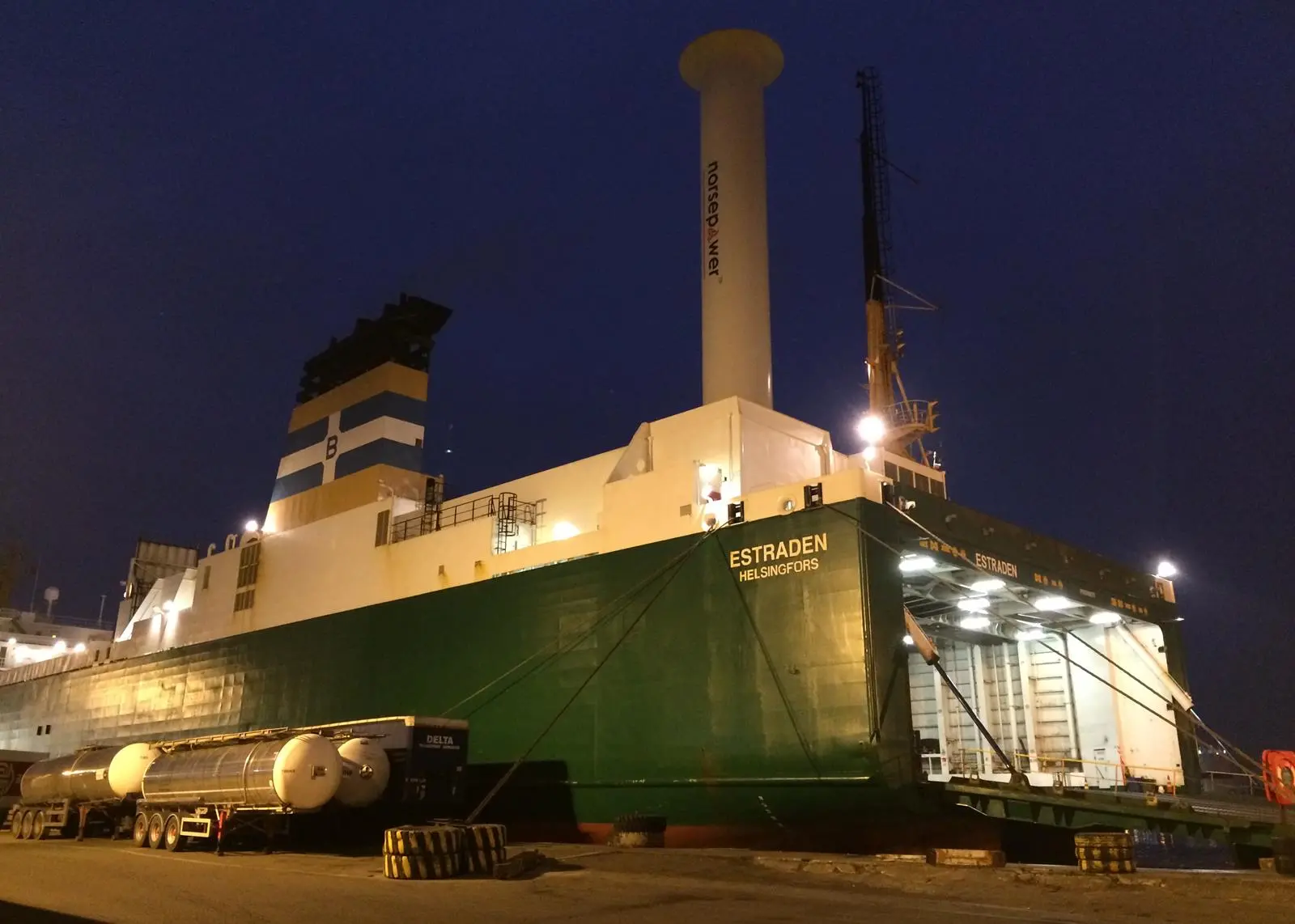
A single small rotor sail was tested on a North Sea route, with results showing fuel savings of 2.6% – resulting in a four-year payback period for the technology. Based on the trials the companies believe that a full system on 9,700dwt ro-ro carrier M/V Estraden with two rotors has the potential to deliver 5% efficiency savings. Norsepower forecasts even bigger savings, of around 20%, for vessels with multiple, large rotors travelling in favourable wind routes.
The rotor sail comprises a spinning cylinder that uses the Magnus effect to harness wind power to propel a ship. When the wind conditions are favourable, this allows the main engines to be throttled back, saving fuel and reducing emissions.
Test vessel Estraden operates a continuous service between the Netherlands and the UK, sailing through the North Sea’s windy corridors at speeds of 16 knots. The installation was completed in two parts: the required foundations were installed during a normal drydock stay, followed by the 18m high rotor during an ordinary seven-hour harbour stay.
“We are proud to be the first shipowner to install the Norsepower Rotor Sail, and demonstrate that wind propulsion technology has verifiable 5% fuel savings on a yearly basis, can be retrofitted without any off-hire costs, and is extremely easy to use in practice. It’s our goal to find ways to establish sustainable shipping with minimal impact on our environment,” said Jörgen Mansnerus, vice president, Bore.
The trials were measured and analysed with continuous monitoring systems from maritime data analysis, software and services provider, NAPA and VTT Technical Research Centre of Finland. VTT Technical Research Centre of Finland collected data over a six-month period, during which both the rotor sail and automation system was operational 99% of the time. The results confirmed that Norsepower’s rotor is able to produce large amounts of thrust force, enabling fuel savings.
A randomised trial by NAPA found clear and significant savings despite largely calm weather conditions throughout the study. After establishing a baseline the rotor sail was activated and de-activated at random intervals to verify that any measured effect was solely due to the sail, and that any benefit was measurable across the vessel’s operating profile.
Tuomas Riski, CEO, Norsepower, said: “The successful trials of our wind technology are a ground-breaking moment not only for Norsepower, but also the wider development of wind propulsion technology for shipping… confirming that wind technologies are commercially-viable solutions that reduce fuel and carbon emissions in the industry.”
Related Articles
 PROPULSION
 GENERAL NEWS
 GENERAL NEWS