



Meeting the EEDI challenge
EEDI regulations, applicable to newbuild ships of more than 400gt and equipped with diesel (or dual-fuel) mechanical propulsion systems, began entry into force in 2013. The purpose is to reduce shipping’s global carbon footprint by cutting fuel consumption. The index is a performance-based calculation of carbon dioxide emissions, based on the technical parameters of a given ship type.
A joint industry project, Sea Trial Analysis-JIP set up in 2004 by Dutch research institute MARIN, Nedlloyd and Shell, in collaboration with several other organisations and companies, provided a basis for speed/power measurements intended to offer IMO a ‘level playing field’ for all ship types when it came to determining the EEDI.
The regulators’ intention was to progressively introduce stricter EEDI rules, with the initial 2013 regulation, known as Phase 0, followed by Phase 1 and Phase 2 in January 2015 and January 2020 respectively, culminating in Phase 3, with entry into force scheduled for 1 January 2025.
Phase 0 did not actually require any actual reduction of fuel consumed, concentrating on the calculation and recording of verifiable fuel consumption data to ensure ships were able to attain fuel consumption figures equal to, or better than, a reference figure for that particular ship type, the reference being drawn up by IMO. Ships under Phase 1, that is to say those contracted after 1 January 2015, with keel laying after 1 July 2015, or delivery after 1 January 2017, would be required to achieve an EEDI value at least 10% better than the EEDI reference point. Phases 2 and 3 require fuel consumption reductions of respectively 20% (or 15% for some ship categories) and 30% compared to the original reference figure.
It is important to note that the above information is considerably simplified: there are numerous exceptions and variations, introduced progressively by various meetings of IMO’s Marine Environment Protection Committee (MEPC). Readers are advised to refer to IMO or class society data to determine actual timescales and EEDI reductions for particular ship types.
Phase three designs
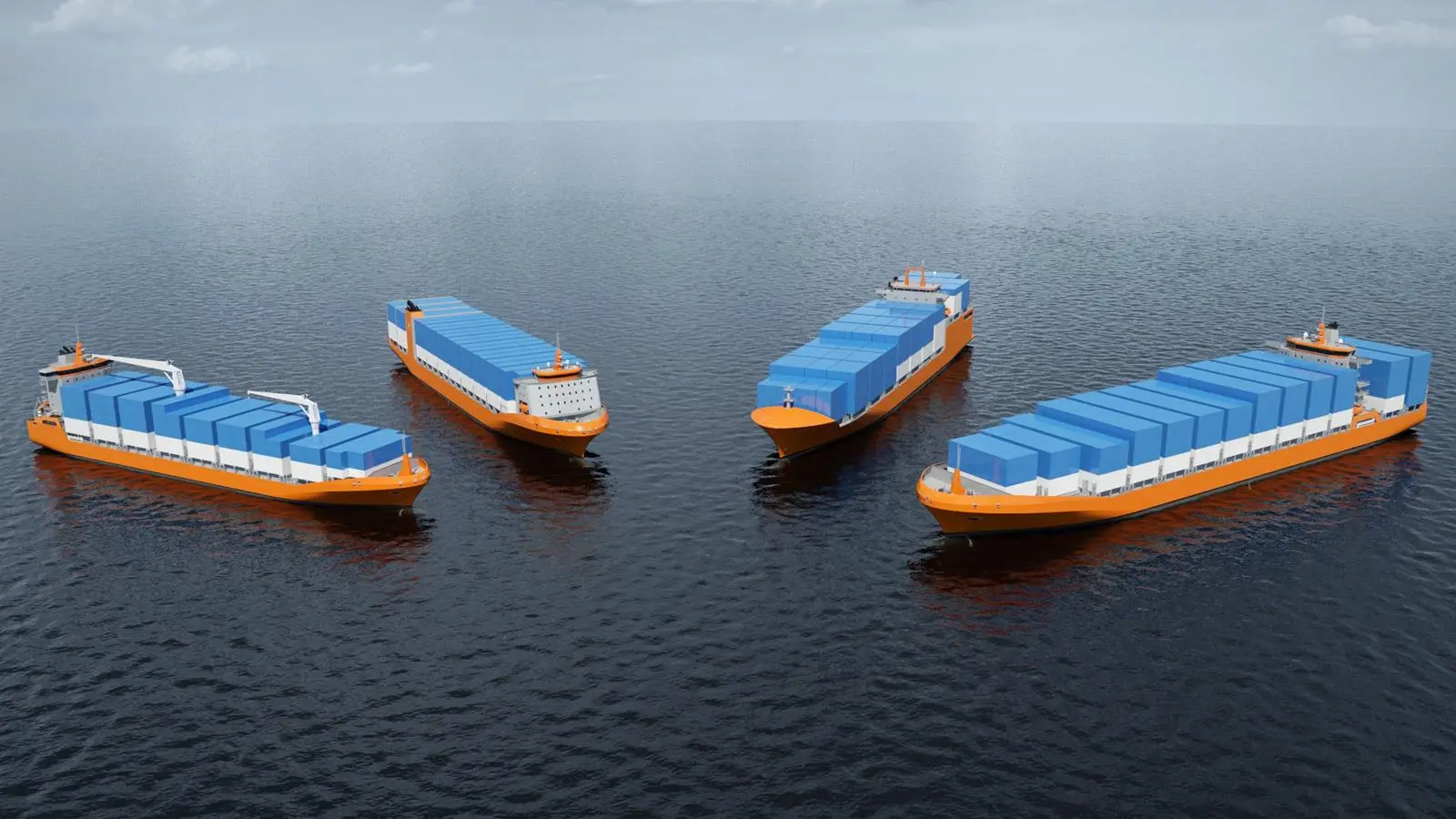
Despite Phase 3 being some way into the future, ship designs are being released now with the potential to comply with the requirement for 30% attained lower fuel consumption than the EEDI reference point. An example is the recently-launched series of container feeder ships from Wärtsilä Ship Design, for which low emissions and fuel consumption figures are particularly important, with the strong possibility of feeder vessels operating primarily within ECAs (emission control areas) and SECAs (sulphur emission control areas).
It became evident that the simplest way to cut fuel consumption was to operate at, and optimise engines and propulsion systems for, lower power outputs. Such was becoming common practice anyway – the desire to cut fuel costs combined with over-capacity in most shipping cargo markets had combined to promote slow steaming as common practice. In fact, slow steaming can, with most ships, achieve sufficient reduction in fuel consumption, and hence carbon dioxide emissions, to achieve Phase 1 compliance without alterations to the basic hull or propulsion system design. In many cases, a 3% speed reduction will produce a 10% reduction in EEDI.
Various studies have shown that the current EEDI calculation methods indicate that the two parameters with the greatest influence of EEDI are speed and length. Beam can have a major impact, less so the draught and prismatic coefficient. This suggests that lower EEDI can best be achieved by designing and building smaller, slower ships. With the trend for increased efficiency resulting from economies of scale – as personified in the current range of ultra-large container ships – there is an interesting challenge ahead for ship designers.
As the more stringent reductions in carbon emissions are phased in, ship operators and designers will need to look at more fundamental ways of reducing fuel consumption through more efficient propulsion systems and hull designs as well as improved operational strategies. In fact, it looks as if most of the necessary developments will concentrate on the propulsion aspects. Trim optimisation, weather routing and similar strategies are already widely employed in the drive to save costs, while the desire for more efficiently planned cargo ships has meant increased block coefficients and lower length-displacement ratio for vessels such as bulk carriers and tankers – design parameters which can work against improvements in EEDI.
All of the above meant that there was, potentially, a temptation to order ships with very low propulsion power, or supply them with new engines in de-rated configuration. Those involved in maritime safety felt that in some case this could mean that ships would be left with insufficient power margin to manoeuvre safety in adverse weather and sea condition.
The IMO’s MEPC has addressed several changes, additions and updates to the EEDI rules and formulae over the years, such as the adoption of EEDI for ships with dual-fuel (diesel and gas) engines and EEDI for diesel/gas electric LNG carriers. But it was not until MEPC 67, in October 2014, that the adverse weather power requirement question was formally revisited. MEPC 67 agreed to revise the relevant guideline, MEPC.232 (65) on propulsion power established by MEPC 65 in 2013, to extend its scope and content without any actual technical changes. The guideline gives two levels for determining minimum power – a basic formula based on ship size (level 1) and a more complex procedure (level 2) which takes into account wave height, wave period and wind speed as well as ship length, thus giving a truer picture of minimum power required for safe manoeuvring.
Honing the formulae
The recent MEPC 68, held at IMO headquarters in May 2015, revised the EEDI level 1 formula, which set power levels for bulk carriers and tankers, with the minimum power (P) expressed in kW, based on deadweight tonnes (DWT) according to a formula as below:
Bulk carriers <145,000dwt: P = 0.0763 x DWT + 3374.3
Bulk carriers >145,000dwt: P = 0.0490 x DWT + 7329.0
Tankers: P = 0.0652 x DWT + 5960.2
This change takes effect six months from its adoption at MEPC 68, and will hopefully lead to a better chance of maintaining safe power levels for these two ship types.
MEPC decided that further power assessment criteria changes (affecting level 2 criteria) would be put on hold pending the outcome of related EU and Japanese research projects (SHOPERA and JASNAOE). The current Level 2 assessment contains three distinct steps. The first is to determine the required advance speed in head wind and waves in order to ensure course-keeping in all wind and wave directions. The second step determines the propulsion power required to maintain this speed and confirm that total main engine output is sufficient to reliably achieve the required propulsion power, while the third step confirms that, at the required propulsion power, the torque is within the installed engine’s design torque limits.
In order to obtain a Level 2 assessment, various criteria need to be identifiable, including rudder area, frontal and lateral windage areas, aerodynamic resistance, calm-water resistance, and propeller open-water characteristics.
However, it has been identified by other regulators as well as class societies that the level 2 assessment has many shortcomings. The guideline suggests that the current level 2 assessment is applied only to Phase 0 of the EEDI. This gives rise to an ambiguity as it will be difficult for many ships currently in build, which, having been contracted since 1 January 2015, and which will need to meet Phase 1 reductions, cannot be assessed to level 2. This means there can be no guarantee that they can comply with the 10% fuel reduction required by Phase 1 and maintain safe manoeuvrability.
SHOPERA (energy efficient SHip OPERAtion) is an EC-funded collaborative project involving several stakeholders in the maritime industry, tasked with improving ship safety while achieving the required reduction in carbon emissions. According to the project’s information, it aims to address the industry’s serious concerns regarding the sufficiency of propulsion power and of steering devices to maintain the manoeuvrability of ships in adverse conditions, assuming that the ship marginally passes the relevant EEDI criterion.
The project believes that it is urgent to look holistically into integrated ship design and operational environments and implement multi-objective optimisation procedures for ship’s power while ensuring safe operation. The ultimate aim is to find the right balance between ship’s efficiency and economy, safety and ‘greenness’. The project will present its results to IMO at the end of 2016. The Japanese Society of Naval Architects and Ocean Engineers is conducting similar research and will also report its findings to IMO.
Related Articles
 PROPULSION
 GENERAL NEWS
 GENERAL NEWS