



GE Marine reveals digital ambitions
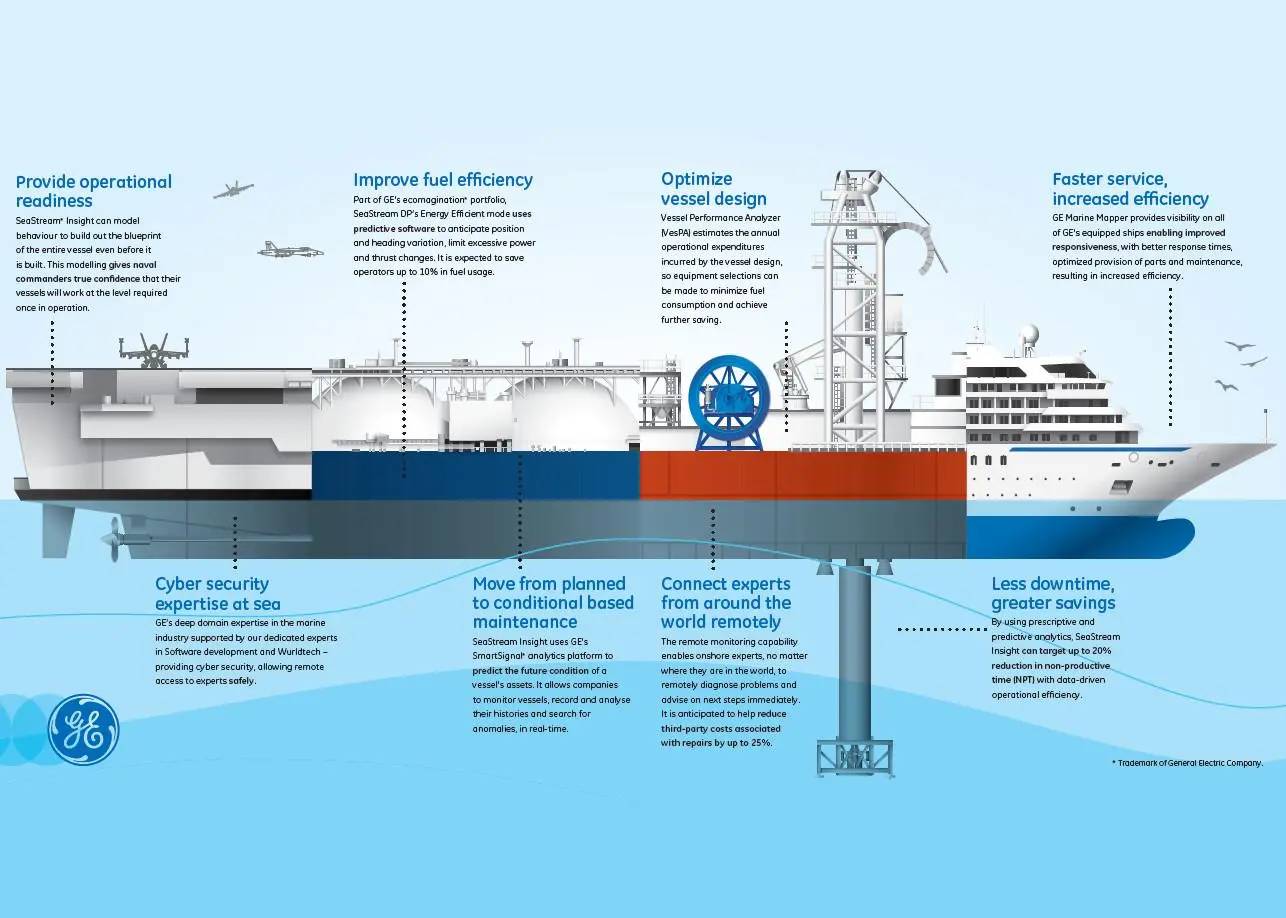
SeaStream Insight is already installed on two drillships to establish proof of concept, and will be trialled on merchant vessels driven by low-speed diesel engines in the second or third quarter of 2016.
GE’s digital marine leader Andy McKeran told The Motorship that the system, powered by GE’s long-established Predix industrial internet platform, will be able to identify potential technical problems weeks or months before they occur. This contrasts with the “rapid post-mortem” that other systems can offer, he added. Such systems may offer a quick solution to problems once they have occurred – or even before they develop into situations that cause lost operational time – but they cannot help operators from avoiding downtime by enabling preventative maintenance.
SeaStream Insight’s predictive capability is based on a ‘digital twin’ of the vessel – a virtual model built over time from up to two years’ of information from the ship’s voyage data recorder. The tool harmonises and diagnoses data from several systems – including those monitoring components and machinery from other suppliers – and uses GE’s SmartSignal analytics software to optimise and predict performance.
“We started by thinking about the industry outcomes we wanted to achieve,” said McKeran. “Focussing on the offshore sector, we looked first at how to reduce downtime [the majority of which is spent looking for the root cause of a problem, according to GE’s recent Digital Marine white paper]. Then at how to reduce third-party costs – getting experts to vessels, particularly those in remote environments. And we also wanted to address some softer issues, such as knowledge retention in an industry where 60% of the workforce is over 50.
“Once we realised that we wanted a condition-based approach for maintenance, we worked on how we could harness our experience and capabilities with Predix as well as competencies from other areas within the company – what we call the GE Store.”
While Predix is not new – some elements have been in use for up to fifteen years and the conglomerate has been demonstrating its Industrial Internet capabilities for around four years – the capabilities are only beginning to be marketed to the traditionally risk averse marine sector. Also powered by Predix platform is GE Marine’s Vessel Performance Analyzer (VesPA) and GE MarineMapper. Both harness the company’s infrastructure and experience of big data, analysis and connectivity.
Digital portfolio
Marine Mapping, a system for tracking and storing data from GE Marine’s installed base of equipment on vessels – currently around 1,400 ships, of which 100 are tracked today – is intended to yield improved insight into equipment for the company and its customers. It is no revolution, as McKeran admits, but is a ‘must have’ for OEMs.
VesPA is altogether more innovative, allowing users to virtually assess alternative power, propulsion and electronics configurations in a fraction of the time previously impossible. The fundamental components are a vast database holding the technical data of all equipment needed in each configuration, and sophisticated algorithms that assess each configuration against performance requirements. Several alternative designs can be processed simultaneously in a matter of minutes, along with operational expenditure implications.
“That means that we can almost instantly begin to have educated discussions with owners about potential opex scenarios, as opposed to the two months or more it might have taken to reach that stage previously,” explains McKeran.
Both tools show the practicability of big data in the marine industry, but SeaStream Insight takes that to a different level. Two years’ worth of data from one vessel, the amount ideally required to build an operational model for SeaStream Insight, equates to around 3 terabytes of information. Storing that information alone, multiplied by many thousand potential client vessels, requires serious computation capability. GE’s existing infrastructure is crucial in enabling that, as is its software and analysis capability, based at the GE Digital Center in San Ramon, USA, as well as a network of experts in its industrial performance and reliability centres.
Handling vessel data is one challenge that GE is equipped to deal with. McKeran offers a nice summary of the thought process behind SeaStream Insight: “What data can we access, how can we harmonise it and what diagnoses can we make? What can we optimize? What can we predict using that data and ultimately what can we systemize?”
Obtaining the data is an altogether different story. The VesPA database of technical information from a wide range of OEMs is a very different beast to those same OEMs allowing access to real-time data from their equipment’s in-service operations. McKeran acknowledges the challenge, and the need for an industry dialogue about sharing data. But he is clear that operational data from equipment on vessels should belong to the owner, while reliability data is owned by the equipment provider. It is with permission from the owner that GE accesses and runs analytics on the data. “All of those massive streams of data are already there, but its true value is not revealed,” he explains. “With GE’s software capability, we can unleash the enormous potential of these Big Data.”
Centralised data is key. The upside of a system that provides a holistic and predictive view of the vessel is evident, with the typical drillship operation a good example. GE estimates that a drillship can lose up US$12 million a year (at US$700,000 a day) through downtime, the vast majority of which is spent searching for the root cause of a problem. That example is no less relevant in the merchant fleet, where days lost off-charter have clear financial implications.
McKeran concludes: “The system aims to improve productivity. If you know you are going to be unable 10% of the time, that’s fine – you, and your customers, can plan for it. So the ability to predict is key to efficiency.”
Related Articles
 ALTERNATIVE FUELS & LUBRICANTS
 GENERAL NEWS
 GENERAL NEWS