



Efficiency and compliance in focus in Hamburg
Highlights from the first day can be reviewed here.
Day two of the conference began with a panel exploring vessel efficiency options for both newbuild ships and retrofits. Kjartan Ross, Business Development Manager, MAN Diesel & Turbo noted that, looking at the entire drive train holistically, it is possible to have a retrofitted vessel that can compete with new buildings for efficiency. He explained that before the fuel price crash last year it was only owner-operators who wanted optimisation. “Now we see a big interest from people who charter out ships too. I think the reason is that some charters are coming to an end and there is an interest in improving these vessels position in the market place,” said Ross.
Arthur Barret, Program Director, LNG Bunkering, GTT, provided a fascinating and in-depth report on a novel ship propulsion concept for container vessels – the PERFECt project for ‘piston-free’, or gas and steam turbine-powered propulsion. Ultra Large Container Vessels need to adapt rapidly to a constantly changing economic environment. Barrett offers a description of an innovative proposal for propulsion of ULCVs that could also be applicable to other type of ships and discusses a case study of a joint project with CMA-CGM.
Jonathan Brown, Chief Engineer, Large Engines, Pascal Revereault-Ricardo UK, presented the results of a study into improving reliability and performance of diesel-electric propulsion configurations/ And Juan Gonzalez-Adalid, General Manager, Sistemar and Thibaut Raes, Project Engineer, Evergas revealed how they had conducted optimisation – in particular propeller changes – on the second generation of Dragon multi-gas carriers.
In a session exploring fuel choices and technology Dr Jerry Ng KL, Founder & CEO, Blue Ocean Solutions discussed the development of emulsion fuels, arguing that they represents a good way to improve combustion of fuel. Ng showed how Blue Ocean Solution has designed its own system to integrate emulsified fuel with electronical controlled engines.
Konrad Räss, General Manager Combustion System, R&D, Winterthur Gas & Diesel then took to the stage to discuss the impact of varying fuel types on two-stroke engine performance. The two-stroke engine is an omnivore – it can take just about any type of fuel you can feed it, said Rass. “But if you eat everything, sometimes you can have problems with digestion.”
Other important sessions examined the impending European Monitoring, Reporting and Verification (MRV) regulation and its global equivalent under development at the IMO. Julien Dufour, CEO, Verifavia Shipping and Poul Woodall, Director, Environment & Sustainability, DFDS Seaways shared insights from the pre-MRV gap analysis conducted for DFDS Seaways; Jakob Buus Petersen, Director, Vessel Performance Solutions, discussed the role of data quality as explored in a new Danish project INNOplus; and Torsten Mundt, Principal Engineer, Environmental R&D, DNV GL – Maritime gave a stakeholder’s perspective of discussions to develop the MRV.
Finally, the increasing role of big data in improving vessel efficiency was explored in the last session of the day, featuring presentations from Michael Haranen, Senior Data Scientist, NAPA; Stefan M Nygård, General Manager, Asset Performance Optimisation Services, Wärtsilä Corp; and Dr. Barry Kidd, Section Manager, Hydrodynamics, AkzoNobel Marine Coatings.
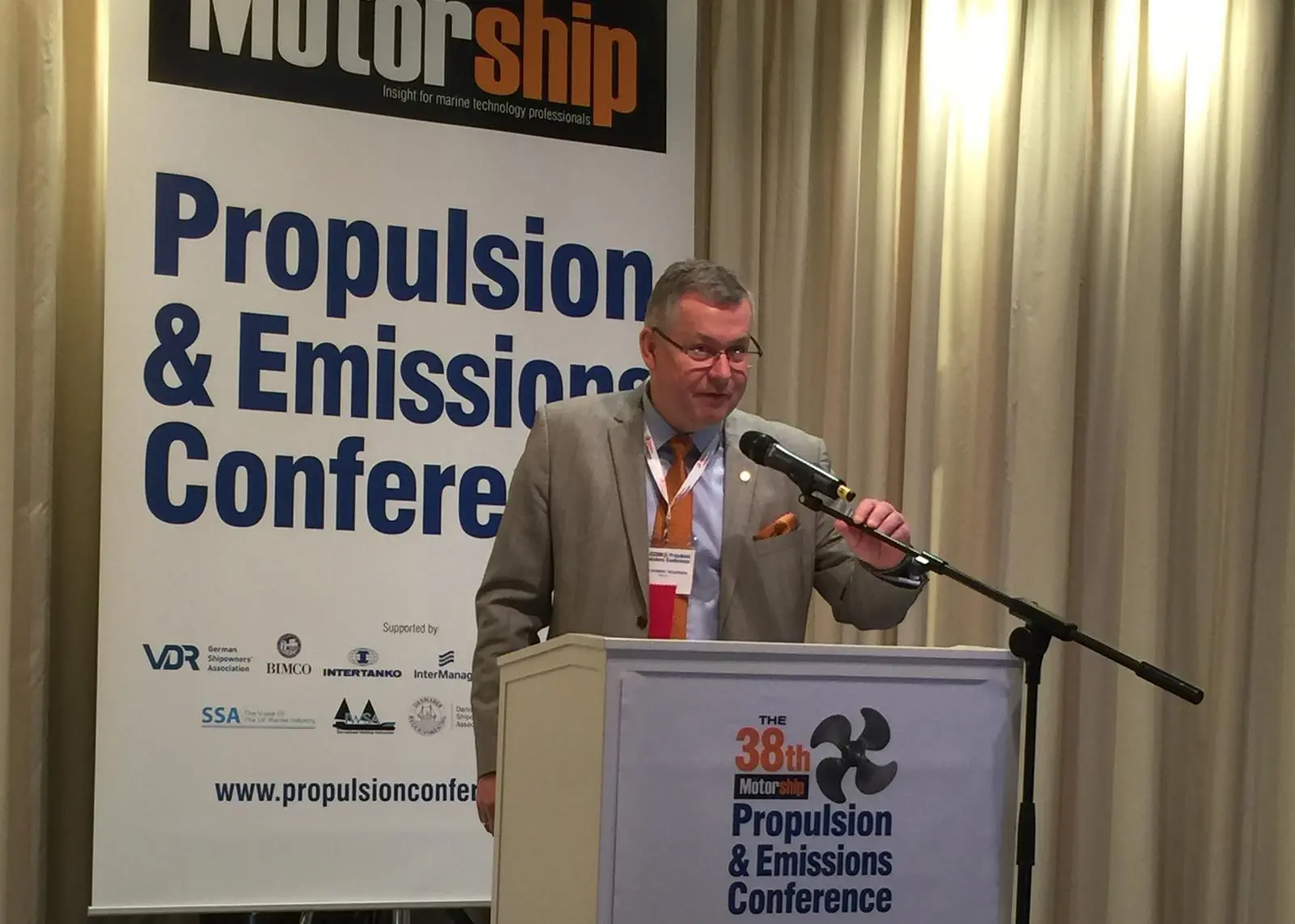
The second and final day of the Propulsions & Emissions Conference was chaired by Lars Robert Pedersen, Deputy Secretary General, BIMCO. An in-depth report will follow in the June issue of The Motorship magazine.
Related Articles
 ALTERNATIVE FUELS & LUBRICANTS
 GENERAL NEWS
 GENERAL NEWS