



Software, integration and fuel flexibility focus for OEMs
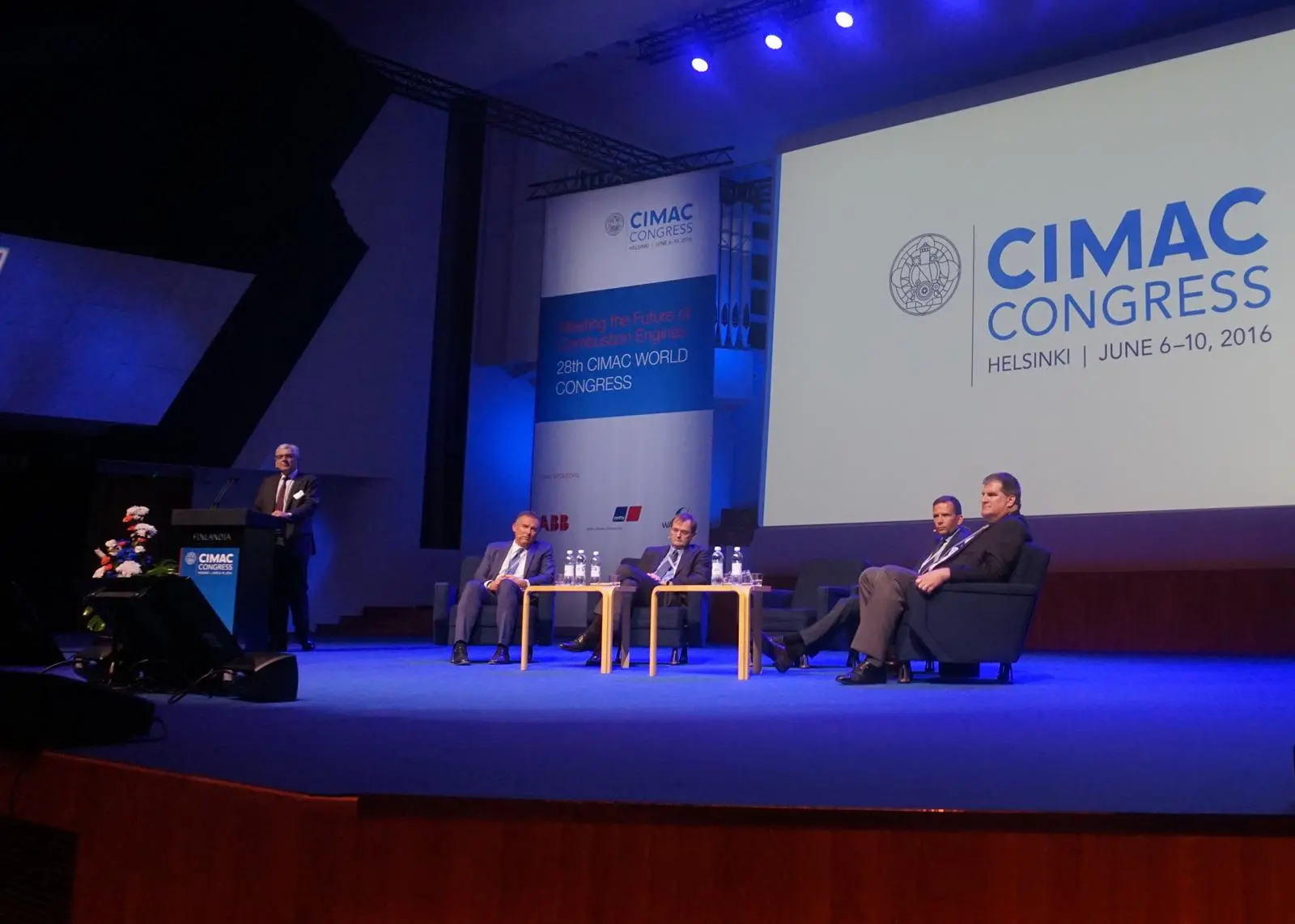
Addressing how the low oil price was changing the engine business, senior representatives from MAN Diesel & Turbo, Wärtsilä Corp and Caterpillar stressed the need to focus on ways to provide value for ship owners beyond engine hardware.
Their remarks were put in context by comments from Paolo Tono, head of Maersk Maritimie Technology, who noted the impact of pressures on the ship owners. “We are navigating in the perfect storm,” he said. “We have the lowest historical index rate for containers, and oil prices close to their low-point in the 1970s.
“Improving energy efficiency is a less profitable initiative… saving tonnes of fuel is not as attractive now as it was nine months ago. But we are still looking with interest and are able to find opportunities. How can we integrate the entire ship even more into a total efficiency framework and from an holistic point of view decide where it makes sense to optimise and how?”
Christian Poensgen, senior vice president engineering at MAN Diesel & Turbo noted that while engine design was leading to efficiency improvements of around 0.3% each year, the gains through systems, software and engine mapping could reach 6.5% over the next decade.
“The payback period our customers [are seeking] is still on average three years,” he said, “and with low fuel prices we need to deliver twice the value for the same price… Our focus will be to work much more on system integration and big data applications, with efficiency driven more through software solutions than by hardware. Engines have to be built more flexible, but the flexibility has to come through software.”
System integration will become more in demand as alternative fuels – notably electric propulsion and energy storage – become more viable, noted Poensgen.
Electric opportunities
“The short sea shipping market in particular will need to take up the challenge of hybridisation and we will develop solutions from there,” he explained. “The efficiency loss on an electric train straight from the engines to the propeller is about 10%. This has to change and it can be changed without significant cost increase.”
Even when electric propulsion becomes a widespread reality in short-sea shipping, the business case may still warrant a diesel engine to be installed, Poensgren suggested. “The price spread for industrial electricity in Europe today and as predicted for next decade is heavily dependent on local electricity suppliers. This means that the piston engine may find space even in hybrid or fully electric, battery operated ships as a factor of stability for calculations in the business plans of our customers.”
Joel D. Feucht, director gas engines at Caterpillar, suggested that a lower cost of energy brings other factors to the fore for owners. “When energy prices are low, other cost apsects become more important,” he said. “We need to look at the other things our customers have to manage in terms of total cost of ownership.
“How do we reduce planned and unplanned downtime? How do we improve service and parts availability? How do we help to keep customers’ efficiency really high? Then there’s integration, digitisation, information management – all those things are key innovations.”
Stephan Wiik, vice president engines, at Wärtsilä Marine Solutions, highlighted the importance of fuel flexibility – with all debate participants agreeing that the marine fuel mix will be far more diverse in the future.
“Imagine a disruptive energy source in the future that would mean we didn’t need our engines anymore,” he said. “Could that actually happen? How do we cope with new technologies such as batteries and renewable electricity and use our engines in combination with that?
“There is not one fuel that fits all, we will see several different installation types, we will see retrofits driven by total lifecycle cost and the area in which you trade. Flexibility is the future and today we are already testing new fuels, and bringing new engines to the market which from the design stage are fuel flexible and can be upgraded or converted for other fuels over the years.”
Related Articles
 ALTERNATIVE FUELS & LUBRICANTS
 GENERAL NEWS
 GENERAL NEWS