



Trade shrugs off uncertainty at Posidonia 2016
In a year that has so far been tainted by negative figures about the state of shipping markets, Posidonia 2016 rallied the industry together and saw over 22,000 shipping professionals walk through its doors.
There was little sign of negativity from the 1,500 exhibitors and delegates who came from around the world to showcase their products and unveil new ideas.
“I am delighted to see the vitality of the sector in spite of the hardships, an impressive example of this is the Greek shipping community holding this event,” explained Matej Zakonjsek, head of cabinet to the European Commissioner for Transport. “The potential of shipping to bring prosperity to Europe is very strong and so is our resolve to work together with all of you to overcome any stormy seas ahead.”
The international maritime trade exhibition took place in Athens at the Metropolitan Expo from 5–10 June in what most believe is a decisive year for Greece and its shipping sector. Regardless of that wider context, the event’s 14% increase in visitor numbers compared to the previous record-breaking exhibition two years ago showed the industry’s desire and ability to move forward.
“Despite the difficulties in both the national and global economic environment, Greek shipping has managed to maintain its leading position,” said Theodoris Dritsas, Greece’s shipping and island policy minister, at the opening ceremony.
He added: “More than 1,350 shipping companies are established in Greece, constituting the driving force for a number of related economic activities providing almost 200,000 jobs both at sea and ashore, covering over 30% of the country’s trade deficit.”
There was technological focus to the affair, which was highlighted by IMO secretary general Kitack Lim. He stated that the industry needs to adopt the technologies it requires for the future in order to adapt to the changing industry.
“New technologies bring improvements and economic viability and profitability too, that is part of the voyage we are taking together. The opportunities offered by new technology puts shipping on the brink of a new era,” said Lim.
Ballast water treatment was also a hot topic, with almost 60 treatment specialist companies attending the event due to the pending ratification of the IMO’s Ballast Water Management Convention, expected before the end of the year.
The Japanese shipbuilding industry – a key building market for Greek owners – were overall very positive about their outlook during the show. Yoshifumi Miyatake, director for international affairs office shipbuilding and ship machinery division, Japan Ministry of Land, Infrastructure and Transport, argued that the country’s shipbuilding and machinery offers many advantages.
“We are committed to the best quality ships. We constantly develop new advanced technologies and innovative services, aiming to provide the best solutions and have attractive financial support,” Miyatake added.
GREEK LNG PROJECT
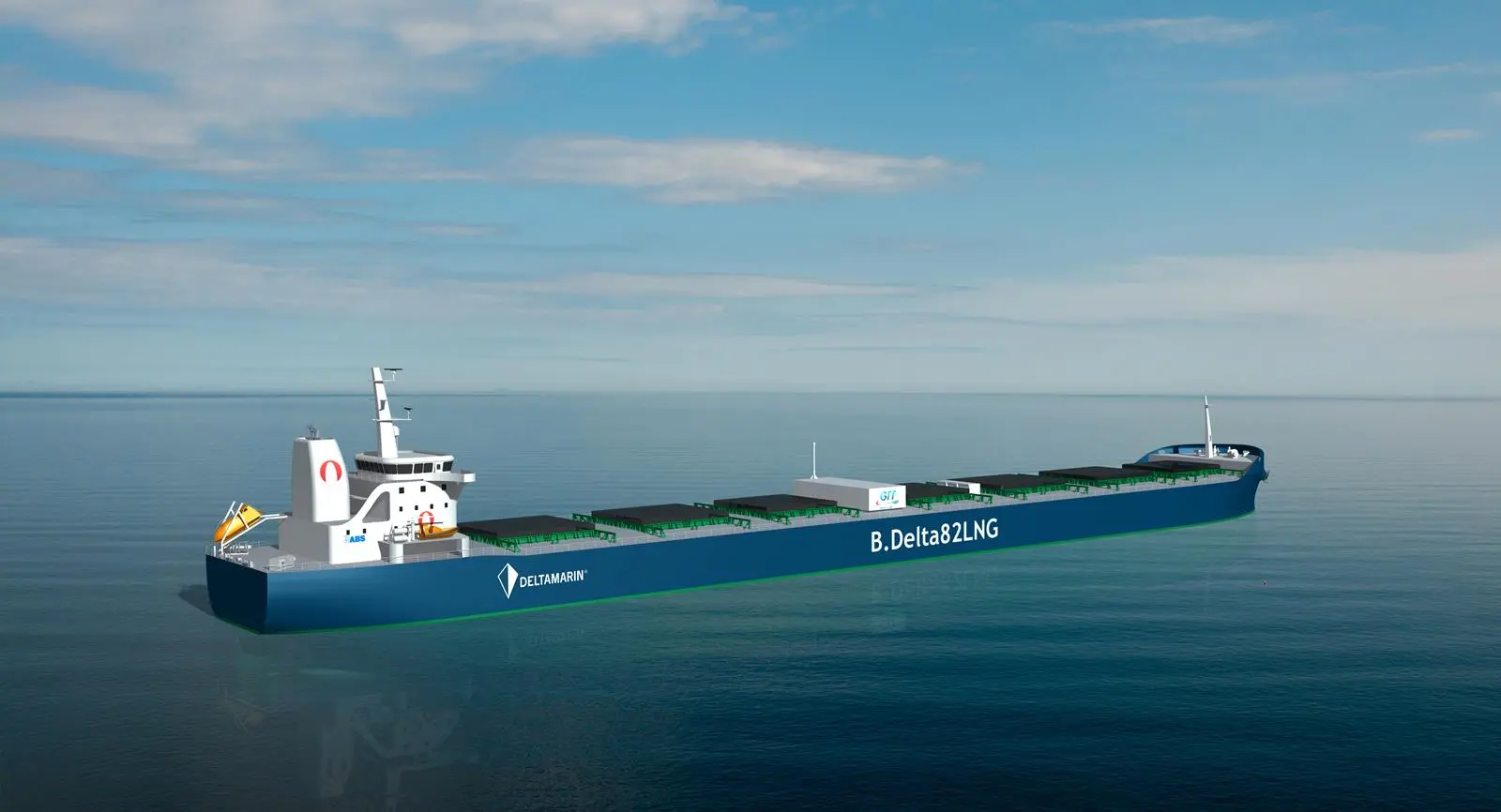
ABS presented its new Project Forward initiative at Posidonia 2016, teaming up with partners Arista Shipping, Deltamarin, GTT and Wärtsilä. The project will develop a dry bulk carrier concept that employs LNG as fuel, aiming to deliver a technically and financially feasible solution for meeting new requirements.
Alexander Panagopulos, Arista Shipping’s principal, explained: “The mission is to develop a next generation of energy-efficient and environment-friendly dry bulk cargo ships across the world beyond 2030.
“The project hopes to mark a number of ‘firsts’ and pull together the experience of leaders in their field to make LNG powered shipping a reality on the high seas.”
With the shipping market subject to cyclical variations, the most significant challenge in such a long-range project will not the be the current condition of the market but the need to adjust in order to meet new trends.
The vessel design by Deltamarin is based on the B.Delta 82 and will utilise a GTT membrane LNG fuel tank. It also features a Wärtsilä four-stroke, medium-speed engine without auxiliary generators, and features twin stage turbocharging, power take off capability and a controllable pitch propeller system.
Project Forward’s new bulk carrier is designed in compliance with the IMO’s Energy Efficiency Design Index 2025 standards, NOx Tier III and Marpol Annex VI SOx emission levels. It envisions a sailing range of 40 days, aiming to bring LNG out of the ECA zones and into deep-sea trading.
ABS is expected to provide approval in principle within the next few weeks, it will then be down to its partner Arista to pursue opportunities to select a shipyard partner.
EFFICIENCY FOCUS FOR OWNERS
A key message throughout the show was that tough market conditions are not deterring Greek owners from investing in their fleets. That spirit was exemplified by news from MAN Diesel & Turbo, which announced an order to supply Piraeus-based Danoas Shipping with fixed pitch Kappel propellers, propeller boss caps with fins and engine-power limitation. The order is for two 8,500teu container vessels, the CSCL Europe and CSCL America.
Dimitrios Vastarouchas, Danaos’ technical director, said: “Our research and development department conducted very thorough investigations before concluding what the right upgrade solutions for these vessels are. We are very confident they will be highly competitive in the market once upgraded.”
Along with the propulsion systems upgrade, the vessels will also enter dock to rebuild their bulbous bows. The combined upgrade package is expected to reduce fuel consumption at the new optimised speed of 18 knots by more than 15%, compared to the vessels’ consumption in 2004.
Both ships are powered by MAN B&W 19k98MC-C main engines rated at 68,520kW at 89.7rpm.
BALLAST IN FOCUS
With the pending ratification of the BWT Convention on the horizon, there was a strong focus on ballast water treatment in Athens. Most fleet operators are yet to make their final decisions on investing in new technologies to help them comply with impending ballast water management regulations around the corner.
With so many different technologies exhibiting at the show, Ecochlor held a workshop on USCG environmental compliance issues at Posidonia to ensure the industry knew the difference between USCG and IMO type approval.
Captain Andrew Norris, US Coast Guard (retired) and Tom Perlich, founder and president of Ecochlor, spoke at The Path to USCG Compliance & Type Approval workshop. It was greeted with a full house and presented results of Ecochlor’s land-based and shipboard testing. The supplier’s ballast water treatment system uses a two-step process to treat ballast water, filtration followed by disinfection.
The workshop also covered the final steps towards type approval and the challenges for manufacturers who are testing for USCG type approval.
Posidonia was also perfectly timed for Evoqua Water Technologies to launch a new compact version of its SeaCURE ballast water management system (BWMS).
Evoqua’s global business manager of ballast water, Matt Granitto, spoke to The Motorship about the latest developments: “We are continuing our type approval testing and we expect to be finished by the end of summer which means we can submit in early autumn. We have redesigned the system. The industry told us they needed a smaller version so we threw out the old design and have compacted it.”
Granitto explained that the design on display at Posidonia was not actually the smallest final version of the SeaCURE. “What you see on display is not even the final product, you can probably take another square metre off the scale.”
The new system has a footprint of just 5.7m2 and is easily transportable to port as one unit. It is designed to be simple to install and can be assembled offsite in order to shorten build time onboard.
Evoqua has also been building up its partnership network, with a build partner in Korea and it has started a legal process to have the same type of partnership in China.
“Alongside this, we have been working on expanding our service network. Evoqua has a big global reach and when something breaks we want there to be an eight-hour response,” concluded Granitto.
DIGITAL COMMITMENT
‘At home in Greece’ was DNV GL’s slogan for its sponsorship of Posidonia 2016, as its 100-year relationship with the Greek shipping industry stays as strong as ever. At the event, the class socity placed emphasis on innovation and digitalisation in the shipping industry as it moves through ‘troubled waters’.
Knut Orbeck-Nilssen, CEO of DNV GL Maritime, explained that only approximately 300 newbuilds, totalling 11m gross tonnes, had been ordered as of June this year. He said: “Despite this being challenging for owners, suppliers and other related areas, if you look at the bigger picture there is still overcapacity so that is a good thing.”
It was argued that now is time for change and modernisation. Orbeck-Nilssen highlighted specific projects such as an order for four (plus options) for ro-pax ferries by Stena Lines at Avic Shipyard in Shanghai.
“That a quality-focused and innovative owner like Stena Lines has chosen to construct these vessels to the new DNV GL rule set clearly shows that our customers are responding to the possibilities created by the rules,” said Orbeck-Nilssen
He added that ropax ferries will be gas ready and prepared to be fuelled by either methanol or LNG.
OMAN WOOS GREECE
Oman Drydock Company (ODC) was keen to highlight its strong relationships with Greek owners at Posidonia. Yong Duk Park, ODC Chief Executive, believed that Posidonia was a perfect place to raise the yard’s profile.
He explained: “ODC has already delivered repairs for more than 50 Greek owned or operated ships. We have an important relationship with Dynacom Ship Management, helping to drydock a number of its vessels including VLCCs. We are further proud to repair the Astro Polaris, owned by Maran Tankers,which we delivered a day ahead of schedule.”
The yard’s LNG business was further boosted during the exhibition when it was awarded a license from Gaztransport and Technigaz (GTT) on its stand by GTT CEO Phillippe Berterottiere. Along with the launch of a partnership with DSEC – a subsidiary of Daewoo Shipbuilding, and Marine Engineering Company Ltd (DSME) – the GTT license was hailed as another positive step towards ODC’s aim of becoming one of the leading shipyards for LNG repairs.
BEARINGS UPTAKE
Craig Carter, director of marketing and customer service, Thordon Bearings spoke to The Motorship about the increasing uptake of its grease-free bearings, including among Greek owners and operators.
The ThorPlas Blue from Thordon Bearings has been gaining clients amongst cruiseship and bulk carrier owners, Carter reported. It is a hard-wearing, grease-free, alternative to the bronze bearings commonly found in grabs, lifeboat davits, winches, fairings and rudder stocks amongst other machinery.
Carter explained: “The main benefit to the ship owners with this product is it eliminates the use of grease and this is important for environmental regulations. The only difference is that with this product the shaft it runs against has to be stainless steel, so that there is no corrosion.”
The product was first used by Princess Cruises on its lifeboat davits after a number of trials but it has picked up in popularity, not only in the cruise industry, but throughout shipping. Greek shipowner Minerva Marine replaced its greased bronze mooring winch bearing with ThorPlas-Blue aboard the 58,156gt crude oil tanker Minerva Hellen. It is now planning to apply the grease-free alternative to other vessels in the fleet.
The company’s propeller shafts, lubricated with seawater, are also gaining ground in an industry where Carter believes others are overcomplicating operations. Carter explained: “What people have started doing over the years is making more complicated procedures. What we say is forget all that. Go back to basics, go back to seawater. No oil, no grease, no impact on the environment.”
The bearings from Thordon have a 15-year guarantee, and Carter reported that bearings installed by Disney Cruise ships in 1998 are yet to be changed. The company had its best year ever in 2015, with 20% growth, and is expecting to be on target to match it this year.
Carter concluded: “The Greek shipping industry remains one of the most influential maritime nations in global shipping, so it is important for us to have a presence at Posidonia. But while Greek shipowners are aware of the environmental and commercial benefits our award-winning COMPAC system, they may not be aware that our grease-free ThorPlas-Blue bearings can also help them save money while protecting the environment.”
BV APP LAUNCH
Bureau Veritas’ marine and offshore division launched its new one-stop-shop mobile application at Posidonia on 8 June. My VeriSTAR has been created to allow marine professionals to easily perform daily class and statutory actions through a user-friendly interface. Shipowners and mangers will be able to monitor their fleet, plan surveys and stay informed at all times.
The first version of the app, which was given a live demo at Posidonia, is now available on the Apple Store and Google Play Store. It includes key functions from the VeriSTAR website and a new Bureau Veritas directory.
Fleet managers will be able to closely monitor selected vessels and the app will enable clients to access a statutory snapshot and visual timeline of their fleets, as well as detailed vessel information, documents, reports and a timeline view of activities.
The class society also spoke about a 3D digital twin modelling system which they hope will dramatically reduce the time needed for checks on structure, seakeeping and stability of new vessels and floating offshore units. Bureau Veritas has entered into a partnership with Dassault Systemes to help develop the 3D model.
Related Articles
 ALTERNATIVE FUELS & LUBRICANTS
 GENERAL NEWS
 GENERAL NEWS