



Current challenges, emerging solutions at CIMAC Congress
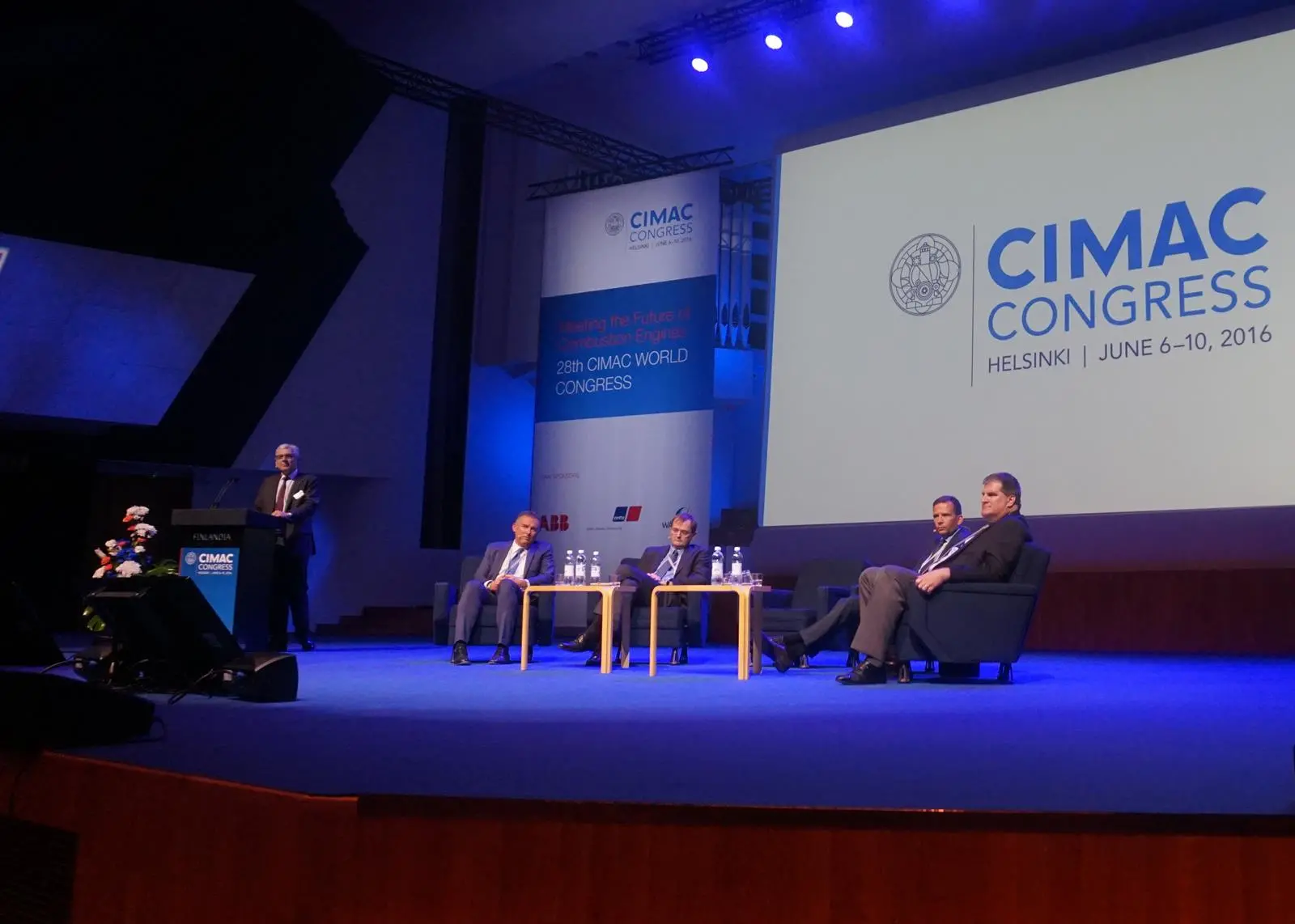
“We are here in challenging times. But we love challenges and we have an obligation to meet them.” Robert Ollus, president of CIMAC Congress 2016 and director of global testing and validation at Wärtsilä, could have been talking of any number of issues facing the industry today. At CIMAC Congress, those challenges were confronted particularly from the angles of emissions abatement, growing demand for system integration and enhanced software applications, and the need to accommodate a rapidly diversifying fuel mix.
A forward-looking panel of major engine manufacturers, with the shipowner perspective provided by Maersk, concluded CIMAC Congress in a way that neatly encapsulated the discussions and presentations (over 300 technical papers this time) of the week. Addressing how the low oil price was changing the engine business, senior representatives from MAN Diesel & Turbo, Wärtsilä Corp and Caterpillar stressed the need to focus on ways to provide value for ship owners far beyond their traditional portfolios of engine hardware.
Their remarks were put in context by comments from Paolo Tono, head of Maersk Maritime Technology, who noted the impact of pressures on the ship owners. “We are navigating in the perfect storm,” he said. “We have the lowest historical index rate for containers, and oil prices close to their low-point in the 1970s.
“Improving energy efficiency is a less profitable initiative… saving tonnes of fuel is not as attractive now as it was nine months ago. But we are still looking with interest and are able to find opportunities. How can we integrate the entire ship even more into a total efficiency framework and from an holistic point of view decide where it makes sense to optimise and how?”
Christian Poensgen, senior vice president engineering at MAN Diesel & Turbo noted that while engine design was leading to efficiency improvements of around 0.3% each year, the gains through systems, software and engine mapping could reach 6.5% over the next decade.
“The payback period our customers [are seeking] is still on average three years,” he said, “and with low fuel prices we need to deliver twice the value for the same price… Our focus will be to work much more on system integration and big data applications, with efficiency driven more through software solutions than by hardware. Engines have to be built more flexible, but the flexibility has to come through software.”
Poensgen noted that system integration will become more in demand as alternative fuels, notably electric propulsion and energy storage, become more viable.
ELECTRIC OPPORTUNITIES
“The short sea shipping market in particular will need to take up the challenge of hybridisation and we will develop solutions from there,” he explained. “The efficiency loss on an electric train straight from the engines to the propeller is about 10%. This has to change and it can be changed without significant cost increase.”
Even when electric propulsion becomes a widespread reality in short-sea shipping, the business case may still warrant a diesel engine to be installed, Poensgren suggested. “The price spread for industrial electricity in Europe today and as predicted for next decade is heavily dependent on local electricity suppliers. This means that the piston engine may find space even in hybrid or fully electric, battery operated ships as a factor of stability for calculations in the business plans of our customers.”
Joel D. Feucht, director gas engines at Caterpillar, suggested that a lower cost of energy brings other factors to the fore for owners. “When energy prices are low, other cost apsects become more important,” he said. “We need to look at the other things our customers have to manage in terms of total cost of ownership.
“How do we reduce planned and unplanned downtime? How do we improve service and parts availability? How do we help to keep customers’ efficiency really high? Then there’s integration, digitisation, information management – all those things are key innovations.”
Stephan Wiik, vice president engines, at Wärtsilä Marine Solutions, highlighted the importance of fuel flexibility – with all debate participants agreeing that the marine fuel mix will be far more diverse in the future.
“Imagine a disruptive energy source in the future that would mean we didn’t need our engines anymore,” he said. “Could that actually happen? How do we cope with new technologies such as batteries and renewable electricity and use our engines in combination with that?”
“There is not one fuel that fits all, we will see several different installation types, we will see retrofits driven by total lifecycle cost and the area in which you trade. Flexibility is the future and today we are already testing new fuels, and bringing new engines to the market which from the design stage are fuel flexible and can be upgraded or converted for other fuels over the years.”
FUTURE FUEL MOSAIC
Those views were echoed in another highlight of the event, a keynote lecture from Harry Robertsson, technical director at Stena Teknik, the vessel design arm of Stena Group. The wide-ranging talk covered Stena’s views of future ship design and in particular improving safety, economy and environmental performance. Overarching all these areas is the group’s perspective on the future fuel scenario
Stena Group’s fleets are likely to be driven by heavy fuel oil cleaned by scrubbers in fifteen years’ time, with other fuels playing a growing role, said Robertsson. He suggested that this could be the most cost-efficient fuel option even if a carbon tax or fee is introduced on top of the fuel price.
At present the company has installed just four scrubbers, with a further three units planned. At a cost of US$5-10 million per installation, this is expensive and potentially complicated work. LNG retrofitting has also been discounted for the time being, except on the group’s LNG carriers, due to both the high cost of conversion (around US$30 million for a ro-pax vessel) and the loss of power – up to 20% of installed power in some cases studied by Stena Teknik, a deficit that would make it difficult for the ships to keep to schedule.
“Our approach to fuels is driven by the 0.1% sulphur limit in the North European ECA, as our activities for Stena Line and Stena RoRo are very much in this area,” said Robertsson. “I agree that we will have a fuel ‘mosaic’ in the future: different ships on different routes in different parts of the world will be running on different fuels.”
The fuel scenario looks very different in fifteen years’ time, according to in-depth research carried out by Stena Group. Then LNG could be an option for newbuild vessels, said Robertsson, in regions where the price is attractive and bunkering infrastructure is available.
Methanol is also firmly in the group’s sights as a result of the company’s conversion work on Stena Germanica – which is in the process of having the third of its four medium-speed Wärtsilä engines converted to methanol running. In Iceland methanol is already being produced in small quantities from CO2 and water (with thermal power to start the process), offering a tantalising prospect of shipping free from fossil fuels.
EXPLORING BATTERIES
“What surprised us in this study was that batteries could be an attractive option for short sea shipping (under 100nm) fifteen years from now,” Robertsson noted. “And in the longer term biofuels and fuel cells will enter the market. But today marine batteries are three times as expensive as car batteries, and so far the capacity and lifespan of fuel cells are too small.”
Stena’s owners are keen to explore the potential of battery power, and the company is starting the process by looking at battery powered bow thrusters. This may eliminate the need to start an additional two generator sets when ships enter port – one to power the thrusters and one for redundancy.
The next step after bow thrusters would be to replace two of the four engines on Stena Line ferries with electrical motors, with shore-charged batteries enabling emission-free sailing in ports and the Stockholm archipelago. The group has also designed a concept vessel, the ro-pax Stena Elektra, which features methanol propulsion and energy storage, as well as a level of autonomous operation and modular design to allow for seasonal changes to operations. Robertsson suggested the vessel could be a reality by 2030.
Robertsson’s description of the Stena approach to future ship design had some interesting implications for propulsion. The multi-fuel scenario of the future may now be a given, but Robertsson’s discussion of batteries potentially powering bow thrusters, and then electric motors replacing two engines on ro-pax vessels, signals new system integration challenges for the industry. In line with the analysis of MAN’s Poensgen, it also places battery systems as competitive to medium-speed engines (over short distances) in the mid-to-long term future.
The propuslion implications of Stena’s future design approach are also noteworthy. Reducing installed power is a key part of the strategy, as is a broader operating profile for vessels, with potentially two (or more) distinct services each year. And the claim that Stena will be ‘driven by HFO with scrubbers’ in 15 years’ time will be noted by suppliers of engines, emissions abatement technology and fuel alike – as well as by the IMO as it consider fuel availability ahead of a decision on the global sulphur cap.
TWO-STROKE ADVANCES
The weight and size implications of emissions abatement technologies are encouraging two-stroke engine designers to work harder than ever on reducing the footprint of their units and allowing for easy, compact integration of SOx and NOx reducing systems. For example, MAN Diesel & Turbo has used a new iterative development concept to reduce the bedplate weight on its latest S90 engine by 700kg. A new rod design has reduced crank pin bearing width by around 15%, increasing the stiffness of the crankshaft and reducing cylinder distance by 100mm, thus reducing the overall size of the engine. The concept will be employed as MAN develops its latest generation of other engine designs.
Similarly, Mitsubishi Heavy Industries has increased piston stroke length by 12% on its new UEC50 LSH ECO electronically controlled engine, first deployed into service in September last year, while keeping the engine compact and light. Stiff and light materials have been used for the engine jacket, wall structures and bedplate, while the combustion chamber features a new heat resistant material and a bore cooling piston, reducing thermal load in the engine.
Alongside increasing power density, there are plenty challenges ahead for two-stroke engine designers. Among them – as illustrated in a paper by WinGD – are the impact of higher firing pressures and modern technologies including multifuel operation, control systems, condition-based maintenance and big data acquisition.
Delegates were also updated on development of dual-fuel two-stroke engines, with first testbed results of MAN’s ME-LGI engine on methanol and WinGD’s X-series, both of which have entered service in the last three months. Service experience of MAN’s ME-GI engines on LNG carriers was also reviewed. The main theme was one of continuous development in safety and ease of use, as well as improving engine running using LNG and ensuring a smooth switchover process between the fuel operations.
CYLINDER WEAR
Modern operating practices and engine designs are presenting new challenges to engine condition. Slow steaming, ultra-long stroke engines and modern engine tunings can increase the risk of cold corrosion and, as we learnt today from Märkisches Werk, variable valve timings also have a potentially underestimated impact on valve wear. Lean-burn gas engines and potentially duel-fuel engines may be particularly susceptible to valve damage.
Winterthur Gas & Diesel is developing several cylinder condition solutions and has formulated an index measuring differences in oil film distribution around the circumference of cylinders. It can be used to compare lube distribution against other cylinders and thus indicate potential problem areas.
Also on oil distribution, Hans Jensen Lubricants presented the results of a test of its Lubtronic Swirl Injection Principle (SIP) injector on a modern MAN Diesel & Turbo engine. Interestingly, the system was able to maintain engine condition using a much lower feed rate than that recommended by MAN until the engine design’s lower limit was factored into the control system algorithms.
Piston ring coatings also have a role to play in preventing engine damage and a new coating formulation was presented by Riken Corp, based on a complex structure of chromium carbide at the right particle size and ratio, with high-energy thermal application.
Automation of cylinder lubrication and monitoring was a noteworthy theme – from MAN Diesel & Turbo’s Automatic Cylinder Oil Mixer (ACOM) trialled with Costamare, delivering adjustable BN at a constant feed rate, to Total Lubmarine’s Online Reporting System (ORS), which when fully developed will be capable of monitoring cylinder condition continuously. But at least one ship operator thinks development should progress further still, to a closed loop cylinder lubrication system with automatic, in-service analysis of oil – to be supplied as standard by engine makers. Given the mixed experience with onboard analysis (particularly the chemical, mix-in-the bottle variety) reported by ship manager and owner NSB Niederelbe Schiffahrtsgesellschaft at a tribology session at CIMAC, this seems a reasonable avenue of development.
FOUR-STROKE GAS
Several interesting trends were evident in papers presented by designers of four-stroke gas and dual-fuel engines. Chief among them were efforts to monitor and counter the knocking effect caused when engines burning a rich mix of LNG and air are subjected to rapid acceleration or sudden high engine loads.
MTU’s high-speed 4000 series (with a power of around 2MW) is the manufacturer’s first engine design to feature in-cylinder pressure sensors, which allow for knocking to be detected as well as allowing for greater control of combustion and ignition. The added expense of sensors is offset by a reduction in other equipment needed, including knock detection systems.
Daihatsu’s DE28DF dual-fuel engine, sized 280x390mm and offering around 2.3MW at 720rpm, also uses pressure sensors to detect knocking, as well as variable valve timing in order to improve NOx emissions and increase power output. Yanmar’s EY26DF dual-fuel engine features fuel/air mixture controls and a load prediction algorithm in order to avoid knocking and misfiring.
All three manufacturers report that dynamic response in gas mode, if kept free of knocking by the above measures, is similar to that of diesel engines.
Engine consultant AVL List also proposed a unified development concept that would allow four-stroke engines (gas or otherwise) to be developed in a unified manner, taking into account all their diverse applications, operational profiles and regulations governing different markets. Rather than building a lead engine optimised for one application and then adapting it to others, a joint approach could significantly reduce development costs and improve standardisation, it was suggested.
TURBOCHARGER FOCUS
With installed power and emissions high on the ship operator agenda, turbocharger manufacturers presented a host of concepts in three full sessions on turbochargers, with five companies – ABB Turbo, Kompressorenbau Bannewitz (KBB), MAN Diesel & Turbo, Mitsubishi Heavy Industries and Wärtsilä all presenting solutions or research findings.
ABB Turbo presented on its recently launched Power2 two-stage turbocharger and Valve Control Management system in an afternoon session dedicated to two-stage turbocharging. Joining the Swiss specialist were KBB, which launched its own two-stage solution, K2B, in 2014. And Wärtsilä discussed its experience of two-stage turbocharging over the last six years, culminating in the system employed on its high efficiency Wärtsilä 31 medium speed engine, launched at Nor-Shipping last year.
While two-stage turbocharging offers potentially big advantages in power output and efficiency, it remains a niche application – particularly for large, slow-speed marine engines. Although manufacturers insist maintenance is no more onerous than for single-stage units, questions from the conference floor suggest that perceived complexity is dissuading ship operators. But that viewpoint may shift as NOx limitations become more widespread and the EEDI places even greater limitations on installed power.
Traditional single-stage units, albeit in several new incarnations, were the focus of a dedicated session. Mitsubishi Heavy Industries presented a new generation turbocharger featuring exhaust gas bypass and variable inlet timing; MAN updated delegates on the development of its electrical turbo blower series, with a two-stroke version to be launched shortly; and ABB Turbo presented two solutions, one for large, high-speed diesel engines and another designed specifically for marine auxiliary generators.
Turbocharger manufacturers are focusing on three fronts: reduced footprint/increased power density; better performance at part load; and reduced lifecycle costs via enhanced ease of service and modular components. ABB Turbo’s MXP turbocharger for auxiliary engines epitomises the latter two design challenges – it is optimised for engine loads of 40%-60% and features a condition-based maintenance platform that eases servicing for ship crew.
Related Articles
 PROPULSION
 GENERAL NEWS
 GENERAL NEWS