



Time for triple screw?
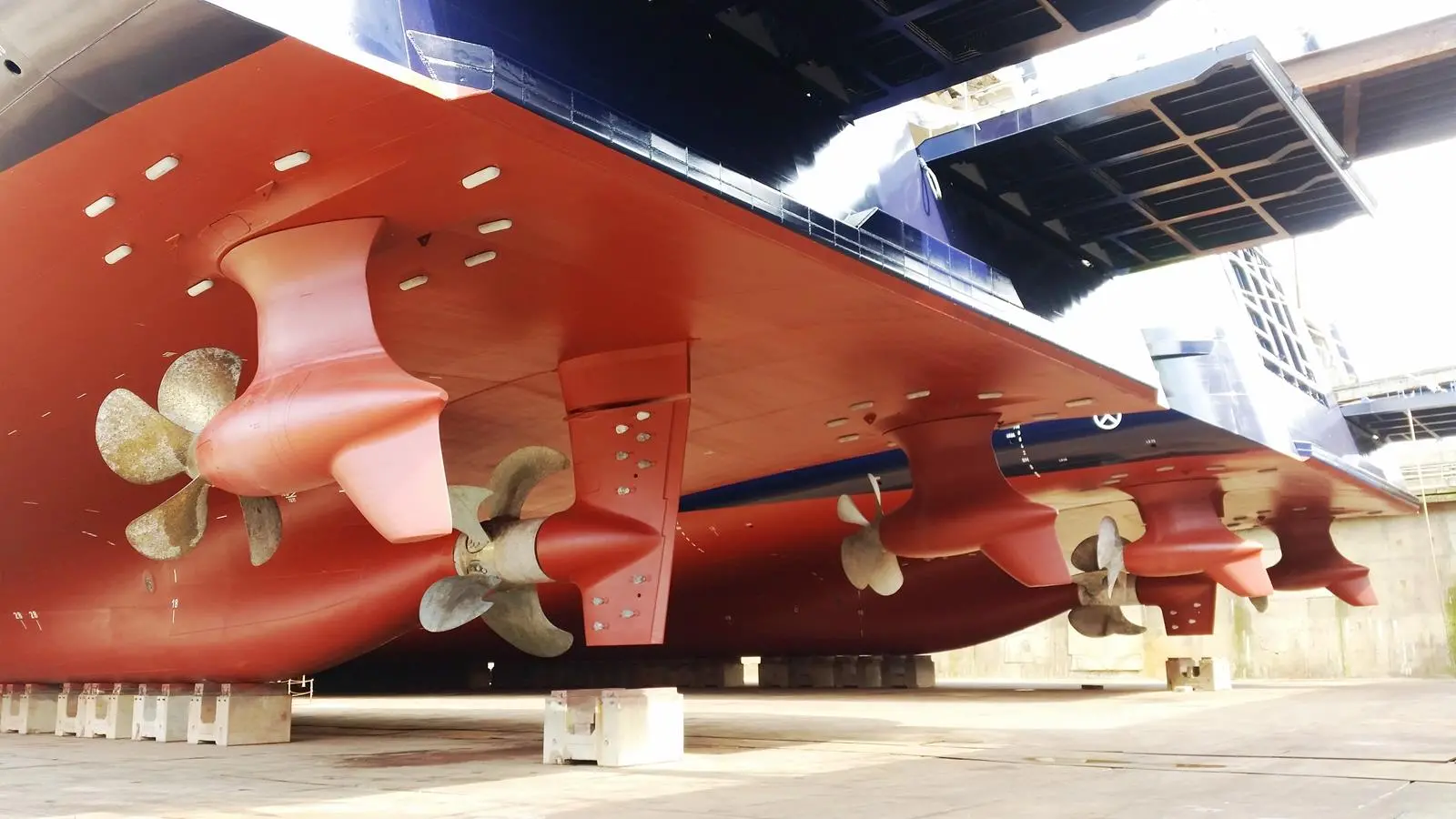
A handful of recent references indicate the trend may be on the rise again. Most high profile among those are two hybrid-propulsion, short sea passenger ferries launched (eventually) by Scandlines. The 169m loa, 5,000dwt duo Berlin and Copenhagen had a troubled start when their owner rejected delivery from original shipbuilder P+S Yards claiming the vessels were overweight, off-spec and too late.
Converted at Fayard in Denmark after P+S went into bankruptcy, the twins emerged 700 tonnes lighter, a lot slimmer and with lightweight new vehicle decks. Scandlines/Siemens Drive Technologies battery-driven hybrid propulsion systems with ESS energy optimisation and AEC Marine closed-loop scrubbers have also replaced the original MaK 9M32CCR diesels.
The new prime movers drive a propulsion configuration that features 13,500kW of central shaftline power, channelled to a controllable pitch propeller (CPP) with fully featherable blades, flanked by two Rolls-Royce AZP120 wing azimuth pods, also with CPPs. The total installed propulsion power of 22,500kW delivers a service speed of 20.5 knots.
Levander points to research conducted by Rolls-Royce and MARIN that suggests such a hybrid setup – central shaft line with two azimuthing thrusters – could offer power savings of 8-12% compared to twin screw configurations. That, he suggests, is the result of lower propeller loading, a favourable wake for the central propeller (as a result of the central skeg), and a clean wake for the wing thrusters. The two thrusters also offer excellent manoeuvring potential.
A similar set-up on Finnish Coast Guard patrol vessel Turva, delivered from STX Rauma, has resulted in a highly efficient ship with useful redundancy options. The 95.8m, 2,165dwt craft, which also holds the distinction of being the first Finnish vessel powered by LNG, entered service in 2014.
ADDED REDUNDANCY
In the aft engine room, a twelve-cylinder Wärtsilä 12V34DF producing 6,400kW is mechanically coupled to a CPP. In the forward engine room, two six-cylinder 6L34DF generating sets with an output of 3,000 kW each produce power for two electrically driven Rolls-Royce AZP120CP azipull thrusters. If the forward engine room is damaged, the shaft generator coupled to the bigger engine can be used to produce electricity for the azimuth thrusters, offering a valuable redundancy and safe return to port option.
While there are benefits to the central shaft line and twin azimuth approach, Levander believes that further advantages can be achieved for certain vessels through three shaft lines. Another study with MARIN suggests savings of 10-12% compared with a double shaft line.
“The centre shaft line would be located inside the centre line skeg, so no additional shaft support is needed,” note Levander. “The skeg is needed for course stability in a twin shaft vessel anyway, so the added resistance is minimal for a triple line arrangement. The benefit is getting 50% more propeller disc area, so lower propeller loading, which is important especially for vessels with restricted drafts. Also, the skeg in the centre will give an increase in hull efficiency for the centre propeller in terms of a larger wake coefficient.”
The central skeg in which the shaft line is located results in a high hull efficiency, notes Levander, with the main propeller adding very little extra drag. Another benefit is lower propeller loading thanks to the greater surface area of three rather than two propellers, resulting in high efficiency in open water.
Manoeuvrability can also be improved with the use of two rudders – or twin rudder-propeller units – to enable ‘crabbing’. Levander noted: “When a twin shaft vessel moves sideways in port, it uses only one propeller to create flow over the rudder in order to create lift force. The other propeller must reverse to keep the ship’s longitudinal thrust component to zero. In the triple screw case, both side propellers can be used to create side thrust and the centre propeller is reversing to keep the vessel in place. This will in effect double the rudder area creating the side force. It will also give redundancy for manoeuvring, so it can be possible to avoid stern tunnel thrusters in vessels that would otherwise need one. This will help to avoid added drag from tunnel thruster openings and keep investment costs down.”
OPTIMISED ENGINES
Machinery can also be optimised, with higher propulsion efficiency enabling fewer engine cylinders or less installed power. And the number of engines can be adapted easily for redundancy and safe return to port options, as in the case of the Tuva.
The choice of triple shaft line, or single central shaftline with azimuth pods, should be considered as potentially viable options for a range of vessels, Levander argues. One of Rolls-Royce’s Blue Ocean innovation team’s projects of late has been the design of a small-scale, expedition cruise vessel configuration. The designs include a predetermined technical specification and layout, scalable from 5,000-20,000gt and 4-11MW, to allow the owner to place their focus on architecture and passenger spaces. In the ‘lifecycle’ option, where initial investment is slightly higher in order to reduce operating expenditure (through greater fuel efficiency), the team has opted for a central shaftline to a large area propeller, complemented by twin Rolls-Royce azipull pods.
Triple shaft lines are not a new concept, but they have certainly fallen out of favour with ship designers. The few recent applications, and the fuel efficiencies suggested in model tests by Rolls-Royce, should at least reignite that interest.
Related Articles
 PROPULSION
 GENERAL NEWS
 GENERAL NEWS