



Six ideas for the evolution of shipping
The six concepts may never be realised but, according to Willie Wagen, director market innovation, Wärtsilä, they represent early thoughts about some very real challenges facing shipping.
“Innovation culture is very important to us and we have started to place some bets on what the future may be,” explains Wagen. “We are not certain, but we cannot afford not to place those bets.”
After consultation across Wärtsilä’s many departments in 2015, the company identified three key trends that are set to disrupt the industry. First and foremost among them was the emergence of green energy.
“At COP21 in Paris, 195 countries decided they wanted a cleaner planet,” recalls Wagen. “This will drive taxes, it will drive regulations, and there will be changes. Amsterdam wants to be emissions free by 2030, so does Copenhagen. On top of that I think people’s opinions are starting to change, and twill become more important than regulations.”
Increasing investment from the big automobile makers and universities supports the idea that green energy will have a key role in shipping in the future. General Motors has laid down US$4 billion to develop an electric car range, while Volkswagen is investing US$10 billion. At universities, where green energy has previously accounted for just 3-4% of research funding, the figure is now reaching 50% in places.
“These investments will drive technology,” says Wagen. “I believe this will lead us into green energy being cheaply available in the future.”
This appears to be happening already in the solar field, for example. Energy density of solar solutions, for a long time less than 10%, has recently reached 70-80% in laboratories. This means that a tanker equipped with solar panels across its length could travel at around 8 knots on a sunny day, says Wagen. At the same time, solar energy is becoming cheaper. A recent auction for a solar farm in Chile valued the energy to be produced at US$29.01 per megawatt hour – around half the price of energy produced at a traditional coal-fired plant.
Digitalisation was another key trend. “Sensors are becoming more intelligent, and connectivity is everywhere,” explains Wagen. “Sensors talk to systems, systems to ship and ship to shore. On top of this, more and more local decisions are being made by artificial intelligence.”
An offshoot of the digitalisation phenomenon provided inspiration for the third factor. The openness of information afforded by increased connectivity and computing power has enabled the emergence of the sharing economy – exemplified in the consumer market by the likes of Airbnb and Uber. “When information is freely available, the middle men lose their advantage and need a new business model,” Wagen explains.
As an example of the impact of open information on the shipping industry, Wagen cites the example of blockchain technology, web coding that allows the secure transfer of funds instantly across the internet. “It has long been said that shipping is the last business you need a fax machine to operate in,” says Wagen. That will change. Blockchain technology will offer total transparency on changes of title and ownership. In some cases in shipping today a piece of paper needs to change hands 30 times before a deal is completed. If you are still in the business, you will be using blockchain in 10 years’ time.”
From those three trends – green energy, digitalisation and the sharing economy – Wagen and his team devised six concepts, presented below. They may not be the ultimate answer to the challenges facing the industry, but they pose some early indications of the extent to which the industry must change.
For Wagen and Wärtsilä, the concepts also offer an opportunity to highlight the company’s approach to innovation. “We carry out small projects in a startup way – small and focussed, to prove that it works in the cheapest way possible. We also like to do this with customers and partners. So if there is an idea that companies cannot develop on their own, and they think they can develop that idea in partnership with Wärtsilä, I invite them to come and talk with us.”
CONVOY
By taking advantage of advanced controls and communication between autonomous components, systems, and vessels, shipping fleets could be operated in convoys. The fuel savings created by vessels closely following each other – between 10-20% according to Wagen – results from the lower entrance speed of water ahead of the aft vessel. By optimising the operations, Wärtsilä believes that significant fuel reductions could be achieved.
The company also envisions that fewer crew members would be needed for convoy ships through the use of system autonomy, artificial intelligence and advanced connectivity. Advanced communication technologies will also rapidly increase the sharing of information, which will save time and optimise the allocation of cargo to vessels.
ZERO: Floating distribution hubs
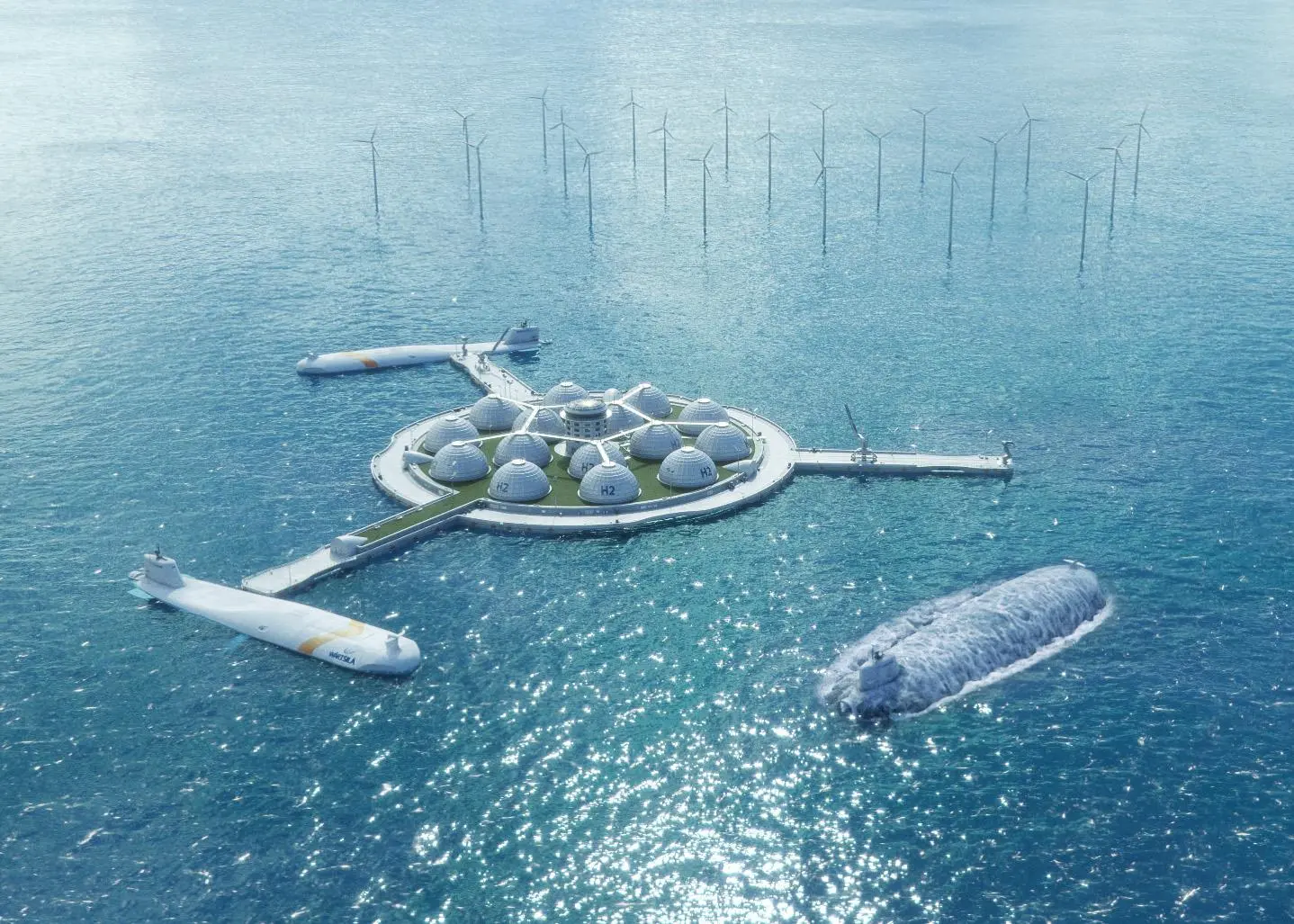
Another scenario imagined by Wärtsilä is to have artificial islands along the main shipping routes, producing emissions-free fuels from solar or wind for powering green energy sources. Clean energy production is becoming a global priority, and its influence on the shipping industry is expected to be felt more and more within the near future.
Wagen says: “The ultimate goal must be to have zero emissions in shipping. Maybe that can be achieved through artificial islands producing clean fuel – hydrogen, other distillates. At the same time you could distribute goods away from the shore, onto smaller vessels that come into the harbour, where you don’t want big ships. And maybe ships could sail under the surface, because that’s the most efficient way to move in the sea.”
EXERGO: Unlimited energy storage
Large investments will drive energy storage using battery technology. Wärtsilä believes that battery energy density will increase substantially during the coming years. This will allow ships to operate in sensitive areas silently and with no exhaust emissions.
“Imagine that you are working in the harbour in Hamburg,” says Wagen. “Imagine that a ship sails out of the harbour silently, with no visible smoke and no emissions. And it does so for a full 20 hour voyage. That will be possible in the near future with the increasing energy density of batteries.”
Z3: Green Energy
To provide reliable, emission free power without upfront investment, highly reliable energy sources and monitoring from the shore through advanced connectivity will be required. This concept envisions the supply of energy for propulsion on an ‘as you go’ basis.
“Imagine that you don’t need to own your own propulsion plant anymore,” say Wagen. “I’ll take out your old equipment, it’s polluting too much and can’t be used in port, and I will send in a new system. It’s clean, reliable and free – we only charge when you use it. That will take away your capex and your risk, and you pay as you go.”
LIITOS: Working together
For efficient cargo sharing, access to the same information by all global operators would ensure, for example, that no container ship sails cargo free. This sharing of assets could be achieved by use of a digital tool.
“When information is readily available, it is easier for new players to enter the market. Amazon and Huawei have already applied for shipping licenses. New players are coming,” warns Wagen.
BEAN to CUP: Manufacturing en route
Factory ships may one day be manufacturing while transporting materials from one market to another. Apart from saving valuable time, this concept could have substantial economic benefits. For example, coffee beans being transported to Europe and Asia from South America could be processed during the voyage so that the ready product is available immediately upon the ship’s arrival in port. Similarly, the quality of seasonal crops could be enhanced by having the ship begin processing soon after harvesting.
“We see this trend coming now in fisheries, where they produce the fish on the way to its destination, saving time to market, and also saving money,” Wagen reports. “The fish might be much fresher when it arrives and you might not need fixed assets like factories.”
Related Articles
 ALTERNATIVE FUELS & LUBRICANTS
 GENERAL NEWS
 GENERAL NEWS