



First movers flock to ferry market
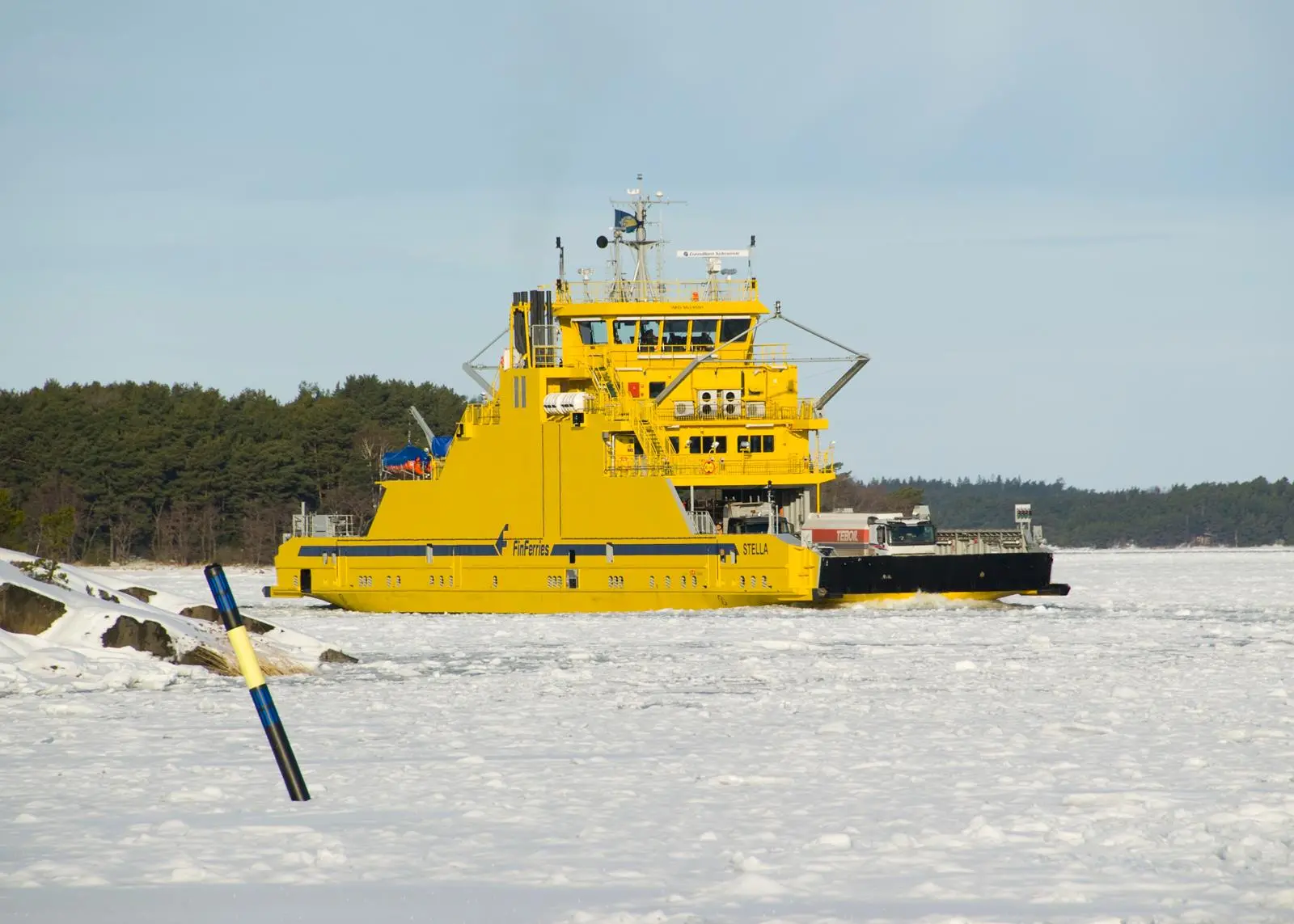
The fact that many ferries are small, cover relatively short distances and often operate within the jurisdiction of a single flag state make them fertile test beds for new technologies. And with passengers on board, safety is a priority. That combination of testing ease and safety focus mean that many systems trialled on short-sea ferries eventually find their way on to bigger, ocean-going vessels. The Interferry conference this year presented many concepts that may soon find favour beyond their debut shipping sector.
With an operating temperature of up to 1,400˚C, Clean Climate Technologies’ (CCT) thermodynamic energy drive – or TED – may not sound like an ideal prototype to test on a passenger ferry. But that is exactly what the company hopes to do after tying up with Australian naval architect Sea Transport in an exclusive deal that will see the technology implemented on future medium-speed ro-pax catamarans.
The concept behind the rechargeable thermal cell is surprisingly elegant. Electricity from the grid heats up the silicone core of the cell to over 1,300˚C, causing the material to begin to melt, and therefore store energy. Stirling motors then convert that heat to electricity via alternators.
The benefits of TED over lithium-ion systems are manifold, according to CCT founder Patrick Glynn. “TED has 2.5 times the energy density of lithium-ion, and we are aiming for a utilisation rate of 0.8, far beyond acid batteries. The beauty is that there is no reaction in the cell – it’s like boiling water and recondensing it. The Stirling motors too are a closed system with low rpm, which means a life of more than 25 years. For maintenance, the seals are replaced every two years and the elements every five years.”
TED also compares favourably in the cost per stored kilowatt-hour, at around US$100. It also offers a cost advantage in terms of raw materials. Lithium was trading at US$500 a tonne last year and, at US$900 today, is heading in a clear direction. TED’s main raw materials of silicone and (for the casing) graphite are far more abundant and affordable.
Glynn reports that the company is aiming for a 12-hour charging period and a 12-hour operating time – allowing for much longer journeys than current lithium-ion powered ships.
A hypothetical case study for a 50m vessel diesel-electric configuration, in which two 5MW/h cells (at US$800,000 apiece) replace two 485kW engines, would add around US$2 million the newbuild cost. An all-electric configuration would increase the extra cost to US$3.3. But reduced operating costs – around US$245,560 a year for a 50/50 hybrid and US$491,120 for an all-electric vessel – make it an enticing proposition.
With around 20 Stirling motors to a single cell, Glynn notes that the system offers impressive redundancy, and would be able to return home on a single cell. Also interesting is the company’s planned business model – it will eventually become an energy company, charging customers for the power they consume. TED has yet to find its first ferry reference, but Sea Transport CEO Stuart Ballantyne notes that several of the naval architect’s customers around the world have already expressed interest in the concept.
AUTOMATIC CROSSING
As reported elsewhere in this issue, Rolls-Royce has announced a major step forward in its automated shipping project with the sale of the first automatic crossing system to Norwegian ferry operator Fjord 1. On the day of the announcement Oskar Levander, vice president of innovation, was discussing the group’s perspective on automation at the Interferry conference.
Describing the new system, Levander said: “These two vessels will have systems where the captain takes them out of the dock and then presses a button and the ship makes the crossing. These are battery ferries, so you don’t want to waste time or energy and it is important to cross consistently in the most efficient way. Here we have used CFD to calculate what is the best way to accelerate and slow down the vessel – so it’s not just about the automation knowledge but also propulsion and hydrodynamic knowledge.”
Automatic crossing is just the first step in the company’s automation journey, and Levander noted that enhanced situational awareness – a fusion of camera, infrared, radar and lidar technology – would also be available next year. The company is already testing this concept on a Finferries vessel under the Finnish Advanced Autonomous Waterborne Applications initiative.
After automatic crossing and situational awareness come automatic docking, and then remote control followed by full automation. Ferries are the natural first references for all these technologies, Levander noted.
“The first movers towards autonomous shipping are really local ships – ferries and tugs for example -and these will emerge before 2020,” said Levander. “Then when we get international regulations in place we will move to ocean going vessels. But ferries are really a cornerstone in this because you only need the local support. They are the first movers.”
There are other reasons why ferries are showing the most interest in automation technology. “Ferries are under constant pressure environmentally,” Levander explained. “They need to reduce emissions and record and report it. Cost and safety are always concerns. And we also see that we need less variability in operations.”
Rolls-Royce’s technology might pave the way to automated ships, but it is worth noting that the systems it is creating also add value to manned vessels along the way. The automatic crossing system and sensor package under trial are prime examples. But they also go towards two other pillars of Rolls-Royce’s ship intelligence strategy: asset optimisation and operational improvement.
As Levander says: “Ship intelligence will give you more efficient and safe operation, but it can also help you integrate your ship crew and shore staff, integrate shipping more into the logistics chain and offer real transparency of your ship operations.”
WIRELESS CHARGING
While Rolls-Royce has made progress in automating the at-sea element of the ferry journey, a partnership between Wärtsilä and vacuum mooring specialist Cavotec is aiming to simplify the docking and charging process for electric vessels. Cavotec can boast more than 1,500 successful vacuum moorings since its first installation in 1999, and the elimination of ropes and bollards has clear benefits: a vessel can be moored in 30 seconds regardless of its size, saving on crucial time and energy for electric ships, as well as reducing wear on thrusters.
“You don’t want to be sitting in the berth churning away fuel, wearing out your engines for no good reason,” says Mike Howie, group product manager for MoorMaster at Cavotec. “We had one customer who had to stop eroding the seabed – they were losing the car park next to the ferry terminal.”
Another bizarre situation occurred when a ferry operator and terminal operator realised, while a vessel was en route to the port for redeployment, that the ship was about 25m too long for its berth. Vacuum mooring offered a solution, said Howie, ensuring that neither fender nor hull plating were damaged during what could have been a difficult docking.
Vacuum mooring on its own is ripe for further uptake, but becomes even more promising when combined with Wärtsilä’s induction charging technology, which has been tested over the last year and a half. It has been shown to provide power of more than 1MW, with losses of just 4% between induction plates more than compensated for by the rapid charging.
Harald Tillung, sales manager, Wärtsilä, explained: “There is a huge change going on in ferry operations, especially in Norway. Over the next few years more than 20 ferries will be built, all operated on electrical supply – either with batteries or as hybrid ferries. Wärtsilä saw this coming and started to design a complete new series of energy efficient ferries. If you start to operate on electricity or batteries, power consumption is extremely important, so we developed ro-ro ferries for 50-120 cars.
“When we started this business we saw that the challenge with battery operation is the charging of the batteries, so we started to develop a wireless charging system. We have been testing it for two years, but we didn’t have the mechanical part. Then we saw that Cavotec had an excellent vacuum mooring system, and with wireless charging it was a perfect combination.”
Wärtsilä has been operating wireless charging on a diesel-electric Norwegian ferry for the past eighteen months, with the onboard generators also charging the batteries and acting as ‘range extenders’, Tillung reported. The combined system will gain its first reference on a Norwegian ferry soon.
BENDING PROPELLERS
Returning to a pure propulsion topic, Takuya Tachikawa of Nakashima Propeller Co presented the latest advances in propeller technology, taking advantage of new composite materials to enhance hydrodynamic performance. The GPX propeller uses the composite material MFRP (metal and fiber reinforced polymer) instead of the usual nickel bronze alloy. The result, claimed Tachikawa, is a reduction in cavitation volume and hull vibration, with a corresponding increase in fuel efficiency.
The GXP propeller is based on three separate technologies. A special hub design (called non-hub vortex technology) reduces the hub vortex, recovering energy. The use of composite materials enabled Nakashima to reduce the size of the propeller blades by up to 20%, reducing cavitation and hull vibrations. And a flexible tip rake means that the ends of the propeller blades bend, improving hydrodynamic performance.
Nakashima has conducted both model and full-scale tests on a variety of vessel types that appear to confirm the efficiency gains. On a ferry test case – a 66.5m loa, 14.3m beam twin screw ferry operating a regular route in Japan – switching to GPX propellers resulted in a +4.3% increase in fuel efficiency over the course of a year.
OTHER INNOVATION
All the above technologies have the potential, in time, to be scaled up to larger vessels. But there were other innovations on display at the Interferry conference that may be
more specifically addressed to ferry challenges.
Ari Huttunen, head of ferry design at Finland-based marine engineering company Foreship, outlined the ‘much more demanding’ requirements being proposed under SOLAS 2020 for increased damage stability, including higher freeboard, wider beam and extra sub-division on vehicle decks. “The semi-watertight sub-division is effective but consumes vehicle space and harbour time,” he acknowledged. “Hopefully there is room to agree a workable solution, so I think we can still design a feasible ferry.”
Paivi Haikkola, head of R&D at naval architect Deltamarin, introduced her company’s concept of safe and affordable ferries purpose-designed for Far East markets. Taking account of the main reasons for incidents, she said the high freeboard designs combined sub-divided hulls, reliable propulsion with power margins for bad weather and passenger spaces that inhibited overcrowding while providing large mustering areas. By using popular steel profiles and locally sourced equipment, the vessels offered a valid compromise of construction and operating costs.
Gerd-Michael Wuersig, DNV-GL’s business director for LNG fuelled ships, described a unique solution for a dual-fuel ro-ro vessel being built for SeaRoad Shipping to operate in environmentally sensitive Australian coastal waters. The ship will store LNG in three aft-located road tank trailers that have been purpose designed as portable shipboard tanks. In 68 risk assessment scenarios, nothing had been found to prevent certification of the system.
John Waterhouse of US-based Elliott Bay Design Group said that new technologies such as alternative fuels and hybrid propulsion complicated the decision process. His company had run computer models of three machinery sets – diesel, diesel-electric hybrids and hydrogen fuel cells with electric propulsion – to compare capital costs, operating expenses and emissions output. He noted that ‘diesel-electric with a large battery began to move the needle on fuel savings with no great difference in costs compared with a small battery’ – but stressed that systems had to be matched to the route for optimal energy management.
Anti-fouling paint technology was discussed by Marilyn Bruno, CEO and co-founder of US company Aequor, which is developing a greener alternative to metal-based coatings that can be used alone or as bio-boosters to improve the performance of existing products. As she recalled: “We’re losing the war on bacteria and their biofilm protection mechanism, so we started by investigating what in nature inhibits the fouling of natural underwater surfaces.” Research found a new genus and several new species of marine microbes that produce non-toxic chemical agents with the ability to inhibit or remove 99.99% of fouling. Aequor has developed a portfolio of more than 40 structural analogues to test which chemical works best on each target – hulls, underwater gear, ballast tanks and water pipes. The company is now planning pre-production pilot tests, including trials with the US Navy.
Related Articles
 ALTERNATIVE FUELS & LUBRICANTS
 GENERAL NEWS
 GENERAL NEWS