



Ramping up for BWM installation
Christmas came early for the first three BWMS suppliers granted USCG approval – but only just. Having confidently expected its approval before the end of the year, on 2 December Optimarin received certification for its OBS system. Three weeks later Alfa Laval and Ocean Saver followed.
Two of the three suppliers have already received orders as a result of the approval. Norwegian UV system supplier Optimarin has signed a new agreement with Fincantieri Bay Shipbuilding (FBS) in Sturgeon Bay, Wisconsin for the delivery of two 500m3/h capacity Optimarin Ballast Systems (OBS). The agreement, which follows an earlier deal with FBS, will see both systems installed on an 155,000-barrel capacity clean products barge, with delivery scheduled for August 2018.
CEO Tore Andersen notes: “We were already busy, but since [approval] enquiries have gone through the roof and our order pipeline is developing at a rate that has surprised even us. We expect to have more orders to announce in the very near future.”
Meanwhile Alfa Laval, which received US type approval on 23 December, reported that its PureBallast 3.1 system has been selected by STAMCO Ship Management “as a direct consequence” of the USCG certification. The agreement for 11 retrofitted systems on ro-ro vessels is expected to generate orders worth around €2.2 million, to be booked in the first quarter of 2017.
Anders Lindmark, head of Alfa Laval PureBallast, Alfa Laval Marine Division, adds: “This order is directly tied to the USCG type approval of PureBallast. Since the type approval was announced, Alfa Laval has seen a clear increase in the number of inquiries about the system.”
LINING UP FOR USCG
The sales boost is understandable: USCG type approval, combined with earlier IMO approval, means that these systems are to date the only ones that can guarantee compliance under the global ballast water management regime. They will soon be joined by others. The USCG reported that it had received its fourth final application for approval in January, from China Shipbuilding Industry subsidiary Sunrui Environmental Engineering for its BalClor electro-chlorination system.
More companies have also set their sights on USCG approval. Among them, Hyde Marine will be starting stain testing of its UV system this month, reports senior market manager Mark Riggio, and expects to submit final approval to the USCG later this year. Like many other suppliers whose systems use UV to disinfect ballast water, the company was dealt a blow last year when the Coast Guard rejected the ‘most probable number’ (MPN) sampling method, and is now making up lost ground.
“We worked with the Coast Guard for three years getting the MPN method approved and fully completed our testing using this internationally approved method,” says Riggio. “[Their decision] required us to invest more than US$2 million in additional testing costs and impacted out our type approval timeline by at least 18 months.”
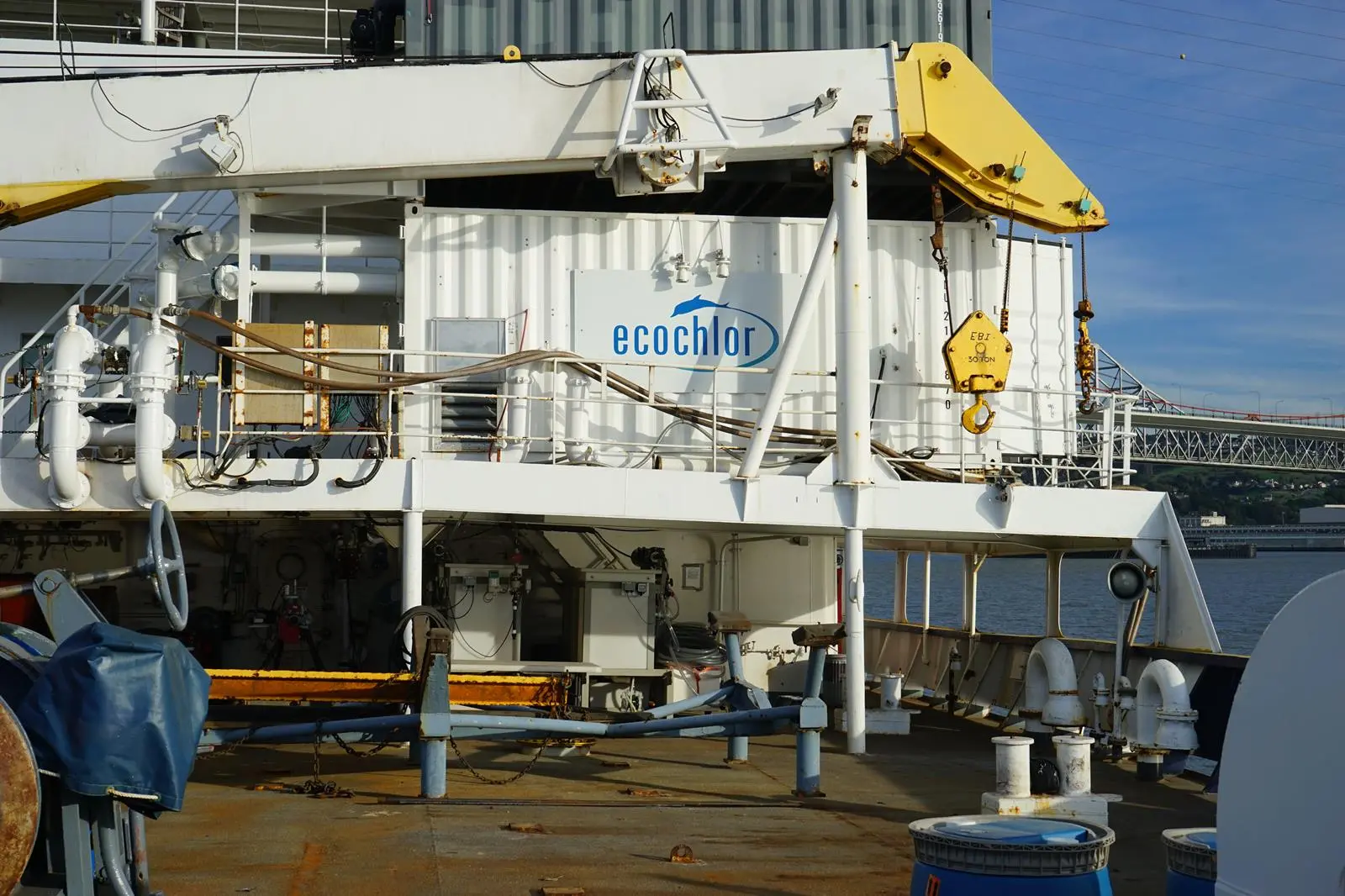
Another company to have invested significantly towards USCG type approval is Ecochlor. Its system injects chlorine dioxide (an environmentally friendly biocide) into ballast water and is distinct from the more widespread electrochlorination method which runs an electric current through salt water to produce chlorine as disinfectant. While the Ecochlor system demands expenditure on chemicals, the twice yearly re-supply is less onerous than that needed for neutralisation chemicals used by electrochlorination systems. This, the low power demand needed and the fact that the generator does not need to be scaled up for bigger flow rates mean that total costs are very competitive on larger vessels.
Tom Perlich, president, Ecochlor notes: “[Working towards USCG approval] has been a costly and time-consuming process. We have spent almost three years [on it] and expenses for testing and services have reached US$3.3 million, with almost US$700,000 for building the BWMS, installation and labour.”
Ecochlor and independent laboratory DNV GL are currently finalising reporting and documents used in support of USCG Type Approval. Upon completion, DNV GL will issue a recommendation to the USCG and Ecochlor will submit an official application to the USCG. Ecochlor anticipates applying to the USCG in the first quarter of 2017.
MEETING THE NEW G8
Even after approval, challenges remain. For Alfa Laval, the first obstacle has been to ensure that the approval applies across its whole system range. The current approval includes PureBallast 3 systems with 100m3/h and 300m3/h UV reactors, and Alfa Laval has reported that it expects approval for the 170m3/h and 600m3/h reactors soon.
“The delay between approvals is due to the evaluation of the mathematically modelled reactor scaling, which is a new process for the USCG,” the company notes. “Additional time is needed to review the already completed verification from the independent DNV GL lab.”
The next challenge on the horizon is compliance with the IMO’s amended G8 guidelines on testing and approval, completed by the Marine Environment Protection Committee last year and awaiting final approval at this year’s meeting. Pending final tests for biological efficacy, Alfa Laval anticipates a completed application for an updated G8 certificate in the first half of 2017.
“The USCG test protocols are generally perceived as more rigorous, standardized and transparent than the G8 guidelines,” notes Ecochlor’s Perlich. “The expectation in the industry is that if a BWMS can pass USCG type approval then it will be accepted by a revised G8 criterion. Ecochlor does not expect any delay in bringing a system to market under the new G8 guidelines.”
Hyde Marine, which has been part of the correspondence group during the G8 updating process, does not anticipate any changes to its testing process, which Riggio says will meet or exceed the new G8 requirements. “We expect we will be able to bring testing compliant with the new G8 guidelines to an administration immediately after they are finalised,” he confirms
TIMING ISSUES
Another challenge remaining is the installation timeframe required under the IMO’s BWM Convention, which comes into effect on 8 September. After that, vessels will be required to install systems on the first subsequent renewal survey for their International Oil Pollution Prevention (IOPP) certificate, But a proposal being considered by IMO to take into account both drydock congestion and the new G8 guidelines would allow vessels whose compliance dates fall within two years after entry into force to comply only after their second IOPP renewal survey.
Perlich says: “We are hopeful that the next MEPC meeting will provide the needed clarity to the industry by establishing firm requirements for ship owners and operators. The USCG has approved systems and more are in the queue, including Ecochlor. These systems will provide the assurance to the industry that they are purchasing systems that will meet not only USCG standards but the revised G-8 guidelines. There is no reason to delay in solving this global environmental problem.”
“Our opinion is that there are sufficient equipment providers and sufficient resources to implement the IMO convention at this time,” agrees Hyde Marine’s Riggio. “Many systems can be installed within the framework of a normal drydocking period with proper planning and preparation.
Hyde Marine is focusing on three key aspects to help our customers meet the implementation timelines. It is working with installation, engineering and shipyard partners to make sure they have all the information and details needed to install its systems with a minimal amount of rework; working with customers to sign frame agreements with fixed pricing to ensure they have equipment available for installation in accordance with their drydock schedules; and standardising its equipment, with ‘fast track’ systems in stock for owners who need systems delivered in a short time frame.
Ecochlor is also investing to enable smooth installation processes for its customers. The company can build 150 to 180 systems a year, and last year its manufacturing and engineering teams standardised processes and pre-fabrication procedures to make it easy to ramp up production as needed. Although the Ecochlor unit is a simple system, with many standard components that can be pre-fabricated, installation still requires some thought on the part of owners, says Perlich.
“Shipowners should be aware of the complexity of a retrofit beyond choosing a treatment system,” he explains. “They need to allow time not only for shipyards for the installation, but also for engineering services with firms that are experienced in BWT installations, as well as for design review and compliance with classification and flag Societies.”
The early winners of USCG type approval may be earning an initial bump in orders, but preparation for potential installation challenges will be crucial as international regulation begins and the fledgling industry reaches maturity.
To find out more about the forthcoming Ballast Water Convention, book your place at the Motorship Propulsion & Emissions Conference which will feature a session on the Convention.
View the full programme online here now!
The early bird delegate rate is currently available. Book your place now to save 20%.
The annual Motorship Propulsion & Emissions Conference is recognised as the most technically informative as well as the longest established conference for the global shipping industry. For further information contact the Events team on +44 1329 825335 or email conferences@propulsionconference.com.
Follow the event on Twitter: @PropulsionConf
Related Articles
 ALTERNATIVE FUELS & LUBRICANTS
 GENERAL NEWS
 GENERAL NEWS