



Successful Remote TA Test for MAN L23/30H Mk3
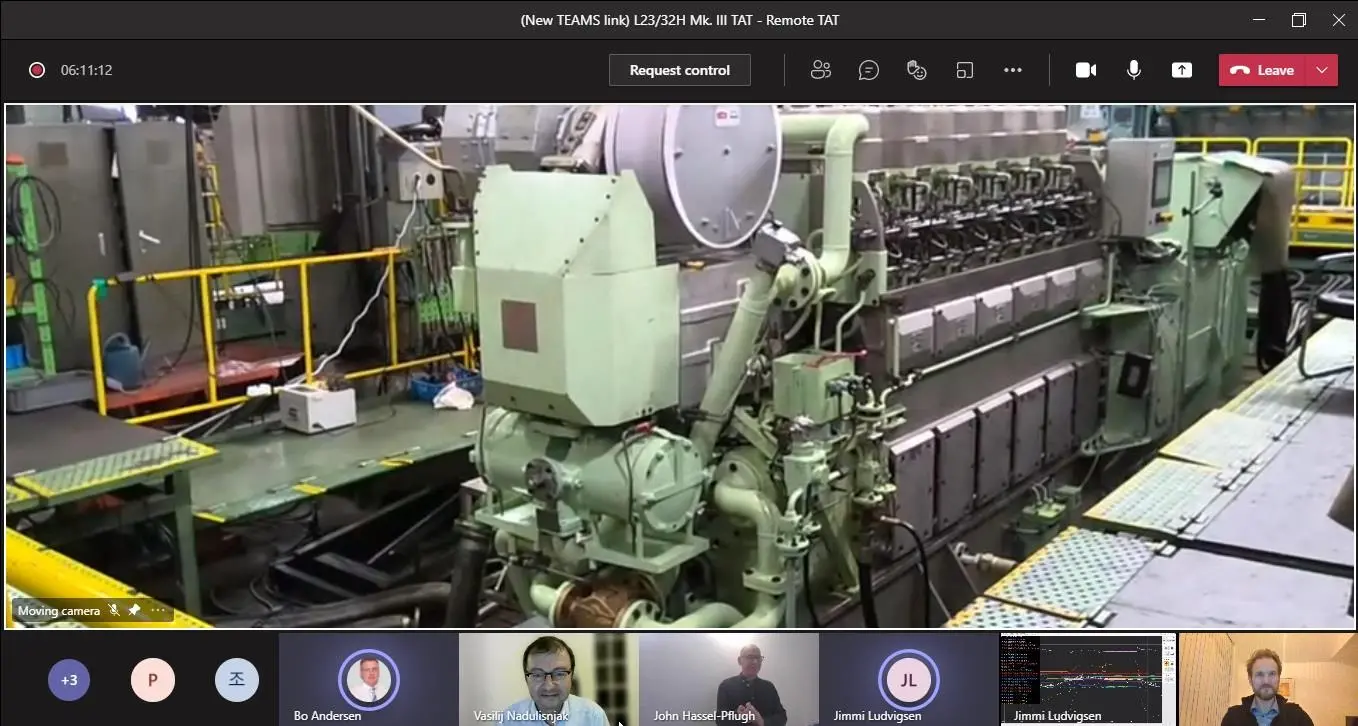
Owing to current Covid-19 restrictions, the TAT was executed on-site in Korea in early March 2021 by STX and MAN Energy Solutions staff. The event was filmed and broadcast globally with viewers watching from Europe, North America and Asia.
Finn Fjeldhøj, Head of Small-Bore, Four-Stroke Engineering, MAN Energy Solutions, said: “TATs are an important step in the entry of every engine to the market. The fact that we could surmount the difficulties posed by the global pandemic with a remote solution to successfully get the engine approved is very pleasing. The experience gathered from this event will prove invaluable in the future.”
MAN Energy Solutions’ Christian Rasmussen, Head of Classification Department, said: “Planning for the event began already in the summer of 2020 as a second wave of the virus hit and travel restrictions began to affect logistics. In response, we initiated a series of meetings with six major classification societies to investigate the possibilities for a remote type-test. Stemming from these, we developed a framework to successfully execute the TAT.”
MAN Energy Solutions has also initiated a project with classification society, ABS, to further refine the structure of remote tests. This particular project is expected to conclude during 2021, after which the company expects to have defined an optimal flow for remote TATs.
First order
Daehan Shipbuilding already ordered the first three 6L23/30H Mk3 GenSets for an Aframax crude tanker newbuilding, under construction for Atlas Maritime, the Greek international shipping company. The order includes an option for a further three Gensets. The engines will achieve Tier III emission levels with the aid of SCR, and are provisionally scheduled for delivery in August 2021.
Applications for the engine include tankers, bulk carriers and product tankers as auxiliary engines, with some sales as prime movers for fishing trawlers and power plants. The engine is mostly diesel-driven, with LNG and bio-oil also used in special environmental areas.
Compared with the preceding Mark 2 variant, the L23/30H Mk3 engine has increased power output of 15%. The engine also features reduced fuel-oil consumption, the longest TBO in its class, an improved conrod design and a two-part piston design for fast maintenance.
Related Articles
 PROPULSION
 GENERAL NEWS
 GENERAL NEWS