



ABB launches new Dynafin propulsion concept, targets 2025 for full scale prototype

Janne Pohjalainen, Global Product Line Manager for Dynafin™, ABB Marine & Ports, explained that the new propulsion concept was expected to lead to “a revolution in propulsion efficiency” in an interview with The Motorship.
Cycloidal propulsion concept
While the propulsion concept represents the culmination of over a decade of research, it is radical, innovative, and inspired by millions of years of evolution. “We have not invented anything new,” Pohjalainen added.
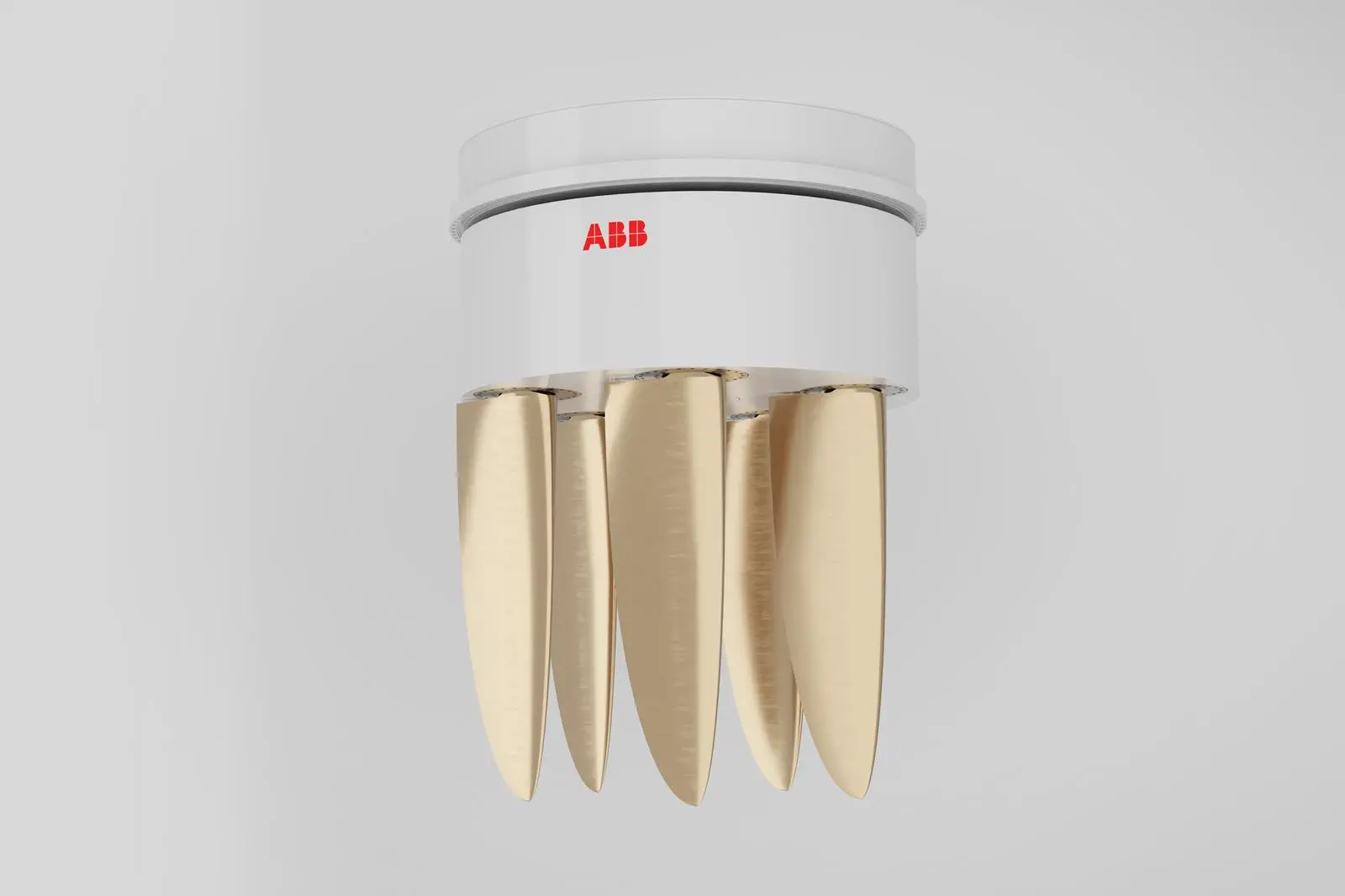
The Dynafin cycloidal-type propulsor solution mimics the movements of whale tail. The concept has been extensively tested, and a scale model has been tested in lake trials.
The first full-scale prototype is estimated to be available in 2025, followed by the first pilot installations being undertaken with customers.
Radical efficiency gains
Based on modelling and pre-launch studies, the Dynafin concept is expected to achieve an open water efficiency level of up to 85%. Translating the open water efficiency into a fuel savings, ABB expects to be able to deliver a fuel consumption saving of 15-20%, if not slightly above 20%.
“An independent study has produced fuel reduction estimates as high as 22%”.
Target segments and vessels
Initially, ABB is understood to be focusing the development of Dynafin propulsion units with a capacity of 1-4MW per unit.
“We are looking at the ferry and car passenger segments, as well as mid-sized cruise vessels, as well as the offshore and energy segments. Other vessels, like yachts and research vessels are also possible, but we are focusing on unit power one to four megawatts, initially.”
ABB is also exploring the possibilities of extending the power range to a higher level at a later stage. In terms of developing higher capacity units, Pohjalainen noted that there were no inherent limitations that would restrict the scope of the propulsion concept, but added that higher capacity units might require the deployment of new technologies and materials to overcome existing technical constraints.
ABB has identified also the retrofit market as an interesting market, given the existing pressures on ship owners to meet upcoming standards.
Regulatory environment
One of the other areas of focus relates to the development of rules governing the cycloidal-type propulsor solution for maritime propulsion. “I think it is one key topic for us to have early involvement and cooperation with the classification societies. We are already holding discussions with classification societies on the topic. It will need some new interpretations and will culminate in the creation of the rules.”
Pohjalainen stressed that ABB was working closely with a number of class societies to ensure that with an estimated interval of two years before the first full-scale trials of the propulsion solution.
Servicing and maintenance model
Pohjalainen added that ABB was already paying attention to the potential servicing and maintenance model. The main components of the propulsion concept itself are expected to be accessible from onboard the ship, which is expected to support a good level of serviceability for the product.
The solution is expected to compatible with a modular spare part distribution model, unlike existing propellers which tend to be supplied on a tailor made basis.
This means that the service and maintenance model might be almost as transformational as the propulsion solution itself, Pohjalainen said.
The Motorship notes that previous research into cycloidal propellers has identified the possibility of reducing cavitation on the propulsor blades, which is associated with an expected reduction in Underwater Radiated Noise (URN).
Vessel control integration
The propulsion concept also offers faster responsiveness from the thrusters, which is expected to lead to enhanced manoeuvrability and control. This is expected to be particularly attractive to ship owners operating or leasing vessels operating in dynamic positioning (DP) mode.
This is expected to directly impact vessel availability in the offshore support vessel segment, which impacts a vessel’s value.
The improvements to ship handling would be felt in all the customer vessel classes, but ship crew should benefit from the ease of integration into ABB vessel control systems.
Energy management aspects
One of the technical challenges of cycloidal propellers is the need to manage fluctuations in the power demand as the oscillating propulsor moves through the water.
Such fluctuations in the transient power loads required to optimise the dynamic thrust provided by the oscillating propulsors require advanced power management concepts, as well as advanced control system integration.
“As a leading edge supplier of solutions for vessel energy management solutions, this is part of ABB’s core competencies.”
Potential areas for future optimisation
Pohjalainen concluded by outlining that it might take some time before the effects of the new propulsion concept are felt fully around the industry. “During our early outreach with vessel designers and naval architects, we have seen some potential for hydrodynamic optimisation, which might allow even further advances.”
The improvements in vessel efficiency will permit vessels to lower power demand, leading to the possibility of reducing the size of installed engines, and optimising the size of fuel tanks and energy storage system (ESS) to meet lower power demand requirements. Pohlajainen added that the compressed footprint of the unit, and the comparatively limited requirements for auxiliary units, may also allow naval architects to optimise cargo capacity within a given vessel envelope.
“However, there are certain characteristics in this propulsion concept which may allow designers to really think outside of the box and then there may be some completely new types of vessel. By which I mean, vessel level designs and concepts which this technology might actually be one of the main enabling technologies.”
Dynafin Functionality
The new propulsion concept features a main electric motor that powers a large wheel rotating at a moderate 30-80 rounds per minute. Vertical blades, each controlled by an individual motor and control system, extend from the wheel. The combined motion of the wheel and blades generates propulsion and steering forces simultaneously, enabling high levels of operational efficiency and precision for ships. The concept follows ABB’s proven design philosophy in marine propulsion of gearless power transmission. As part of an electric propulsion power system, the concept is also fully compatible with zero-emission battery and fuel cell technologies.
Related Articles
 ALTERNATIVE FUELS & LUBRICANTS
 GENERAL NEWS
 GENERAL NEWS