



ABC marches up power band with IMO III-ready solution
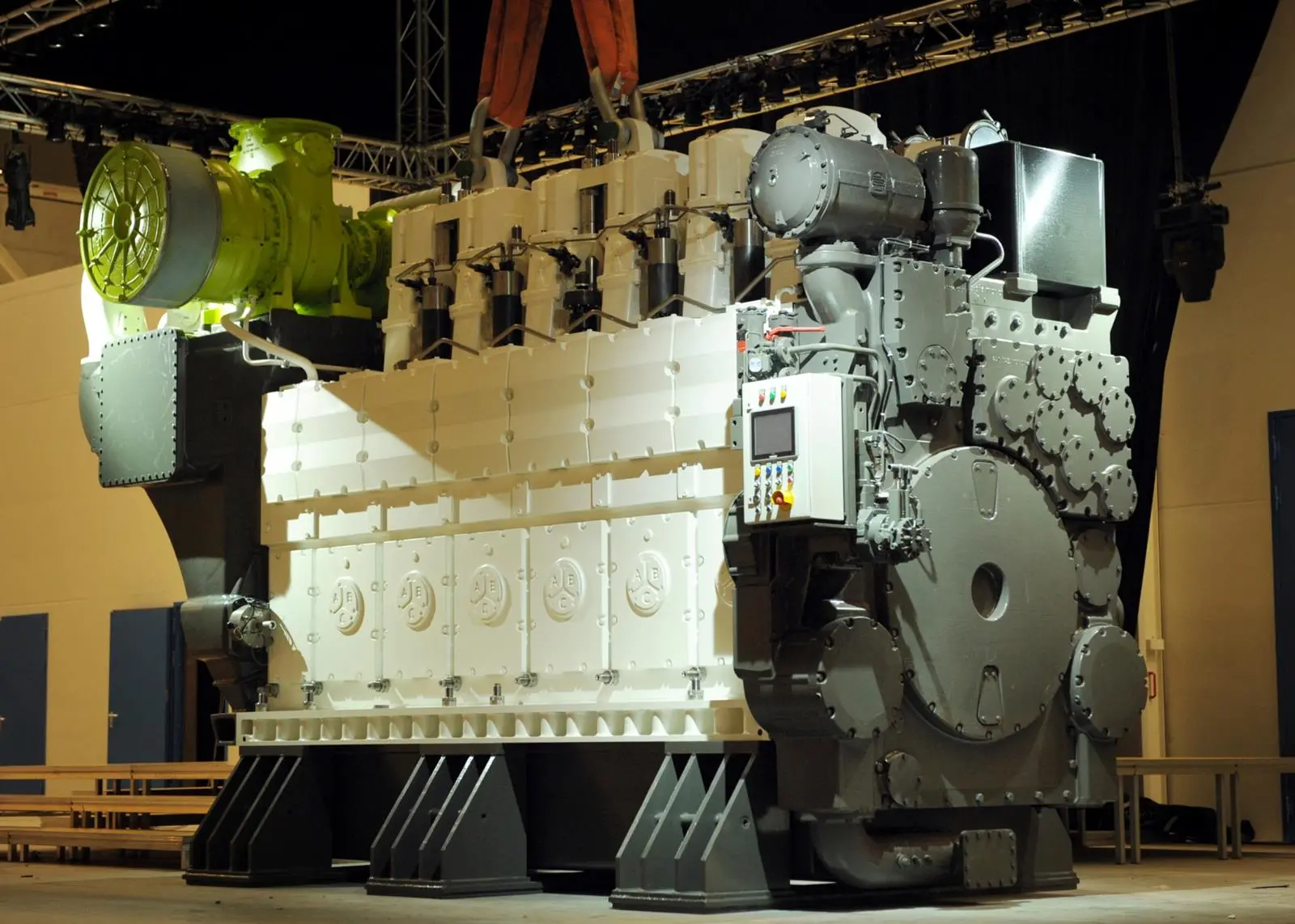
Long-established, predominantly and necessarily export-orientated, and a champion of local employment and in-house or otherwise European component sourcing, medium-speed specialist Anglo Belgian Corporation(ABC) has demonstrated its innovative capacity with the high performance, environmentally-attuned D36 engine range.
The new generation considerably extends the company’s market reach as regards both power concentration and fields of application, and offers IMO Tier III NOx compliance without the added expense of aftertreatment.
Although first announced a year ago at the SMM Exhibition in Hamburg, a detailed presentation at May’s CIMAC Congress provided many further insights into the development of the meticulously crafted addition to the Ghent factory’s production programme. The quality and content of the paper The CRISTAL engine: ABC’s new medium-speed diesel engine, developed to comply with IMO III, prepared by personnel from ABC and Ghent University, was such that it received the 2013 CIMAC President’s Award, which recognises practical contributions to the future success of the engine industry. The authors of the paper were Lieven Vervaeke and Tim Berckmoes of Anglo Belgian Corporation and Sebastian Verhelst of Ghent University.
In its reference to the ‘Cristal’ engine, the title of the paper used the acronym for the latest cooperative endeavour of ABC and Ghent University within the framework of the ‘Clean Reliable Innovative Sustainable Two-stage Alternative Line’ engine research project. Partially funded by the Flemish Agency for Innovation by Science and Technology (IWT Vlaanderen), Cristal focused on developing tools to create the D36 engine. The project is also directed at the adaptation of one of ABC’s older engine types, the DZC, to meet new emission legislation.
The engine maker has a long track record of research collaboration with the university’s Transport Technology group, which is skilled in devising engine simulation tools, and whose test resources were strengthened several years ago by the commissioning of the Ghent University Combustion Chamber 1, known as GUCCI. With optical access in two directions, and conceived for medium-speed engine investigations, the constant volume combustion chamber enables visualisation of fuel spray and combustion characteristics under engine-like conditions, and has been used extensively in the Cristal project.
The D36 has a cylinder bore of 365mm and piston stroke of 420mm, and delivers a maximum 650kW per cylinder at 750rpm. Since the series will encompass eight- and nine-cylinder in-line and subsequently also 12- and 16-cylinder vee-types, the new breed will cover maximum power outputs from 3,900kW to 10,400kW. The company’s largest prime mover hitherto is the 16-cylinder model of the DZC type, turning out 4,000kW at 1,000rpm.
The basic design is foreseen for operation at different speeds on nominal torque, thereby conferring a high degree of flexibility as to type of application, and reflecting ABC’s diversified business profile. However, while the company is very well established in the power generation, rail traction and industrial markets, its oldest and largest business area is the marine market, and the D36 generation affords the means for deeper and wider penetration of the shipping sector.
“The main market for this engine is foreseen to be in propulsion, and in both marine and stationary generator applications,” the CIMAC audience was told. “With this market target, the nominal engine speed was set at 750rpm, and a power output of 10MW should be possible with one engine unit. To continue our history of building robust and reliable engines, we have set a moderate piston speed of 10.5m/s and a BMEP of not more than 24 bar. With these boundaries, the bore and stroke are defined, and as a next target we have set the design firing pressure for the engine at 240 bar.” While the normal firing pressure will be around 210 bar, the higher pitching of this key criterion affords an ample design margin for the future.
The adoption of an optimised common-rail system, two-stage turbocharging and integral exhaust gas recirculation (EGR) will allow the DL36 to meet IMO Tier III NOx emission criteria without the need to incorporate SCR and with negligible adverse effect on fuel consumption. Where the IMO Tier III standard is not required, a full mechanical version will remain available. Dual-fuel, tri-fuel and biofuel variants are foreseen.
The applied turbocharging technology emanates from KBB (Kompressorenbau Bannewitz). The German specialist developed new low-pressure and high-pressure turbochargers to provide a two-stage turbocharging arrangement. The integration of EGR with the charging system makes for a unique configuration, dubbed the Eureka concept. Like ABC, KBB is owned by the Luxembourg-based Ogepar Group.
Despite the need to incorporate high-tech systems on the engines, a key target from the outset was a comparatively simple design configuration offering ease of maintenance. “We have always seen the engine as one compact unit, with the emphasis on short length, and without the need to install additional emission aftertreatment next to the engine,” said ABC. “The results of long-term investigations into the injection and combustion process have been implemented so that the emission reduction is being executed in the heart of the engine: the combustion process itself.”
It is anticipated that the first production engines, in six-cylinder format, will be ready for delivery before the end of 2013, followed by eight-cylinder models in 2014.
Related Articles
 PROPULSION
 GENERAL NEWS
 GENERAL NEWS