



ABS LISW event identifies decarbonisation challenges
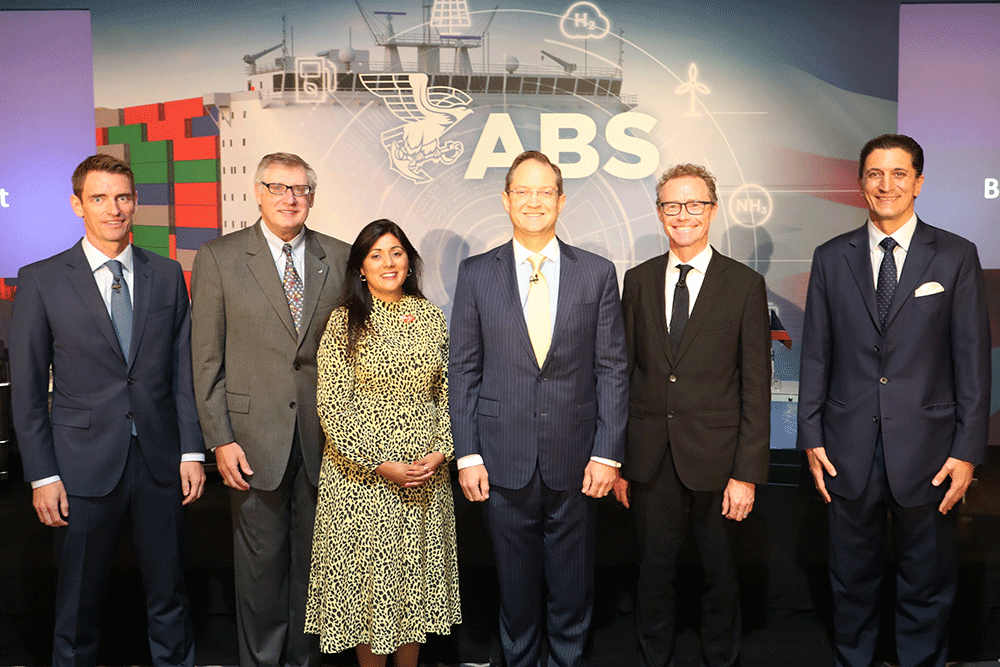
The panellists included Andrian Dacy, CEO of JP Morgan Global Transport; Rasmus Bach Nielsen, Global Head of Wet Freight at Trafigura and John Radziwill, CTM CEO. The panel held a wide-ranging discussion on the decarbonisation challenge facing the industry over the next 30 years to meet with ABS Chairman, President and CEO Christopher J. Wiernicki.
The panel offered on insights on how new technology can make shipping more efficient, new and existing alternative fuels, carbon emission reduction strategies, sources of finance in a decarbonizing economy and the impact of shipyard consolidation on new vessel designs.
The panel provided an interesting mix of near-term practical solutions, with a particular emphasis on the environmental benefits offered by slow steaming, and the transformational changes that the process of digitalisation will have for the industry. Wiernicki identified significant efficiency gains covering crew costs, daily operating costs, maintenance costs, technology running costs and more. The introduction of sensor packages as standard for newbuildings from one shipyard would permit the use of condition monitoring systems, Wiernicki added.
There was less consensus around the issues of a carbon tax, which divided the panellists with Dacy highlighting the uneven record of the European carbon emissions trading scheme. The Poseidon Principles also provoked prolonged discussion, with the scheme’s scope and methodology attracted criticism. However, Dacy warned: “There is not one institutional investor in the west that is not thinking about the ESG (Environmental Social Governance) Agenda and the ESG status of their investments. The reality is that the largest pools of capital have made sustainability a priority. These issues may not trickle into your business straight away but capital moves the market and CIOs or finance executives are all thinking that way. It’s part of the broader conversation in the industry.”
A separate area was the increasing focus on recording and capturing environmental emissions: Rasmus Bach Nielsen noted that Trafigura was asking ship owners to report the CO2 used during the transportation of a commodity. Panel moderator Julian Bray of Tradewinds noted that some UK-based companies are currently opting to report the CO2 emissions generated during different stages of commodity extraction and delivery, including seaborne transportation.
By comparison, there was less consensus around the technological solutions to reaching the IMO’s 2050 goals, and there was no discussion of fuel cells or battery hybridisation. Wiernicki stressed that the future was likely to see a combination of different fuels, as part of a solution, while Rasmus Bach Nielsen stressed that the low emissions generated during the production of ammonia from wind power meant it may represent an attractive solution in “two to three years”.
Related Articles
 ALTERNATIVE FUELS & LUBRICANTS
 GENERAL NEWS
 GENERAL NEWS