



Airmax prototype demonstrator airborne
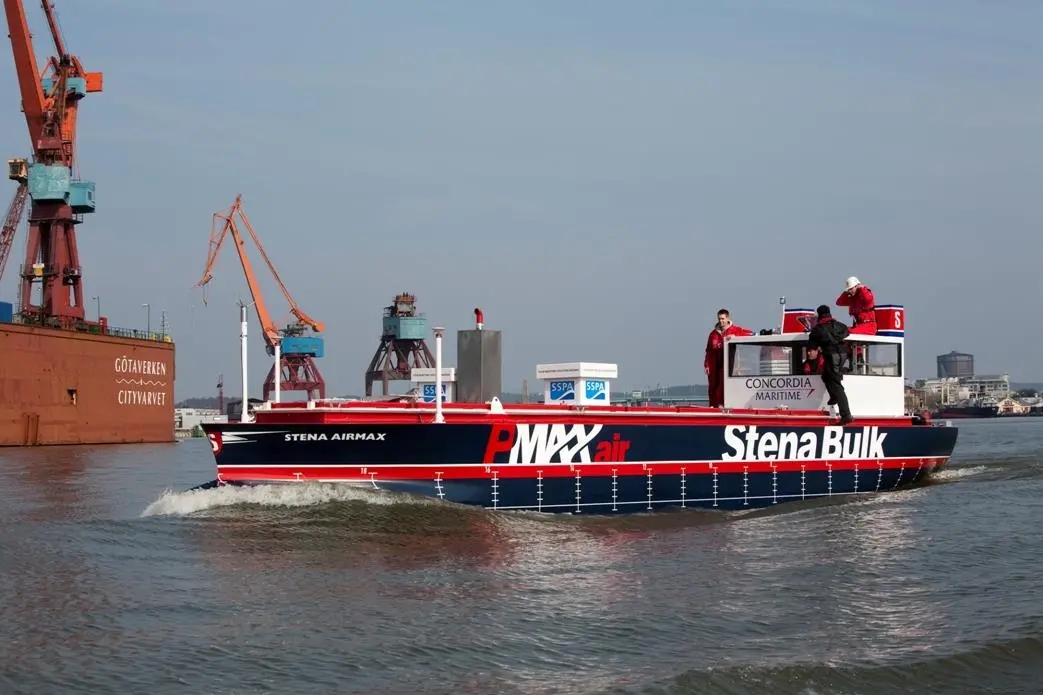
Stena will invest in the region of SEK 50 million in the project. Following the very good results achieved in tests with small ship models, Stena Teknik has developed this large-scale model weighing 25 tonnes. The same tests will now be carried out with the Stena Airmax.
Five years ago, Stena Teknik initiated a development project in order to find a method of reducing a ship’s water resistance, thus radically reducing energy utilisation and fuel consumption of large tankers in the future. “The results of the tests carried out are very promising. Depending on the type of ship and speed, we expect energy savings of 20-30 percent. This will now be verified in tests with the newly built prototype
Stena Airmax
”, says Ulf G. Ryder, president and ceo of Stena Bulk.
Stena Teknik has co-operated with Chalmers University of Technology and SSPA in Gothenburg in the development project and the construction of the P-MAXair model. The
Stena Airmax
will be tested in the Gullmars Fjord on the Swedish West Coast, during spring 2010 when extensive test-programmes will be run. The model will be powered by electric motors during these simulations.
The concept involves reducing the ‘wet surface’, i.e. the part of the hull that is in contact with the water, thus slowing down the ship. This is achieved by means of a cavity filled with air in the bottom of the hull. This means that the water is in contact with air instead of steel plate, thus reducing friction. This may seem simple, but a number of phenomena complicate the picture. These include internal wave formation in the cavity, which reduces the positive effect. A balance must also be struck between optimising the air pressure to achieve the greatest possible reduction in resistance and, at the same time, minimising air leakage.
Testing ship models in test basins has a long history and the technique of scaling up the results from a model to an actual ship is well known. However, Stena’s project is different in that air is also involved. There is no previous experience of the effect of the air when a model is scaled up to full scale. Building a ship based on normal model tests of a 4m long model would have been very risky.
Accordingly, Stena decided to build a 1:12 model, i.e. a 15m long model, to verify that the results achieved also applied on a larger scale. This has never been done before. Testing the air regulation system will also be an important part of a future project.
Stena has applied for a patent for the wide and flat bulbous bow, which facilitates a favourable water flow below the hull.
Related Articles
 ALTERNATIVE FUELS & LUBRICANTS
 GENERAL NEWS
 GENERAL NEWS