



Ammonia cracking project will focus on cost and reliability

The APOLO project, (Advanced POwer conversion technoLogies based on Onboard ammonia cracking through novel membrane reactors), got underway on 1 January 2024. The project will develop technology solutions for using ammonia as a hydrogen carrier on commercial ships. It will demonstrate power conversion from commercially available fuel cell systems and will test an ammonia cracker coupled with a novel ammonia engine running on an ammonia/hydrogen blend.
The project received more than 7.5 million Euro through the European Climate, Infrastructure and Environment Executive Agency. Partners in the project include Corvus Energy, H2Site, Tecnalia, Eindhoven University of Technology (TUE), 1 CUBE, Chalmers University of Technology, Nuvera Fuel Cells, shipyard Astander, hydrogen and ammonia producer Fertiberia and LEC GMBH.
The consortium will specifically focus on showcasing:
i) a 125kW power conversion system that utilizes an ammonia cracker coupled with a PEM fuel cell system, achieving an overall system efficiency of 51% to 54%. The ammonia cracker will be customized to work with different pressure conditions and efficiency levels to evaluate the flexibility of the cracking system for all types of PEM fuel cells.
ii) A 125kW partial ammonia cracker coupled with a 4-stroke engine, exhibiting an overall system efficiency above 45%. A selective catalytic reduction system will also be developed for the removal of NOx emissions from the exhaust of the novel engine.
APOLO is dedicated to minimising the ecological footprint of transportation and energy, focusing on the maritime sector.
Tecnalia’s Dr Angela Mary Thomas will be the coordinator of the consortium. “In the APOLO Project, the partners will develop new materials (catalysts, sorbents, and membranes) as well as modifying key components like fuel cells and ammonia engines with better performance to decrease the footprint and costs of the system,” she says.
Demonstrating the stability of the membranes under real conditions for a prolonged time will be one of the most crucial aspects of the project, she says. “When successful, this project will deliver cracking technology for onboard application which will be a big step closer to commercialisation.”
The cost and reliability of the solution is important for the uptake of ammonia as a shipping fuel, she says. “APOLO plans to tackle this point by making the system more reliable and more efficient (thus cheaper) than conventional systems. Along with that, APOLO will work on the safety aspects of the solution, as well as the life cycle analysis of the new technology, so that there will be a holistic approach to the problem.”
Tecnalia and TUE have been developing membranes and membrane reactors for hydrogen separation and production since 2009. These membranes and the know-how have been transferred to H2Site which is now involved in scaling up the production of prototypes and commercial systems.
First onboard demonstration
As reported in The Motorship, in November 2023, H2SITE validated a first ammonia cracker to produce high-purity hydrogen for onboard power generation using a 30kW PEM fuel cell. The system has been installed on the 4.4m long Bertha B supply vessel and is powering auxiliaries as the vessel sails near-shore along the coast of the Gulf of Biscay.
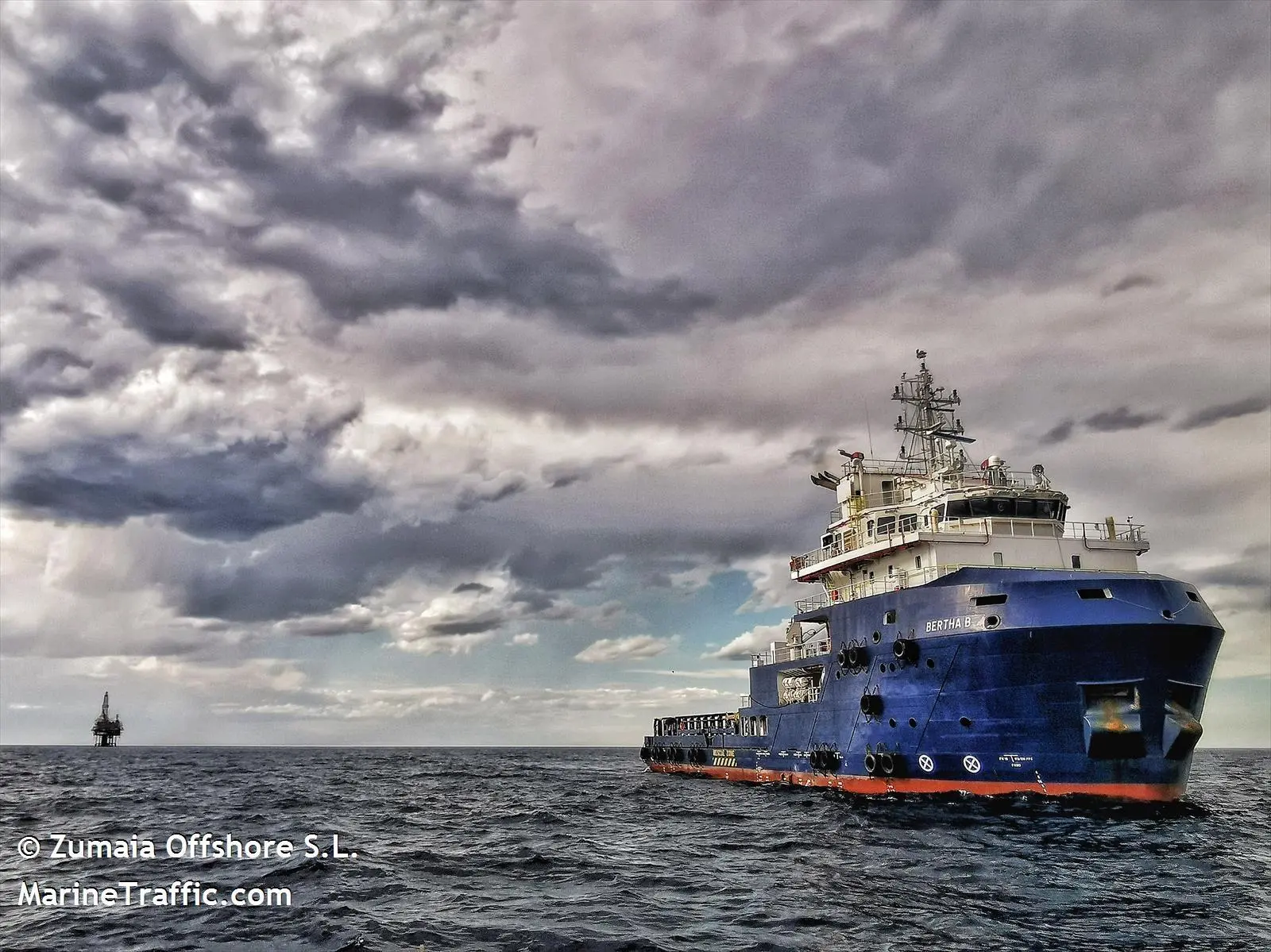
TUE and Tecnalia have therefore achieved an initial proof of concept for ammonia decomposition using the membrane reactors. “Through the APOLO project, Tecnalia and TUE will develop the next generation hydrogen selective membranes with the aim of further improving the performance of the membranes and decreasing the costs,” says APOLO project technical director Dr Fausto Gallucci of TUE. “These membranes will also have larger area per volume of vessel, which makes the reactor smaller and cheaper.”
The project sees the participation of highly acclaimed research centres and universities, though it is highly industrially driven, says Gallucci. This shows that the ammonia-cracking concept is gaining traction in Europe, which can result in faster uptake at an industrial level. To further assist in that, researchers from Chalmers University of Technology will assess the environmental, cost and social performance of the technologies developed using a life cycle assessment methodology.
The technologies developed in APOLO will be targeted at the 30,000 ships in the global fleet that have 1 to 10MW power requirements for propulsion. A significant number of them are around 3MW, and the initial aim over the next decade is to provide ammonia-powered solutions suitable for them.
“The APOLO project is targeting scalability beyond 3MW which will solve the need for main propulsion power for a large segment of ships,” says Svenn Kjetil Haveland, VP Development Projects at Corvus Energy.
Corvus Energy will work with H2Site and the other partners on the development, integration, testing and demonstration of the ammonia cracker with the Corvus Pelican PEM fuel cell. In addition, Corvus Energy will lead a work package developing a business case for these systems onboard ships. Project outcomes will advance zero-emission shipping and be a step forward for the use of ammonia in maritime transportation, says Haveland.
“In decarbonizing the maritime sector, ammonia will be an essential part of the energy mix for ships sailing the longest routes and that also emit the most,” he says. “There are no commercially viable ammonia solutions available for the shipowners as of today. Developing advanced methods for cracking ammonia and demonstrating scalability and overall system efficiency is an important step forward.”
The Corvus Pelican fuel cell system was developed during the H2NOR research project that started in 2021. H2NOR was initiated by Corvus Energy, Toyota and other partners to fast-track the development and production of sustainable and scalable maritime hydrogen fuel cell systems. The result of the three-year development was the safest marine fuel cell system to date, says Corvus Energy. Using the well-proven fuel cell technology from Toyota, used in more than 20,000 cars, and adding the safety level needed for marine, enables the Pelican fuel cell system to be installed anywhere onboard a vessel.
The modular and flexible system is designed to be inherently gas safe, meaning that the surrounding machinery space is considered gas safe under all conditions. This significantly reduces the requirements for safety support systems and ventilation, thereby enabling more efficient integration of the fuel cell system inside a ship’s hull.
The Pelican fuel cell system is currently being tested with hydrogen at Corvus premises and is scheduled to be set in operation on a first sailing vessel in summer 2024. The APOLO project will continue product development further to improve parameters that are important to shipowners, such as system lifetime and fuel efficiency, says Haveland. “The goal of an overall efficiency of 51-54% is expected to be achieved by combining a high efficiency ammonia cracker with a fuel cell system with efficiency well over 50%.”
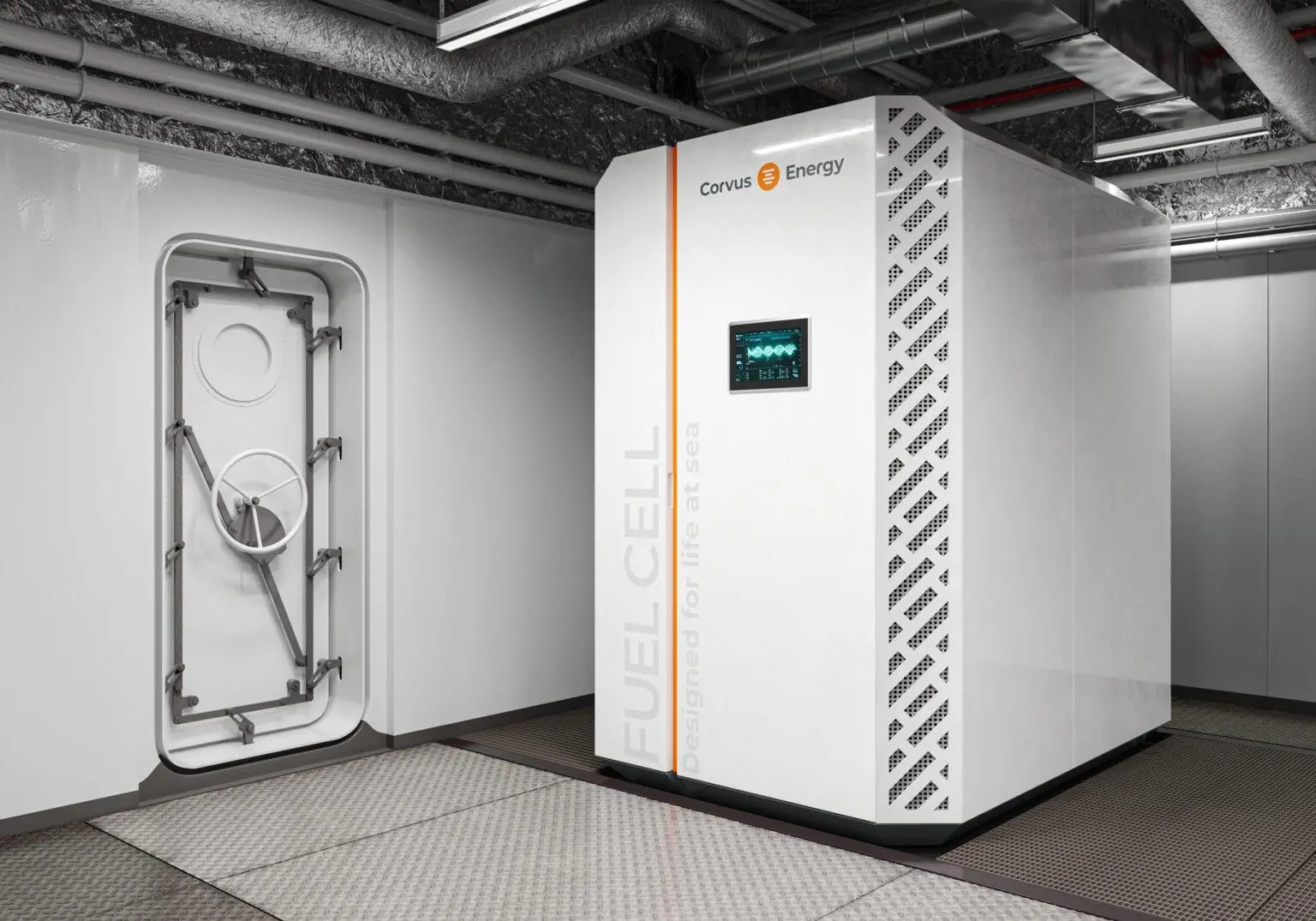
Hydrogen as a fuel is very explosive, so ensuring safety onboard a vessel is of utmost importance. “The Corvus solution ensures that by encapsulating the hydrogen-based fuel cell stack in a closed box and surrounding it with nitrogen it is safe even if an error should occur,” said Haveland.
“The Pelican fuel cell system is modular to enable mass-production benefits and at the same time flexibility in ship applications, and the APOLO project will work on the same line. The Pelican fuel cell system has redundancy by being able to run despite an error and shutdown of one or more fuel cell modules. It is also expected that the first installation will have power redundancy in the form of a backup diesel engine or energy storage system or both.”
Corvus Energy says its fuel cell systems are ideally combined with Corvus Energy batteries to form a hybrid power system. Energy storage systems handle load variations perfectly, and fuel cell systems perform best at stable loads. Corvus Energy is currently developing CoPilot, an application that supports system integrators in optimally distributing power between fuel cell systems and batteries. The results are prolonged lifetime, more efficient operation, simplified integration effort, and reduced total cost of ownership.
“The battery limits for the APOLO system are set without energy storage as this is not vital for the development,” says Haveland. “However, in a ship installation, there will of course be ammonia tanks supplying ammonia into the cracker, and it will be accompanied with batteries connected to the electrical switchboard to improve performance.”
Haveland says: “We believe the maritime industry needs a spectrum of zero-emission fuels to decarbonize, being both compressed hydrogen, liquified hydrogen, ammonia etc.”
“I give credit to the EU Commission that has set forth the direction for this development and awarded this great consortium with EU funding to enable an important step in maritime decarbonization.”
Related Articles
 UNCATEGORISED
 UNCATEGORISED
 UNCATEGORISED