



Anemoi and Lloyd’s Register consider UK market

Question: What role is Lloyd’s Register (LR) playing in supporting the UK’s maritime clusters—through classification, digital services, or training—to ensure resilience and growth in a changing global trade environment?
James Frew, advisory director, LR: As the global trade environment continues to evolve, LR’s role is to make sure our clients don’t just react to change but lead that change. LR vessels benefit from more than just classification, they’re supported by a full spectrum of professional maritime services. LR combines deep engineering expertise with strategic advisory, digital innovation, and regulatory foresight to help clients navigate complexity with confidence.
LR’s strength lies in translating regulatory complexity into actionable pathways. We help shipowners not only meet compliance thresholds but also future-proof their fleets against upcoming changes, working closely with clients to assess fuel options, retrofit strategies, and voyage planning tools.
Our digital solutions are relied upon by more than 30,000 vessels, following the acquisition of OneOcean in 2022 and Ocean Technologies Group in 2024. From voyage optimisation tools to predictive maintenance platforms, we offer solutions that enhance operational efficiency and reduce lifecycle costs.
LR is supporting a range of stakeholders across UK maritime clusters to help enable the industry’s energy transition through technical leadership in alternative fuels such as ammonia, biofuels and nuclear, while also working to shape international regulations for a safe and effective energy transition
Question: What challenges and opportunities do you see in scaling wind propulsion systems across the UK fleet, and how can regional maritime hubs support the wider rollout of this technology?
Luke McEwen, technical director, Anemoi Marine Technologies: Scaling wind propulsion systems across the UK fleet presents both challenges and opportunities. At Anemoi, we already work with UK based shipowners such as Tufton, which reflects a strong appetite within the UK maritime sector to pursue sustainable shipping solutions. However, aligning this with the practicalities of shipbuilding and docking remains a hurdle for vessels that operate locally in UK waters.
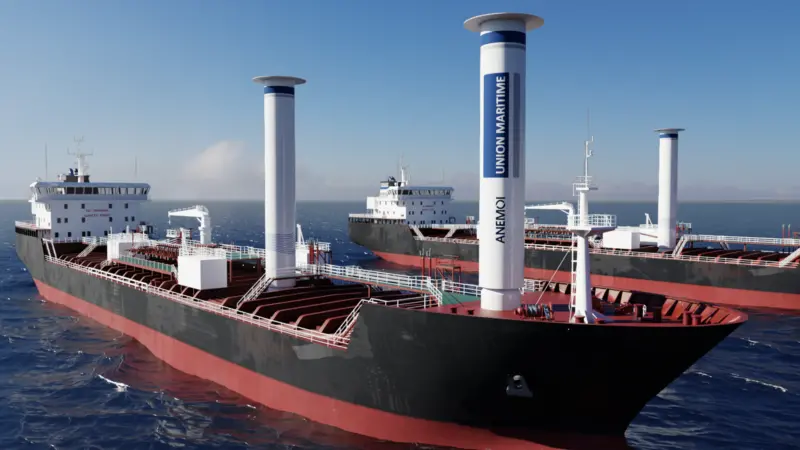
Our primary market consists of large bulk carriers and tankers, which are mainly built and docked in Asia. To meet this demand efficiently, we’ve established our production base in China. In contrast, the UK shipbuilding industry focuses largely on naval or smaller commercial vessels, which are not typically suited to our larger Rotor Sails. That said, we’ve recently developed a smaller 3.5m diameter Rotor Sail, which opens up the potential for collaboration and we’re keen to explore opportunities to work with UK shipyards.
Another key challenge is the high cost of manufacturing in the UK, which currently makes large scale production less viable.
Question: How is Anemoi collaborating with UK-based shipyards, designers, or classification societies to integrate rotor sails into newbuild and retrofit projects, and what role does the UK supply chain play in delivering these solutions?
Luke McEwen, technical director, Anemoi: Anemoi is a UK based company with the majority of our workforce living and working here. This includes sales, marketing, projects, finance and, of course, all of our engineering, design, and R&D activities are based here. We collaborate closely with UK partners such as Houlder and Pressure Design Hydraulics to support the development and integration of our Rotor Sail technology. We also buy some key components from the UK, such as anemometers and weather stations from Gill Instruments.
Government support has been instrumental in our progress. Through funding from the 4th Clean Maritime Demonstration Competition (CMDC), we’ve developed a smaller 3.5m diameter Rotor Sail designed for use on smaller vessels. Manufacturing of these has begun in China, with the first installations expected in early 2026. The CMDC work also included a valuable assessment of the UK supply chain capability for Rotor Sail components, with a view to setting up future production and installation in the UK.
We also have had a land-based test facility with a UK-built prototype Rotor Sail at the Port of Blyth since 2013, which continues to provide valuable performance data. This is now complemented by larger test beds at our production site in Jiangsu, China, with the capacity to produce up to 250 Rotor Sails annually.
While installations may largely occur in Asia currently, the UK plays a crucial role in our innovation and product development.
Question: “Britannia rules the waves” is perhaps not the axiom it once was, but in what areas would you say the UK is still leading in the maritime world and why? (This can include the global decarbonisation push, etc)
Mark Tipping, Global Power to X Director, LR: Our report ‘Advanced Maritime Nuclear: A unique opportunity for the UK’, released earlier this year in collaboration with NorthStandard and CORE POWER, found that the UK is well positioned to lead the safe development and deployment of new nuclear power systems for commercial ships and floating nuclear power plants.
With nuclear’s ability to deliver zero-emission energy at scale, it could play a pivotal role in enabling the industry to meet long-term sustainability goals. Nuclear-powered vessels offer operational endurance, global reach, and independence from conventional fuel supply chains. Beyond ships, floating nuclear power plants could bring clean energy to remote coastal areas and offshore industries. These floating facilities can be built in shipyards and stationed at sea, where they’d generate electricity and send it back to shore via undersea cables.
LR is actively engaged in shaping the regulatory and safety frameworks needed to support the use of nuclear in maritime, ensuring that innovation is matched by integrity and operational assurance. Our work in this area includes the ATLAS initiative (Atomic Technologies Licensed for Applications at Sea) in partnership with the IAEA to establish frameworks for maritime nuclear applications. LR is also collaborating with Microsoft to use generative AI to enable a faster and more cost-effective pathway through regulation, which is essential for making nuclear a viable clean energy solution.

Luke McEwen, technical director, Anemoi: The UK may no longer dominate shipbuilding, but it continues to lead in maritime innovation, especially in clean technologies. Several WASP suppliers, including Anemoi, are based here, alongside developers of other energy-efficiency systems like air lubrication.
Government support, particularly through Innovate UK, has played a key role in advancing these technologies. While the industry has evolved, the UK remains a global contributor by driving the innovations needed for a decarbonised maritime future.
Question: How supportive is UK maritime policy and regulation in helping to accelerate innovation and deployment of clean technologies?
Luke McEwen, technical director, Anemoi: The UK government has been very clear on its Maritime 2025 strategy published in 2019, including a Clean Maritime Plan, which demonstrates promising intention. Initiatives such as the CMDC, which support innovation and early-stage trials are incredibly valuable for technology providers looking to make a global difference. However, stronger financial and operational incentives would help accelerate deployment in the UK if there is an appetite.
Question: What should the UK maritime sector be doing today to ensure its relevance in 2030 and beyond, especially as the energy transition accelerates?
Luke McEwen, technical director, Anemoi: To stay competitive through the energy transition, the UK maritime sector needs greater investment in clean tech. While schemes like the CMDC have helped, UK funding lags behind the EU. UK companies are eligible to join consortia bidding for Horizon Europe funding but cannot lead a consortium and there are EU-funded initiatives such as Interreg which exclude UK-based participants.
As the technology is fast-evolving, developing and exploiting intellectual property in clean energy will be essential for businesses that want to get ahead and stay ahead of the global competition. Early-stage funding and investment is key to helping UK companies to achieve th
Related Articles
 NEWS
NEWS
 ALTERNATIVE FUELS & LUBRICANTS
 ALTERNATIVE FUELS & LUBRICANTS