



Australian gas-fuelled ro-ro order for FSG
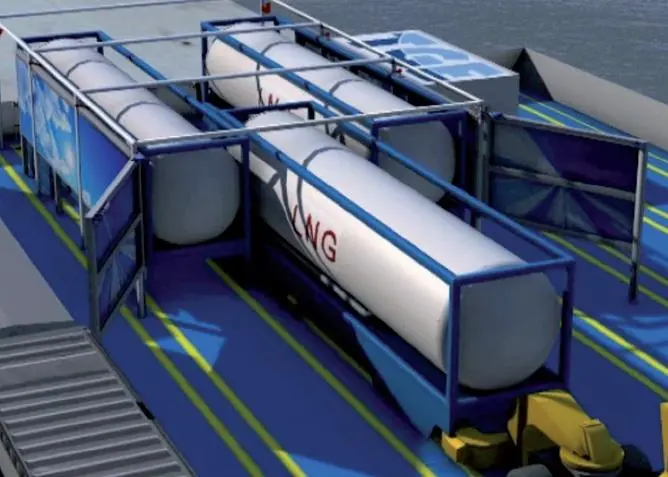
FSG says that it has been working intensively with SeaRoad for some time on this project, which can now successfully move into a new phase following the contract signing. The ship will be 181m length oa, 26.6m wide, and have more than 1,960 lane-metres available. Service speed will be 20.5 knots. It is planned to start construction at Flensburg in September 2015 and to deliver the ship in the third quarter of 2016.
LNG fuelling will be accomplished using mobile tanks taken onboard during regular loading and unloading. FSG has developed a locking system which will enable the tanks, once on board, to be secured and to become the equivalent of fixed tanks.
FSG MD Peter Sierk said: “On the one hand, our shipyard is to deliver a ship to Australia for the first time ever. On the other hand, this newbuilding demonstrates yet again the high-level competence of our yard and our innovative capabilities. We are very proud that SeaRoad has chosen us and that our ideas have prevailed over those of international competitors. We look forward to continuing the good and intensive co-operation we already enjoy with SeaRoad and which has been characterised over the time by great trust, professionalism and by our mutual focus on finding innovative solutions.”
Claimed to be the first ro-ro ferry of this size with LNG propulsion, the ship will provide a regular liner service between Melbourne and Tasmania. She will boast a flexible cargo carrying capability, carrying containers, including reefer units, trailers, cars and hazardous cargo as well as livestock. FSG says that she will be the first ro-ro able to transport reefer containers and hazardous cargo side by side, thanks to a new concept developed by the yard.
Mr Sierk said: “LNG operation is currently the cleanest fuel combustion process in existence. The emission of sulphur oxides and dust is almost nil while that of nitrous oxides is also reduced by nearly 100% and that of carbon dioxide by about 20%.”
Related Articles
 ALTERNATIVE FUELS & LUBRICANTS
 GENERAL NEWS
 GENERAL NEWS