



Automated charging for battery ferry
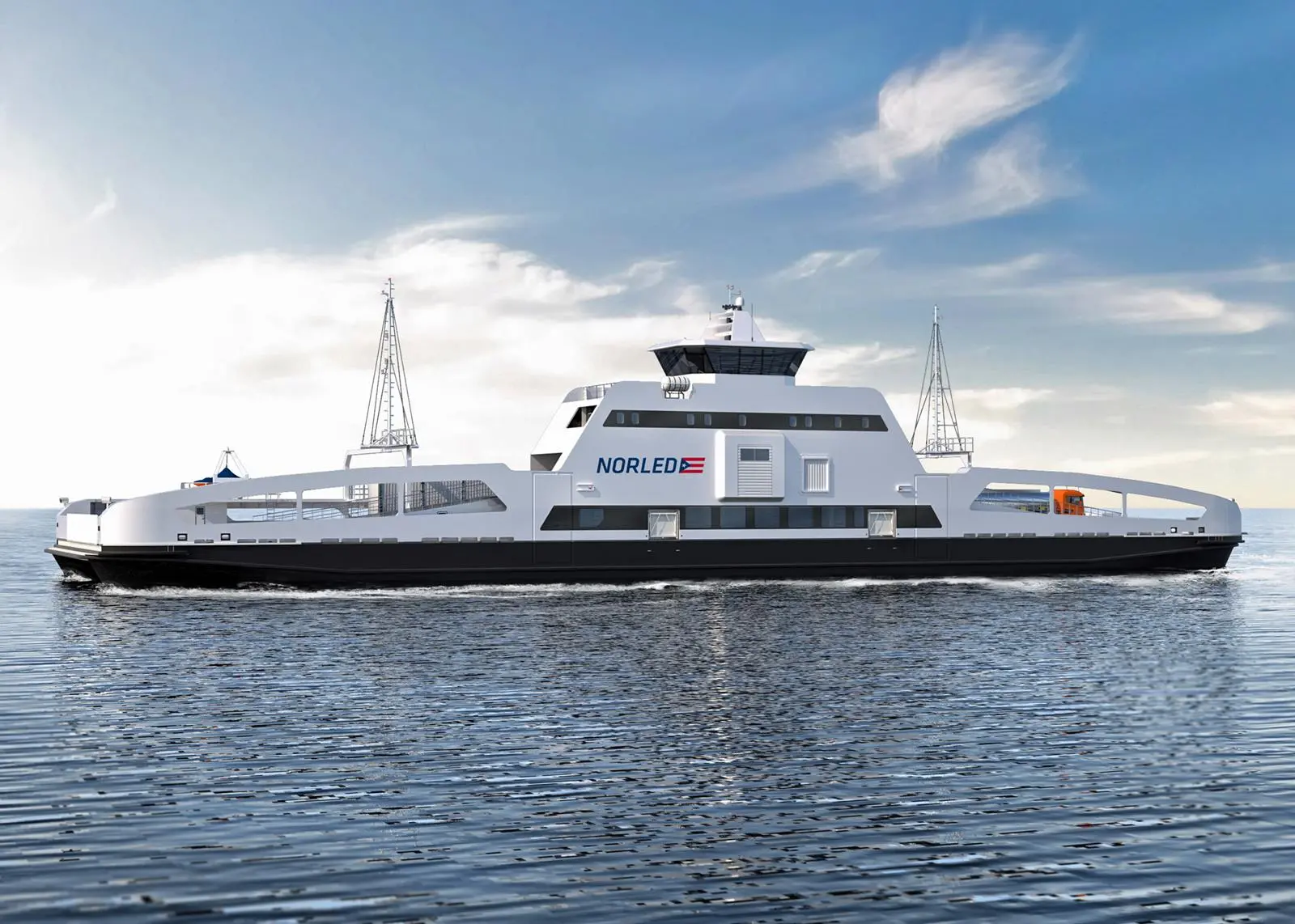
With the planned introduction of the world’s first fully battery powered ro-pax ferries in 2015 the operators wanted a shore electrical connection system that could be plugged in quickly for charging the batteries. The two ferries, which will operate on a service in Norway, will have just 10 minutes to turn around at each end of the route, so the operators wanted an automated connection system for the shore power charging link to allow the maximum time for re-charging the batteries.
The 80m long ferries are based on efficient catamaran hulls and there is accommodation on board for 360 passengers and deck space for 120 cars. The ferries will operate on the Lavik-Oppedal route across the Sognefjord, with each ship making 17 crossings per day. They are powered by two 400kW electric motors that will give a 10 knot speed when operating on half power. The battery installation weighs in at 10tonnes.
Not only will the ferries have an automated electric connection system but the ferry berths will be equipped with the MoorMaster system that will allow the vessel to be secured alongside automatically without any ropes. Both the MoorMaster system and the AMP (alternative maritime power) electric supply system have been developed and supplied by Cavotec. The MoorMaster is already in use at several ferry terminals in Norway and the Netherlands, but this will be the first installation of a version of AMP which has been developed specifically for this route.
Cavotec claims that the level of automation at these ferry terminals is unprecedented. “These are the first systems anywhere in the world that integrate automated mooring and automated shore to ship AMP,” said Sofus Gedde-Dahl, MD of Cavotec Norge.
The system will be initiated by the captain of the ferry who will signal on a hand-held radio remote control. The mooring system will signal to the AMP unit when the ship is safely moored alongside. Then a laser sensor will guide the AMP connector to a hatch in the side of the vessel, connect to the ship’s batteries and start charging. For departure the system will operate automatically in reverse. To power the batteries in the short charging time available, the charging rate has to be high meaning that the connection system has to be capable of handling a high-power connection. It will be supplied from a battery system installed onshore which in turn will charged at a slow rate from the local grid.
Cavotec, a Swiss company listed in Sweden but with subsidiaries worldwide, says it specialises in developing challenging connection systems. AMP is based around a ‘cold ironing’ connection system developed for providing ships with shore power. MoorMaster is based on a vacuum system that is built into the quay and which can hold the ship in position with considerable attraction force,
The aluminium hulls of these ferries were built in Poland and then towed to the Fjellstrand shipyard for fitting out. The project is a collaboration between Fjellstrand, Siemens and Rolls-Royce. The first ferry is due to enter service on 1 January 2015 and will be operated by Norled.
Related Articles
 PROPULSION
 GENERAL NEWS
 GENERAL NEWS