



Autonomous ships to overhaul hub-and-spoke logistics
As Eero Lehtovaara of ABB says, when it comes to autonomy, “one size does NOT fit all”. He adds: “I don’t see the driver for crewless operations on ships above 2,000dwt… where the technology is steadily moving toward decision support activities, rather than unmanned operations”.
But, it’s a very different picture for domestic traffic – cable and road ferries, for example. “Those will be the first to be unmanned or highly automated,” says Lehtovaara. “And as they will be operating under one flag, they can go ahead with no need for changes at IMO.”
Despite a few initial stumbles, it appears developments are now picking up speed.
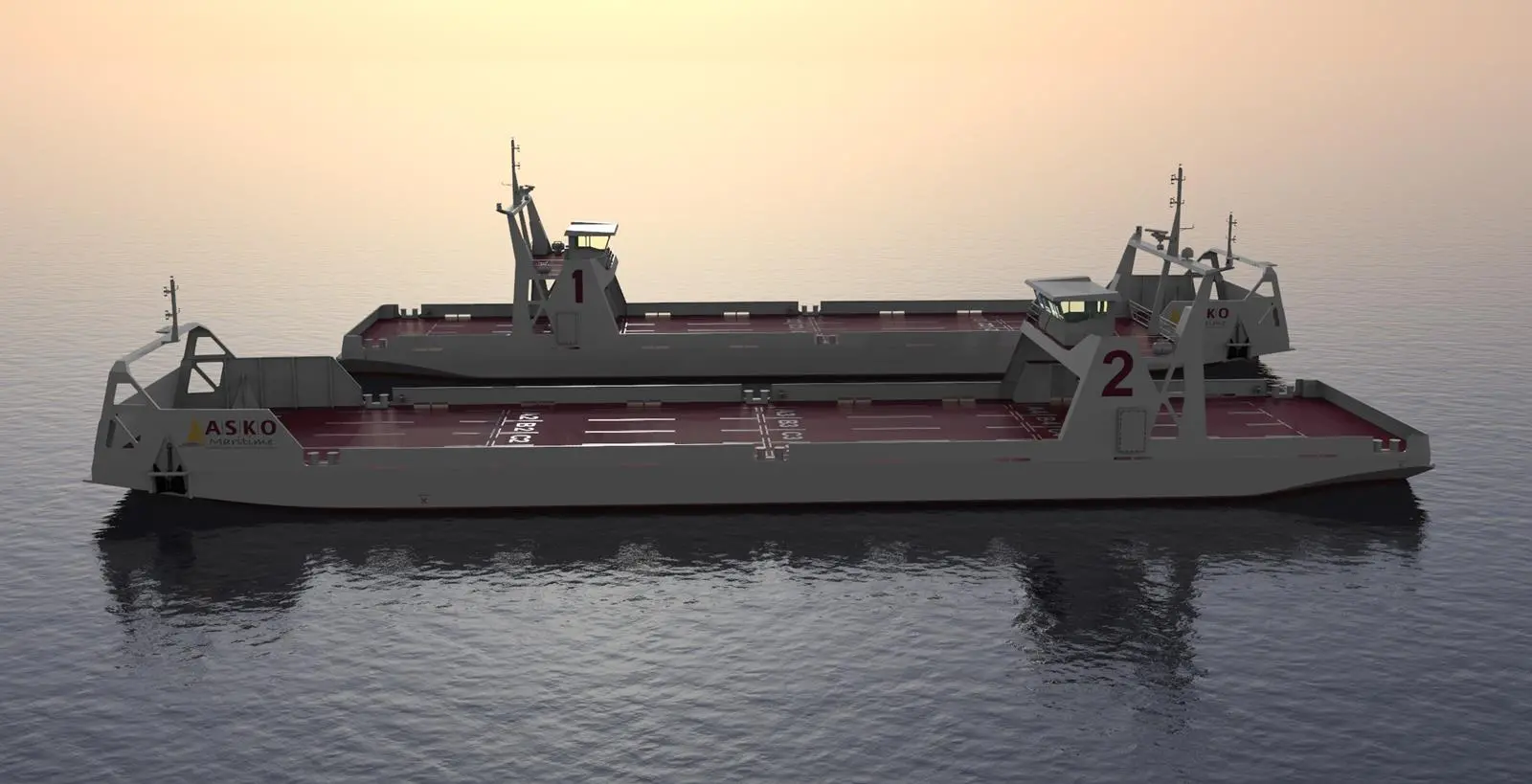
Take, for example, Norway’s largest grocery wholesaler, ASKO. Two 67m long electric ferries (to be built at the Cochin shipyard) will improve the company’s logistics operation by connecting the ports of Moss and Horten on opposite sides of the Oslo Fjord, replacing 150 daily truck runs.
A pair of twin battery installations totalling 1,846-kWh give the vessels a pretty large redundant power margin. Although there are two hours to recharge at each end of the transit, each ship could complete a day’s operation on a full charge “with no top-up”, says Pia Meling of Massterly: that’s four, 8kn 15km crossings. But even so, an emergency UPS will also be installed above the main deck, complete with electric and fire isolation.
However, the Oslo Fjord is quite a busy area, so communication is the other part of the picture. The remote operations centre onshore, manned by Massterly, will keep up a continuous watch over the vessels “and will be able to call up other vessels and talk to them,” says Meling. It helps that their entire route is within the Horten VTS control area and covered by GSM 4G (4G+, and later 5G) public mobile telephone networks. “This should be sufficient for communication with external antennas,” she says, adding that Kongsberg’s private network – Maritime Broadband Radio – will be established as a back-up.
Despite the apparent novelty, it’s not a huge technology leap argues Lehtovaara: recognition systems with enough intelligence to avoid other marine traffic have already been developed and utilised by minor autonomous surface craft for a while. As a result, he says that smaller cargo and road ferries “are not much more than horizontal elevators”, with about as much need for manning.
Further, safety could actually benefit from low-level autonomy: “Operating this kind of ferry is dangerously boring,” he says: “Better to let a machine do it.” While deviations from the routine need to be defined and discussed, answers could be relatively simple: a full blackout may just mean dropping anchor and sending a distress signal to the maritime rescue centre. If it’s a short inland hop, “it might even be the local fire brigade that responds”, adds Lehtovaara.
But the most exciting possibilities are not single-vendor owned and various business cases are emerging to correct what Ørnulf Jan Rødseth of SINTEF describes as a fundamental problem: “Ships generally carry cargo from where it isn’t supposed to be, to where it’s not wanted.” Therefore, a number of studies are looking at filling in the missing leg; a role currently taken by trucks at the cost of a far heavier ecological footprint.
One such Scandinavian investigation, lead by North Sea Container Line in cooperation with SINTEF and the Port of Trondheim, is looking at cargo shuttles to link coastal and rural or urban destinations “as currently, containerships lose about five hours sailing crossing the fjords” he explains.
However, any answer “has to be fully automated or, the personnel costs are prohibitive”, says Rødseth. That might not be significant for a long run “but for shorter distances, it’s a bigger proportion of the total”, he says, adding that one study on a bulk carrier showed that each transhipment point “lost about 5% of the total value of the cargo”.
Most interestingly, these studies have also looked at optimal vessel size – and the conclusions turn the ‘economies of scale’ argument on its head.
“If we split the cargo into 10 or 15 teu units – putting them on smaller, 30m or 40m vessels – we can take it right into the city centre,” Rødseth explains. That turns out to give the route a significant cost advantage. He adds: “It would also suit small to medium-sized manufacturing clusters.”
Altering typical feeder patterns could trigger a cascade of changes. Another SINTEF/NTNU study for shortsea and coastal shipping which looked at 80m vessels covering a couple of hundred kilometres suggested this kind of operation could run regularly – if it was to accept partially filled slots: the anathema of bigger ships.
Despite half-capacity loading, the answer was potentially 40% more cost-effective than traditional alternatives, especially if tied in with other changes. Therefore the report also suggested adapting vessels’ hydrodynamics to avoid ‘boundary speed’ impacts, which raise water resistance sharply, the answer being “new more slender designs”.
It can lead to further form changes. The writers go on to say: “The autonomous variants of the concepts do not have a traditional bridge superstructure…[but] the ship is equipped with sensors”. It stopped short of totally crewless vessels (dropping crew from seven to two) but also established that removing the superstructure would allow for increased capacity.
Interestingly, ship shape has also been a concern for the ASKO vessels. It’s a controlled operation and will be able to avoid too many variations, but still, with a full load of 16 trailers, total deck cargo will average around 450t, so utilising battery power alone means energy efficiency is a concern, says Meling. A reasonably sheltered route helps, “it allows a very simple, but efficient design with a 15m beam, and a shallow draft of only 1.7m”, she explains, “so the vessels will be able to sail four hours at 8 knots, consuming under 1,600kW of energy”.
Further, it’s notable that while these two ships will have a bridge to allow for initially manned operation, it seems this will likely be dispensed with on future vessels.
There are further benefits to automation, adds Rødseth: “If you can load directly onto the vessel, then you can save double handling costs and time,” he points out. This also means other patterns of operation might suit different scenarios: “You could leave a dumb barge in position to fill up, and then move it with a pusher tug.”
HANDLING
However, you can’t easily mix autonomous operation with people, so that means auto-mooring and remote/intelligent container handling inside a restricted zone has to be part of the solution. The technology is already mature, and so is the safety aspect, he points out: “It’s been done for a long time at the big automated terminals.”
But it requires scaling down. Again, there is another kind of ‘boundary effect’ noted by Rødseth: he points out that the landside handling – the sticking point for the Yara Birkland project – can be one of the most expensive elements.
Once again, small is beautiful: reduce the individual container or parcel weight to below 25t and move back from 40ft to 20ft standard containers “and you can keep the parameters down for the cranes and so on, gaining a significant cost efficiency on the quayside investment”, he explains.
It’s a transferable model with a broader application. Another case study, led by DFDS, is looking into linking ro-ro shortsea services across the Benelux region with inland waterway barges, rather than trucking the trailers to and from the harbour, says Rødseth. Interestingly, the ASKO vessels have decided on this approach, using ro-ro trailers rather than craning containers on and off. But ASKO has also decided to eventually make these terminal tractor operations autonomous, says Meling, adding that there’s a plethora of autonomous truck projects from big manufacturers already underway.
However, the concept might prove useful in other scenarios; Rødseth points out: “For example, big ports like Busan in Korea are built outside the city, so they have to move containers 40 or 50km to the urban population… but if they could travel inward this way, it would save road emissions.”
Despite this, when it comes to passenger-carrying vessels, there’s also the “social license” to consider, says Lehtovaara: “How do you feel about a crossing on a completely automatic, unmanned ferry?”
However, minds can change. Autonomous ferries could prove a saviour for remote industrial clusters and communities threatened by port closure or relocation – take Trondheim, where the cost of prime coastal real estate is rocketing and the port may simply be priced out of business. Usefully, the ASKO vessels are showing it’s possible to operate “within the existing rules” says Meling. “We don’t have a new framework; we are proving ‘equivalence’ inside the current local and international, IMO regulations.”
Related Articles
 ALTERNATIVE FUELS & LUBRICANTS
 GENERAL NEWS
 GENERAL NEWS