



Battery powered ferries report
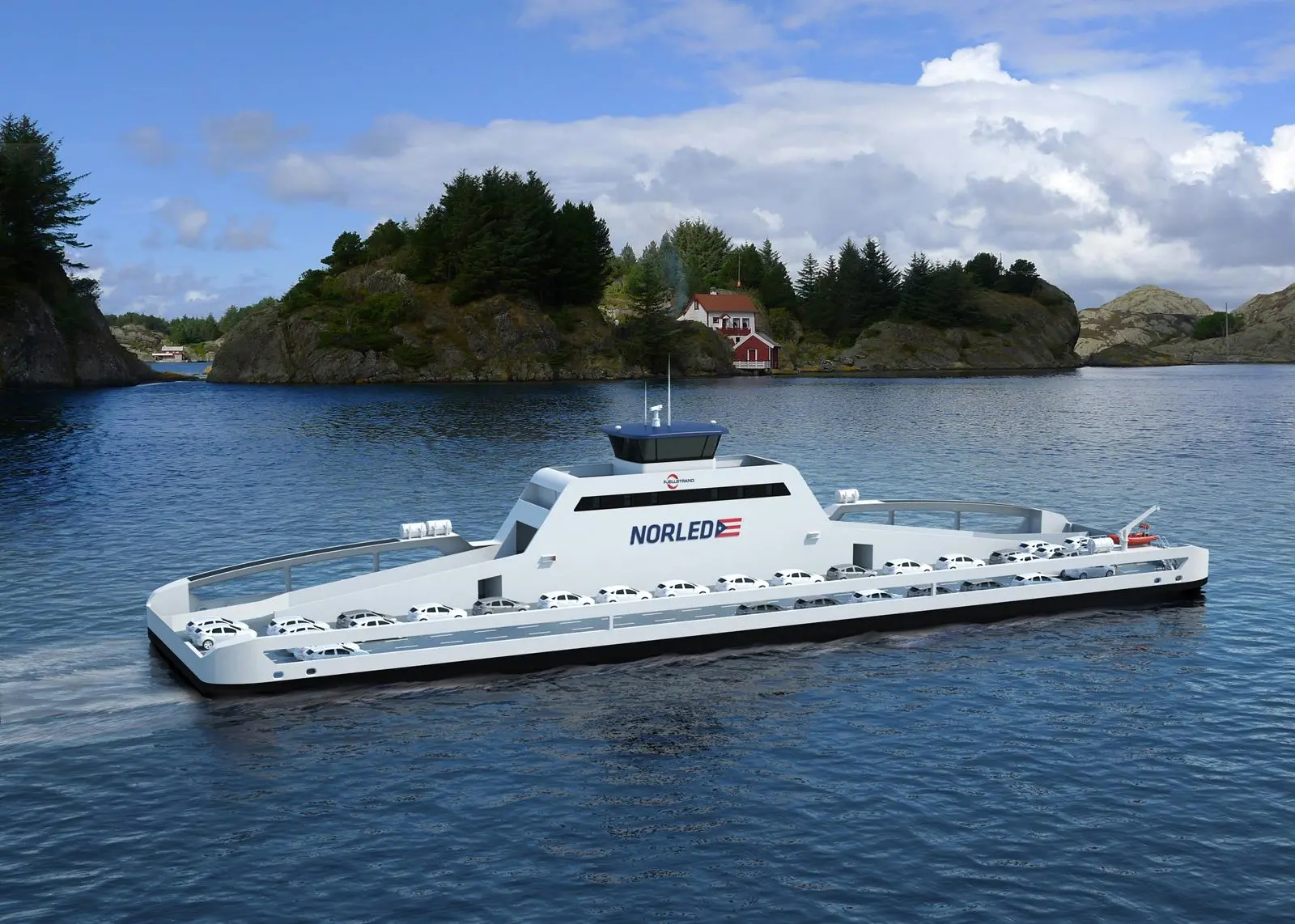
Norwegian ferry operator Norled is introducing the Zero Cat 120 catamaran ferry on its short Lavik-Oppedal route early this year. While other battery-equipped ferries have used energy storage as part of a hybrid configuration the new ship is notable in that battery power is its sole mode of propulsion.
The 80m long, double-ended aluminium hulled ferry is designed to make the 5.7km crossing of the Sognefjord in 20 minutes, with a further 10 minutes at each stop for loading and unloading. It will make 34 trips each day, carrying up to 360 passengers and 120 cars. Between each crossing the batteries will be plugged in for a top-up charge, with the main charging happening overnight, using hydro-electrically generated electricity.
The electrical system is supplied by Siemens, using the company’s BlueDrive Plus C energy management system. Two 450kW electric motors drive Rolls-Royce Azipull thrusters with CP propellers, which can be fully feathered. The lithium-ion battery packs are supplied by Corvus Energy. 224 Corvus AT6500 modules have been provided, with a total capacity of 1.46MW. About 1MW-worth of batteries are onboard in two banks, one at each end of the ferry. The remaining batteries are sited on shore, with a 260kW battery at each shore station. In the short interval between crossings the onboard battery bank at the shore end is recharged from the shore batteries, which is said to avoid uneven drain on the local grid.
The ship’s on-board power needs are also met by the batteries, with a HVAV system that makes full use of waste heat recovery to minimise power required. The ship, designed and built by Fjellstrand of Norway, is said to offer savings of 1 million litres of diesel fuel a year, with emissions reductions of 570t of CO2 and 15t of NOx compared with conventional ferries.
Siemens and Corvus have collaborated on several other projects, notably the conversion of four Scandlines ro-pax ships to hybrid operation. For the conversion projects, Siemens supplied its BlueDrive PlusC system which has enabled batteries to be incorporated in the ships’ existing diesel-electric power plants, resulting in a true hybrid system. The companies are also cooperating with Fjord1 on an LNG-battery hybrid ferry project in Norway.
Scottish venture
Corvus batteries are used in CalMac’s two hybrid ferries operating in Scotland. Said to be the first two purpose-built hybrid ferries in operation, the vessels are small in size (at 43.5m length overall) but big in technological innovation. Three 330kW Volvo Penta diesel gensets are installed, although only one is needed for normal operation, driving two 375kW electric Voith Schneider propeller units. The 700kW battery pack is recharged overnight and is used to supplement the diesel power. At slack times when only two crossings are undertaken during the day the ships can operate on battery power alone. The electrical system was designed and supplied by Imtech of the Netherlands.
Imtech, through its Turkish subsidiary Elkon, has recently been awarded a contract to deliver the hybrid electric propulsion system for a pair of ferries being built by Sedef, of Tuzla, Turkey, for Seaspan of Canada.
The 148.9m ferries will have an electric system based on dual-fuel (diesel and LNG) gensets and a battery pack of as-yet unspecified size. The ships are designed to carry up to 59 freight trailers and will replace ageing conventionally-powered ferries, providing a significant reduction in greenhouse gas emissions while ensuring high levels of performance, reliability and efficiency.
Elkon notes its long association with the Sedef shipyard and has been involved in electrical system work on more than 500 vessels over the last 30 years. It will carry out the design, specification, production and installation of the hybrid electrical package, which includes the propulsion and automation systems.
Construction of the ferries is expected to begin in 2015, and delivery is scheduled for late 2016. Interestingly, the contract went to Sedef in a competitive tendering process involving some 40 shipyards globally, including Seaspan’s own shipbuilding facility in Vancouver.
- Read more on battery power and specialist propulsion in The Motorship’s February issue, out now. To subscribe, click here.
Related Articles
 PROPULSION
 GENERAL NEWS
 GENERAL NEWS