



Beyond LNG: Alternative gas fuels advance
LNG has successfully been applied to vessels other than gas carriers, of course, and has demonstrated its benefits as a clean, economical alternative to liquid fuels. But it has a disadvantage, and that is in the onboard storage and processing required. Not only does this involve bulky and expensive equipment, despite the best efforts of the engine and fuel suppliers, as well as classification societies, some safety-related concerns remain. Natural gas does not have to be stored under pressure, it can be merely compressed, and CNG has been touted as a marine fuel, but for ships other than CNG carriers the size of tank requited is likely to limit it to vessels operating on very short range, such as tugs and coastal ferries.
Other gases are available, of course. And although they do not solve the LNG questions – arguably bring uncertainties of their own – they do seem to be gaining ground as viable alternative fuels for ships.
Methanol is one such gas. The Stena Line freight ferry Stena Germanica has recently been converted to run its Wartsila four-stroke engines on methanol, operating between Gothenburg and Keil. According to Stena, emissions from methanol are roughly the same as for LNG, but the fuel is easier to process and does not place the same demands on infrastructure.
Methanol can be produced from natural gas, coal, biomass or even carbon dioxide, and promises cuts in emissions of around 99% SOx, NOX by 60%, particulates 95% and 25% CO2 compared to conventional marine fuels.
The same gas has been successfully demonstrated by MAN Diesel & Turbo as a viable fuel for large two-stroke engines. Unlike the four-stroke gas and dual fuel engines, and two-strokes using a low pressure gas system, which use the Otto cycle when running on gas, MAN maintains the Diesel cycle for both oil and gas operation, which it says avoids any change in power density or load response, results in no methane slip, and hence higher carbon emissions, and avoids risk of knocking. The Diesel cycle is maintained too for the ME-LGI version of MAN’s gas engines, which employ a fuel booster valve to allow operation with low-pressure, low flashpoint fuels including methanol.
The company has received seven orders for methanol-fuelled two-stroke engines to power methanol carriers for several different owners. Vice president and head of R&D, Søren H. Jensen, says: “A number of years ago we identified the need to develop an engine that could run on more environmentally-friendly, competitively-priced fuels as an alternative to MDO/MGO. We believe the ability of the ME-LGI engine to run on sulphur-free fuels offers great potential. Methanol carriers have already operated at sea for many years. With a viable, convenient and economic fuel already on-board, exploiting a fraction of the cargo to power a vessel makes sense.”
Development of MAN’s methanol engine, which operates on 95% methanol and 5% diesel, was carried out in conjunction with long-term partner Alfa Laval. Alfa Laval’s Monza laboratory in Italy has developed a fuel conditioning system for low-flashpoint fuels, such as methanol, ethanol, DME and LPG. In addition, Alfa Laval is to explore new booster systems for these fuel alternatives, whose common denominator is a low flashpoint below 60°C. The next stage in development is a fuel conditioning system for use with LPG fuel.
“Low viscosity, a low boiling point and high corrosiveness make fuels like methanol a particular challenge for fuel conditioning systems,” says Paolo Golla, head of Alfa Laval’s FCM product centre.
“Since methanol has a flashpoint lower than 60°C, current class rules are not applicable,” says Mr Golla. “The class notation must be developed in pace with the technology, and here we are extremely proud to be part of the process.”
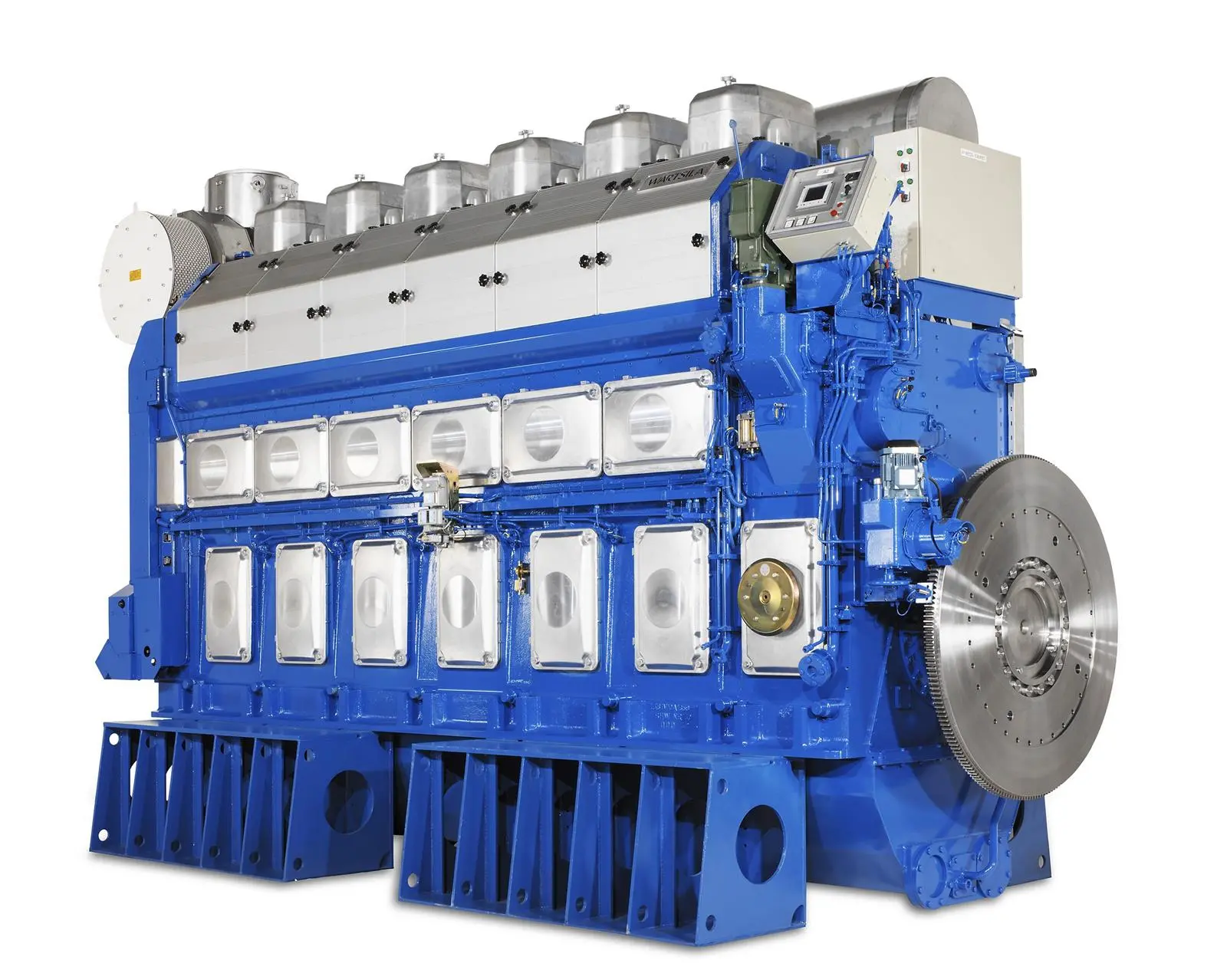
In the large four-stroke field, Wärtsilä has announced that its 50DF marine engine has been successfully tested and certified to run on ethane (LEG).
The test programme was in conjunction with gas tanker operator Evergas, whose CEO Steffen Jacobsen says: “We are very pleased that the Wärtsilä engines will be capable of utilising ethane boil-off gas as fuel. It increases our operational efficiency and improves flexibility in the bunkering of fuels. All in all it results in a significant reduction in operating costs, while also providing a minimal environmental footprint. It also enables us to offer our customers increased flexibility, which has a monetary value to them.”
According to Wärtsilä, the capability to efficiently burn ethane boil-off gas as engine fuel significantly reduces the need for gas re-liquefaction during the voyage. This means that less power is needed for cargo handling, adding to efficiency and lowering the ship’s overall environmental impact.
The company adds that the 50DF can meet IMO Tier III regulations without need of secondary measures using either LNG or LEG as fuel, and can seamlessly switch between LNG, LEG, HFO or distillate without interruption or the need for hardware modification.
“This is yet another significant breakthrough for Wärtsilä’s multi-fuel technology. The option to utilise ethane gas as a marine fuel further extends the fuel flexibility of our DF engine portfolio. It also provides yet another option to achieve compliance with the IMO’s stringent Tier III legislation,” said Lars Anderson, vice president, engine sales, Wärtsilä Ship Power.
Related Articles
 PROPULSION
 GENERAL NEWS
 GENERAL NEWS