



Boost to the dedicated reefer concept
The unfolding strategy involves multiple newbuilds of different sizes, including further examples of the largest breakbulk-orientated design to date, and spans completions over the 2025-2027 period.
Two vessels of some 904,950ft3 capacity, due to be delivered by Shikoku Dockyard of Japan during the early stages of 2025, will constitute the leading edge of the fleet renewal plan, to be followed by eight or nine further newbuilds in the 660,000-700,000ft3 category up to the end of 2027.
Notwithstanding the erosion of the specialised reefer vessels’ market share—a process that accelerated over the past two and a half decades—in the face of business targeting, freight rate pressure, and capacity growth by powerful container shipping groups, the project highlights continuing opportunities in niche trades and reefer logistics. The modern, pallet-optimised, geared vessel, albeit with much increased provision for containers, can build on strengths in providing fast, direct and seasonally-variable connections, obviating transhipment.
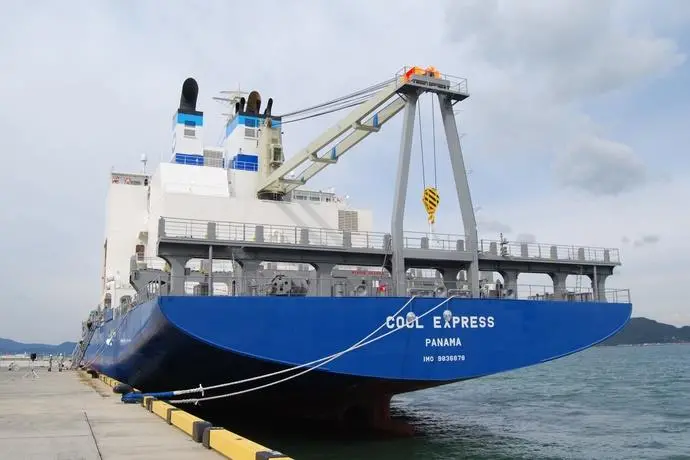
The two newbuilds at the top end of the range will be repeats of the largest and youngest member of the Cool Carriers fleet, the 904,950ft3-capacity Cool Eagle, commissioned from Shikoku’s Takamatsu yard on Japan’s Seto Inland Sea in February 2021.
Cool Eagle was based on the same template adopted for sisters Cool Express and Cool Explorer, delivered in 2018 and 2019 respectively by Shikoku, and constituting the world’s most advanced and record-breaking capacity development thereto of the classical reefer vessel concept.
Compartmentalised by tweendecks and equipped to transport goods at temperatures as low as minus 30degC, the design imbues self-sufficiency in cargo handling by way of an array of five 40t deck cranes. Moreover, increased versatility and scope for backloads is conferred by slots for up to 607TEU or 400FEU containers, and by the scope to load about 800 cars, traditionally a return cargo for reeferships. Redolent of today’s fully-cellular mainliner, a lattice of lashing bridges affords additional security and turnaround efficiency for boxes carried on deck.
Not only the further E-class vessels, but also the subsequent, somewhat smaller newbuilds, will embody an underdeck configuration that gives a 2.5m headroom, so as to accommodate goods on high-cube pallets. This provision denotes an important juncture in the evolution of the dedicated reefership genre.
Moreover, each vessel will incorporate an exhaust gas cleaning system, or scrubber. The technical specification has been shaped with reference to the EU’s Emission Trading System, a key tool for cost-effective reduction of greenhouse gas emissions.
Just as the beneficial and contractual owner of the current three E-class vessels is Nissen Kaiun of Japan, whose business model is to order newbuilds for long-term charter to established operators, it is understood that similar arrangements figure in Cool Carriers’ new tonnage programme. The latter currently has around 45 reefers at its disposal, and has had a new head office constructed in Limassol, Cyprus, to support the growing fleet.
Related Articles
 METHANOL
 GENERAL NEWS
 HYDROGEN