



BREAKING BAD
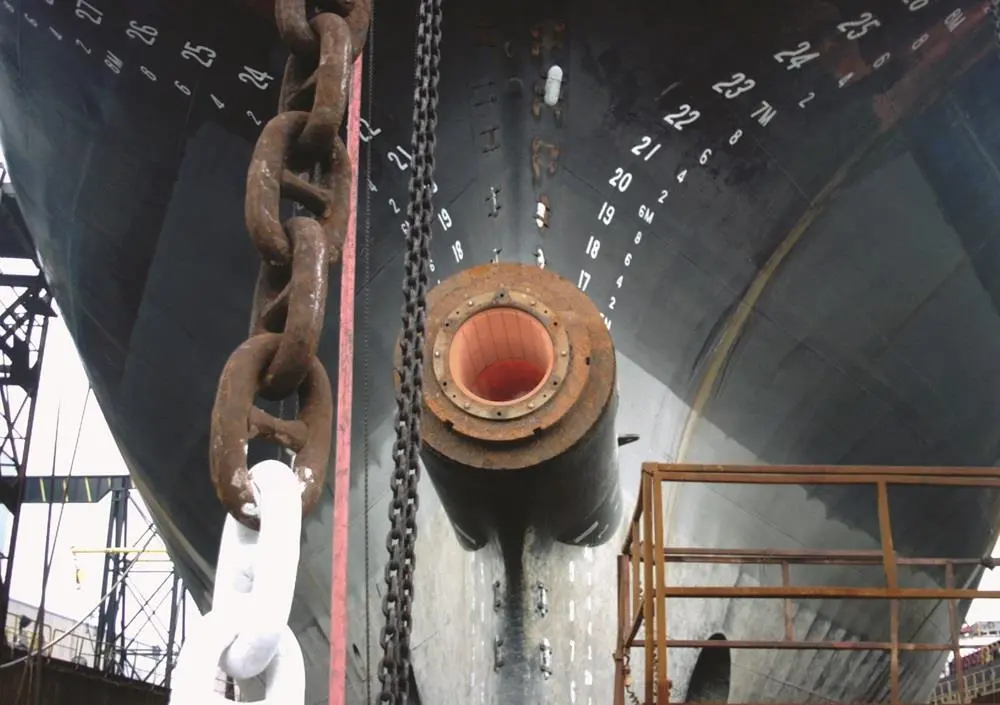
As shipowners and recycling facilities get to grips with the Hong Kong International Convention for the Safe and Environmentally Sound Recycling of Ships (HKC), which entered into force on 26 June 2025, questions are emerging around hard to recycle substances commonly found in marine bearings and other ship equipment, potentially creating an overlooked compliance risk.
Thermoset polymers, thermoplastics, vulcanised rubbers, per- and polyfluoroalkyl substances (PFAS), and perfluorooctane sulfonates (PFOS) are commonly used in ship systems across all market segments, due to their undeniable performance benefits. But they are near impossible to recycle.
In a 2021 paper published in the Journal of Materials Science & Technology, the authors state: “The widespread use of thermoset composites has raised great environmental and economic awareness of the need to recycle a substantial amount of thermoset composites wastes. Due to the crosslinked networks, conventional thermosets cannot be dissolved, melted, remoulded, and reprocessed.”
Thermosets are also the focus of a 2021 study in Green Energy & Environment, with Longlong Ma, Yu Liu, Xiangyu Ge, et al stating “thermosetting composites cannot be recycled using conventional processing methods.” They also said methods such as pyrolysis remain technically limited or economically unviable.
Other research has found recyclability after maritime use is potentially problematic due to seawater aging and biofouling. A 2022 polymer guidance paper from Cefic-LRI, for instance, found that many cross-linked polymers used in marine environments are incompatible with recycling goals and persist in landfill for decades.
In their findings, authors Dr Stefan Haun and Dr Hennecke found that cross-linked or partially insoluble polymers (like thermosets) commonly fail standard biodegradability tests in marine and soil environments and that such materials should be flagged as persistent under EU REACH criteria.
Indeed, the European Commission is considering revising REACH to potentially bring polymers under its scope, which could mean that certain polymers, such as three-dimensional crosslinked polymers, might need to be registered, evaluated, and potentially authorised or restricted.
Robin Townsend, co-founder of ship recycling consultancy Marprof Environmental, agreed that certain bearing materials present recycling challenges as they are “designed to be robust and persistent”.
A marine engineer at Diamorph, the parent company behind Tenmat, Feroform and Railko brand bearings, agreed.
“They’re not made to be recycled; they’re made to last. That’s the whole purpose of it, due to it being a critical application,” he said. “But this doesn’t mean that they can’t be reused on another project or another vessel, because they can machine the ID and OD [inside and outside diameters]. We’re not going to be completely against taking them back.”
Although there is currently no organised aftersales take-back programme or second-hand market for polymer bearings, it’s an interesting proposition given that these seemingly indestructible bearings can outlast the very ships on which they are installed.
So, what’s the manufacturers take on all of this?
Finland-headquartered Wärtsilä did not respond to emails about the recyclability of its water-lubricated shaft line solutions, but what we do know is its Envirosafe bearing system is based on an advanced resin with synthetic fibres and advanced friction modifiers.
Thordon Bearings, too, would not comment on the recyclability of its bearings. “We are not disclosing what our polymer is, only that we continuously review global, regional and local regulations across all of our business areas for compliance purposes”, said a company spokesperson. However, in Thordon Elastomeric Engineering Manual Version: 2022.1, available on the company’s website, it confirms it uses material “made from thermosetting resins, which are three-dimensional, crosslinked condensation polymers”.
Thermoset polymers, vulcanised rubbers, PFASs and the like have escaped the HKC net. And if these bearing materials are not listed in the Convention’s appendices, flagged by IHM inspectors, or easily and cost effectively recycled, then landfill or incineration is likely the only option; solutions that produce toxic by-products – dioxins, VOCs, microplastics.
There is a disconnect that needs to be addressed,” said Marprof’s Robin Townsend. Many of the materials covered in HKC are already covered by other conventions and have controls, so does not include new measures for newbuilds. PFAS, for example, is not covered in the Hong Kong Convention, but PFOS, which is a member of the wider set of PFASs, is covered in the 2013 European Union Ship Recycling Regulation (EUSRR).
One leading materials scientist told The Motorship: “I don’t think that anytime soon there will be recyclable bearing materials. While the recycling of thermosets and polymers in general is certainly a very important topic, the actual environmental benefit is difficult to determine and not clear. As mechanical recycling is impossible for thermoset materials, the only viable option is chemical recycling. The environmental benefit of these recycling technologies is so far not always positive and has to be evaluated for every material individually.
“There is no easy fit for this problem right now and to be honest, I doubt that there will be a solution anytime soon. Polymers’ chemical recyclability and degradability usually go hand-in-hand, and you just don’t want materials for example bearings to be degradable. A more advanced plastic waste management system is nevertheless desirable. Incinerating or well-managed landfills are certainly better solutions compared to uncontrolled leaching into the environment.”
Regulatory oversights will inevitably be tightened as the industry gets to grips with the Hong Kong Convention, which will mean thermosets and thermoplastics are eventually accounted for.
Modifying the mix
Researchers are working on ways to overcome the problem of recycling thermosets. According to some studies, by modifying the mix with chemical linkers, the material is easier to break down while retaining its mechanical properties.
One such technology is Recyclamine®, a type of cleavable epoxy system developed to retain the strength of conventional thermosets while enabling chemical breakdown at end-of-life.
This incorporates specially engineered “chemical linkers” into the polymer structure that can be broken under mild conditions, typically using a warm, weak acid solution. It allows the cured composite to “depolymerise” into a reusable thermoplastic and recover clean reinforcement fibres such as glass or carbon. Unlike incineration or pyrolysis, this process generates minimal emissions and preserves material value.
Another promising avenue involves the use of Vitrimers or covalent adaptable networks (CAN) materials, which can behave like traditional thermosets during use but have dynamic chemical bonds that can shift and re-form when exposed to elevated temperatures. This means they can be reshaped, repaired, or even remoulded like thermoplastics, without fully breaking down the polymer network.
However, while industrial trials are underway in sectors like automotive and electronics, they have yet to reach commercial maturity in high-load environments.
Related Articles
 METHANOL
 MONITORING, CONTROL & DIGITALISATION
 MONITORING, CONTROL & DIGITALISATION