



Brittany begins scrubber roll-out
Brittany Ferries hit the headlines last year when it announced an ambitious programme to build a new large LNG-fuelled cruise ferry and convert several others in its fleet to run on gas. And then, at the end of the year, it put those plans on hold after the hoped-for dispensation to allow it to continue using low-sulphur residual fuels for a while, until the LNG conversions could be completed, failed to materialise. So instead the company is going down the scrubber route.
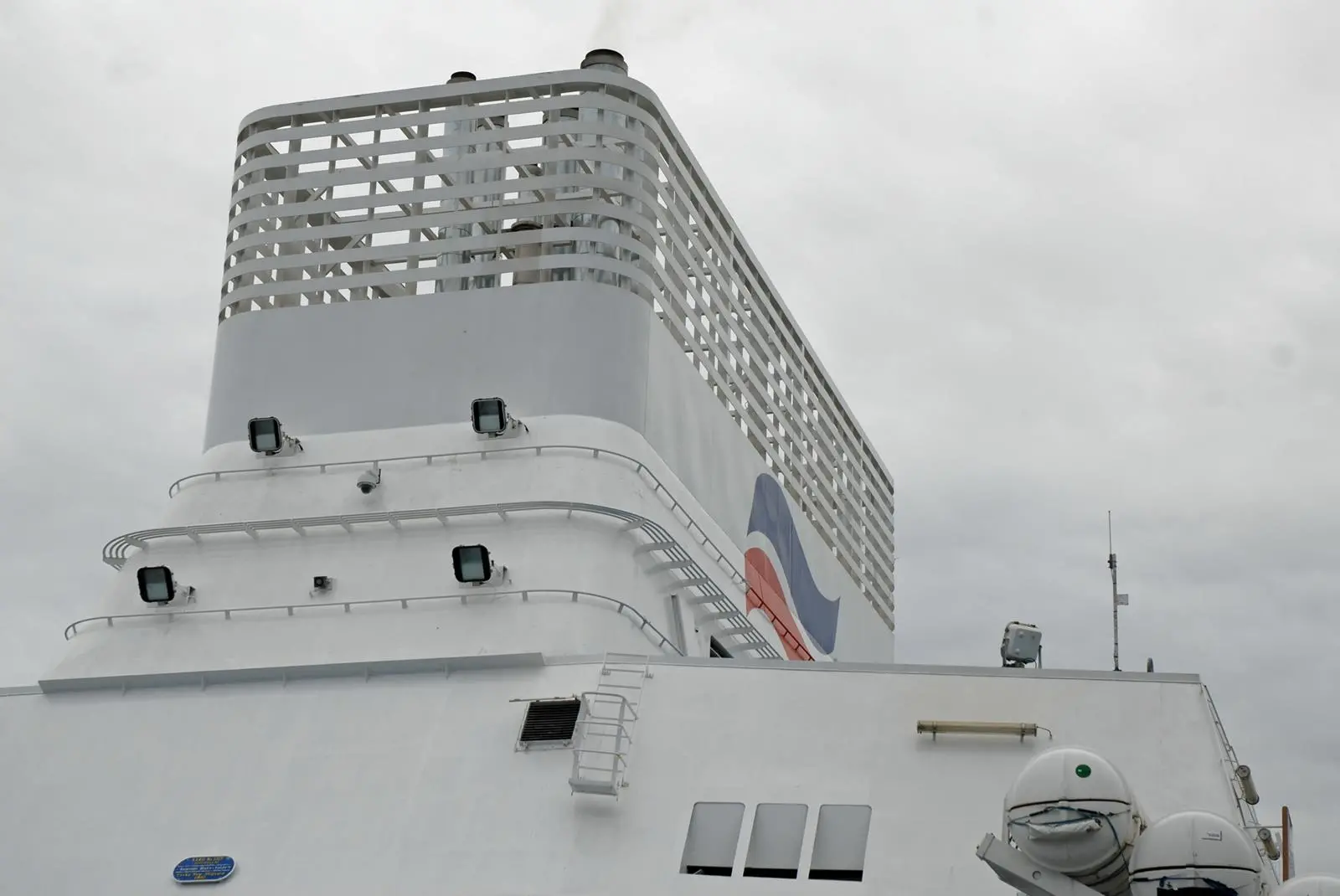
A recent trip to France provided the opportunity to view the first Brittany Ferries scrubber installation at close hand. The Normandie, built in Finland in 1992 and normally operating on the Portsmouth (UK) to Ouistreham (France) route, had its exhaust gas cleaning system installed at the Astander shipyard in Santander, Spain, the whole job taking just over two months. The timescale was impressive for a ‘first off’ job of this nature, carried out on a comparatively old ship which was designed and built well before the possibility of scrubber installation was ever considered. Much of this is down to the choice of the particularly compact system supplied by Green Tech Marine of Norway, which is almost entirely contained in an enlarged funnel with little other alteration to the ship proving necessary. Compared with some other ferry scrubber conversions, which have involved lengthening the ship to accommodate the extra equipment, the result is particularly neat and although the larger funnel takes away a little of the ship’s aesthetic feel, it is far from uneasy on the eye.
Green Tech – now known as Yara Marine Technologies, following a takeover in 2014 – claims to have the most compact and most economical scrubber system on the market, and the company says it has picked up orders for 21 systems for ro-pax ships operating in the Northern European ECAs.
Normandie has seven separate scrubbers in total, one for each of the four main engines and three covering the auxiliaries. All seven are contained within the new enlarged funnel, though some of the additional pipework and wiring had to be sited outside the funnel.
The Normandie installation is being followed by Cap Finistère (Feb/Mar 2015) and Barfleur (Mar/Apr 2015). The first three installations – all powered by Wärtsilä four-stroke engines – are all open loop scrubbers, though the next three conversions, the MaK-powered Mont St Michel, Pont Aven and Armorique, scheduled to be carried out over the 2015/2016 winter period, may use hybrid designs. The remaining three ships will all use low sulphur MGO: Bretagne because the age and layout of the ship makes a scrubber installation impractical, and Etretat because the vessel is on charter. The Normandie Express high speed catamaran has always used MGO, so no modifications have been needed to allow this ship to continue to operate.
The company’s Spanish routes are mostly outside the English Channel ECA, so until the ships operating to Santander and Bilbao get their scrubbers, they will switch between residual and distillate fuel as required. The switching process is arguably less critical for four-stroke engines than with low speed two-strokes, and will have to be undertaken frequently on these regular voyages, but the company believes it can manage the process safely and smoothly. As a matter of environmental policy Brittany Ferries had previously standardised on using HFO with a maximum 1% sulphur content, as required in the Northern European ECAs pre-2015, and it will continue to use the same fuel, but does feel that the scrubber gives a degree of flexibility in fuel choice.
One environmental argument levelled against scrubbers is that they produce their own waste which has to be disposed of. Brittany Ferries tells us that seawater which has passed through the system is diluted to a suitable ph level to allow it to be pumped back into the sea, while solid particulates extracted by the scrubber are stored onboard for safe disposal on land. While on the subject of discharges, the company says that its fleet is already equipped with ballast water treatment systems, so that particular question is not an issue.
As far as the all-important question of economics is concerned, Brittany Ferries director Stephen Tuckwell told us that at current price differentials of about 40% between LSMGO and HFO, the cost of fitting scrubbers will be written off over three years. “But there are other factors at play,” he added, “such as the availability of fuel types.”
Related Articles
 PROPULSION
 GENERAL NEWS
 GENERAL NEWS