



Bunker levy on tankers won’t achieve short-term goals
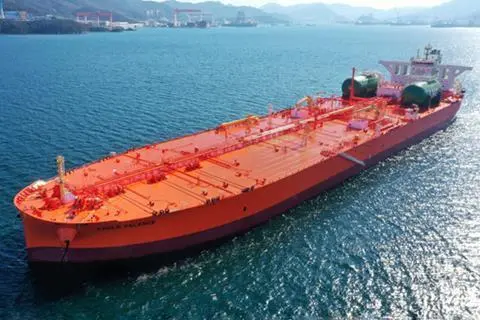
The study, conducted by researchers from the Technical University of Denmark and the Cyprus University of Technology, focused on the short-term impact of a bunker fuel levy, reduced sailing speeds, rather than it’s more long-term benefit of financing technological change within the industry.
Historical data was used to evaluate the relationship between fuel prices, freight rates and vessel speed between 2010 and 2018. The researchers then modelled the impact of a market-based bunker levy to predict how it would affect ship speed in the future.
Evaluating a range of tanker sizes and levies of between $100 and $1,200 per metric ton of fuel, the researchers concluded that levies, depending on the vessel and sailing pattern, could lead to a short-term reduction of up to 43% of CO2 emissions. This high value was only achieved in times of high spot rates. Additionally, they concluded that any period of fleet over-capacity before 2050 would make market-based levies less effective in the short term.
The speed reduction induced would be highly dependent on the ratio of freight rates to fuel price at the time of enforcement. When spot rates are low, the emissions reduction is lower as ships are already sailing at slower speeds, so a levy would have less impact.
In one case evaluated, a VLCC sailing on a high spot rate with a bunker levy of $600-900/MT would likely achieve CO2 reductions of 36-43%, but sailing on a low spot rate, with a bunker levy of $100-200/MT would only achieve CO2 reductions of 5-13%.
“We reiterate a recommendation made in Gkonis and Psaraftis (2012) which seems more relevant now,” state the researchers. “If laden leg ship speeds are not constrained by charter party clauses (which is the scenario examined in this paper), lower CO2 emissions are likely to occur. Conversely, a charter party agreement specifying a prescribed speed, explicitly or implicitly, might entail significant costs, both in terms of additional fuel (which is a private cost matter) and in terms of additional CO2 emissions (which is a cost to society).” Regulatory action to prevent such clauses in charter party agreements could be beneficial.
The researchers note that additional AIS data would strengthen their analysis. The Motorship notes that the study was unable to take into account the potential for switching to other fuel types. A levy may offer a potential incentive to charterers or shipowners to consider fuelling tankers on LNG, or other alternative fuels.
The article has been published in the Transportation Research Part D journal and is available here.
Related Articles
 ALTERNATIVE FUELS & LUBRICANTS
 GENERAL NEWS
 GENERAL NEWS