



Canadian Operator Keeps Faith With Hovercraft
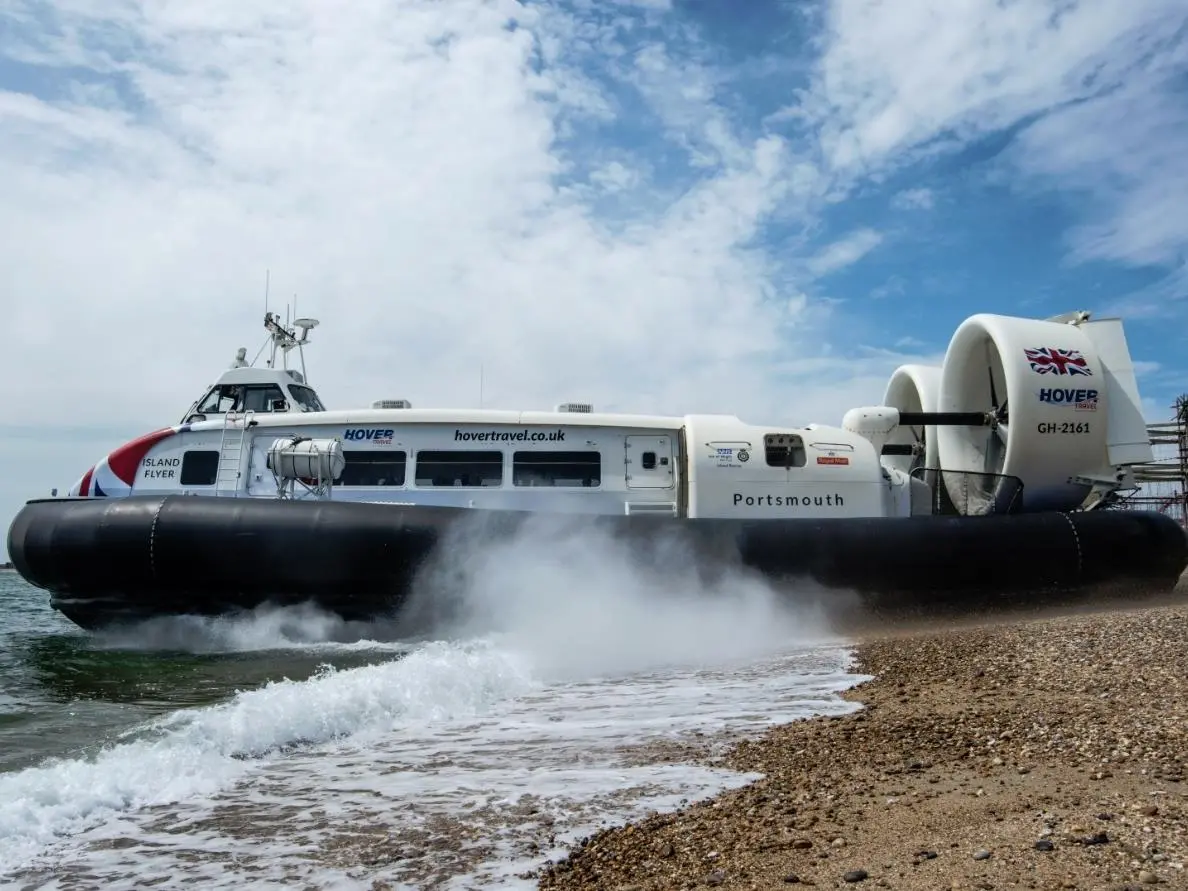
Provincial ferry owner and operator Société des Traversiers du Québec (STQ) has ordered a small, passenger-only newbuild to supersede a Griffon 2000TD-type hovercraft constructed in 2012 and used to maintain a local service on the north shore of the Gulf of St Lawrence.
The new hovercraft, costing C$4.35m (US$3.2m), is expected to ensure the reliability of the Saint-Augustin River crossing, providing the versatility in operating over water, ice, gravel and asphalt in challenging climatic conditions to directly link the airport at Pakuashipi with the settlement of Saint-Augustin. The existing 13m craft will be retained as the relief ferry.
The Saint-Augustin ferry replacement project forms part of a much wider investment programme being rolled-out by STQ. This includes a medium-term plan, valued at over C$190m (US$138m) to order three battery-powered vessels for two services in the St Lawrence Valley.
Griffon Hoverwork’s current workload includes three 24m high-speed hovercraft destined to restore a 10 nautical mile Japanese coastal link between Oita Airport, at Kunisaki, and Oita City. The final craft in the series of customised, 12000TD-type amphibious ferries is due to be delivered in early 2024.
The £25m (US$30.4m) contract from the Oita Prefecture authorities in Japan was followed by the Southampton-headquartered company’s extension of its production capabilities through a lease on premises at Trafalgar Wharf, Portchester, in the Portsmouth area, accompanied by recruitment of extra aluminium fabricators.
Griffon Hoverwork has also put down a marker for future developments by participating in a UK Government-sponsored project to investigate the prospective use of hydrogen fuel. The ZEHPHyr feasibility study aims to de-risk the key barriers to the adoption of a zero-emission hydrogen-based propulsion system for hovercraft.
ZEHPHyr forms part of the Clean Maritime Demonstration Competition Round 2, launched in May 2022 and funded by the UK Department of Transport. The project, which has qualified for a £569,000 (US$691,000) grant, is led by engineering consultant Blue Bear Systems, partnered by Bramble Energy, Nyobolt, Aquatera, the European Marine Energy Centre, and Griffon Hoverwork.
It is envisaged that the novel propulsion solution will be demonstrated on 80-seat and 12-seat hovercraft, and introduction of zero-emission hovercraft into commercial service is anticipated after 2025.
Riding on a cushion of air, a hovercraft produces virtually no wash or wake at high speed, a fact that chimes well with local administrations and port communities. Moreover, such craft can maintain operations and schedules independent of tides and ice, and offer the capability to travel up and over foreshores.
Related Articles
 METHANOL
 GENERAL NEWS
 HYDROGEN