



Charting a path to compliance: LR’s CO2 Verifier
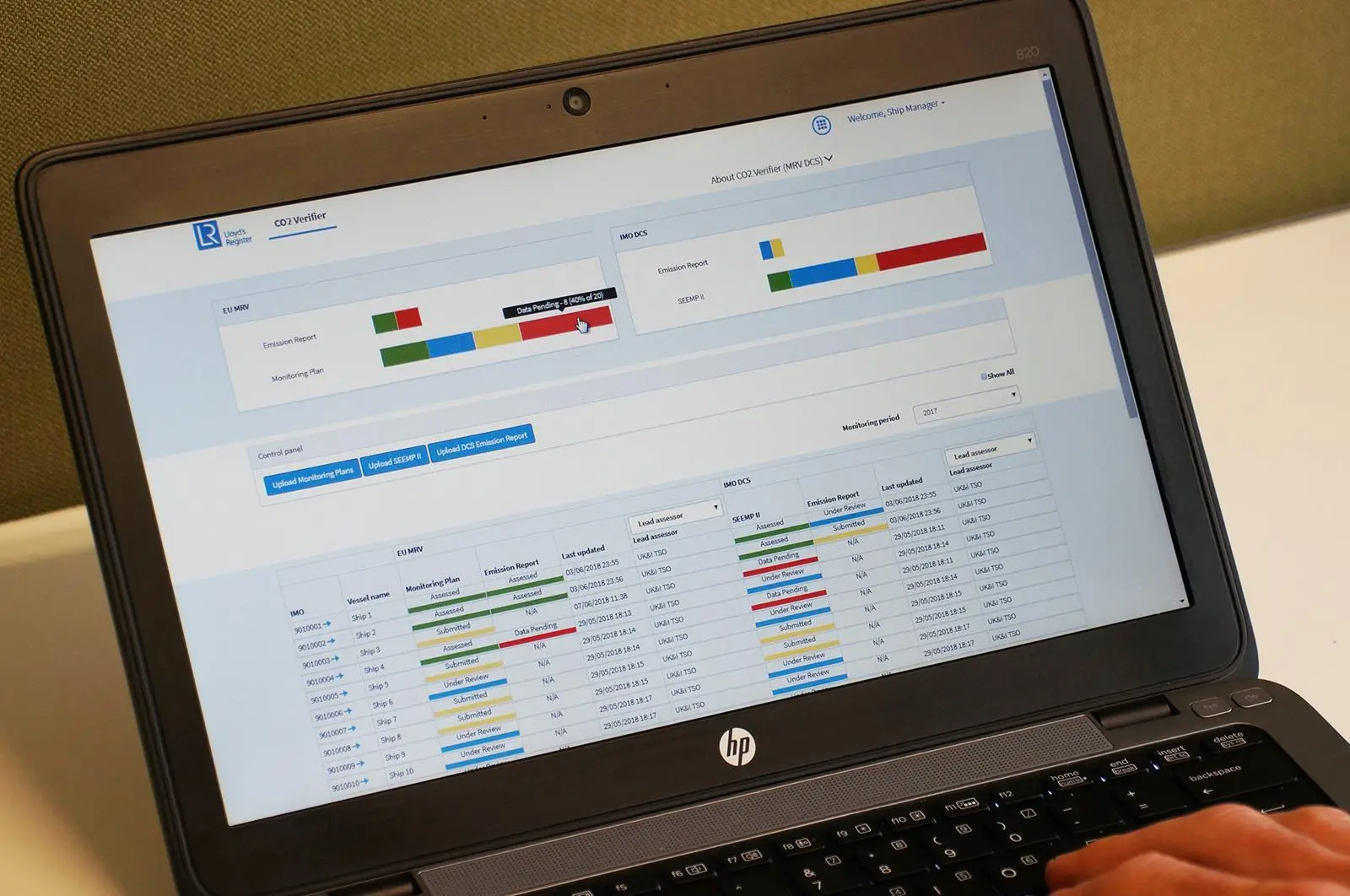
It is a timely moment to look at options for ensuring compliance. The requirement for reporting CO2 emissions data for the EU’s monitoring, reporting and verification (MRV) scheme takes effect from 30 April 2019, and for IMO’s data collection system (DCS) the Statement of Compliance will be due on 31 May 2020. Shortly after that, the deadline for the IMO to receive all of 2019’s DCS fuel consumption data from flag administrations or their recognised organisations will occur on 30 June 2020.
Early adopter
LR was in the first wave of classification societies responding to future demands for fuel consumption reporting and verification of CO2 emissions reporting.
Having identified the industry’s need for a solution, LR developed a viable scalable solution, using its Innovation and Co-creation model and in-house expertise, and launched LR’s CO2 Verifier in June 2018 at Posidonia, Greece.
The solution has expanded rapidly, and currently over 4,000 ships use LR’s CO2 Verifier solution. Around 40 percent of the vessels using CO2 Verifier are classed by LR and the profile of users ranges from single vessels up to fleet management scale solutions for 100-vessel fleets, where the solution has been used to replace an existing large document storage system.
“The main advantages for our customers is that the system is simple to use and offers flexibility in terms of access rights – whether you want to empower crew members onboard vessels to upload documents or enable fleet managers or environmental compliance managers – whilst the app gives administrators the opportunity to see the status of submissions and to access delivery teams” McLoughlin noted.
The IMO-DCS reports generated by the CO2 Verifier are reviewed by LR before a statement of compliance is generated. As the review process is a manual process, this ensures the independent appraisal of the accuracy of the data submitted.
Ensuring a proper handover
While the regulations themselves are clear, vessel owners may be exposed to findings of non-compliance in Port State Control or Flag State inspections if they do not have access to complete data, particularly where a vessel has changed hands within the current reporting period.
“When vessels change hands, we would advise shipowners to ensure that they get access to historical fuel consumption data from the previous owner and receive assurances that the previous owner will submit data for independent verification to cover the period of time in which they operated the vessel.” McLoughlin warned. It is clear that for IMO DCS, the owner or operator at the time is responsible, and for EU MRV the owner/operator at the end of the year is responsible.
Evolving regulations
There are a number of other areas of reporting regulations that LR is following closely. “China has introduced its own reporting requirements and that is something that we are looking closely at,” McLoughlin said, adding that other states may also introduce stand-alone requirements.
McLoughlin is sympathetic towards ship operators who find the proliferation of competing reporting standards burdensome. The CO2 Verifier helps shipowners and operators to generate separate outputs for submission to the different schemes, recognising that the consideration of cargo carried, and more broadly voyage based activities and “at berth” activities for EU-MRV regulations differs from the periodic activities required under the IMO DCS scheme.
“We think that the DCS system is here to stay for at least the medium term, while we will have to see how the IMO wants to develop the reporting system”, McLoughlin noted, but added that there have been some discussions towards common definitions between the DCS and MRV systems.
Digitalisation and self-service
However, looking further afield, there is little sign that the situation will simplify over the medium term. One of the advantages of the CO2 Verifier system is that it represents a scalable solution that could be extended to cover other reporting requirements that also require independent verification.
It is a key way-marker on LR’s journey towards a more digitalised future.
“We regard the CO2 Verifier portal as a part of our existing service delivery, and think it is an important step on the path towards offering our customers greater integration and self-service opportunities,” McLoughlin said, adding that the classification society was continually examining other areas for innovation to ensure that LR remains as relevant to its clients in the future as in the past.
Related Articles
 ALTERNATIVE FUELS & LUBRICANTS
 GENERAL NEWS
 GENERAL NEWS