



CII rules for chemical tankers criticised
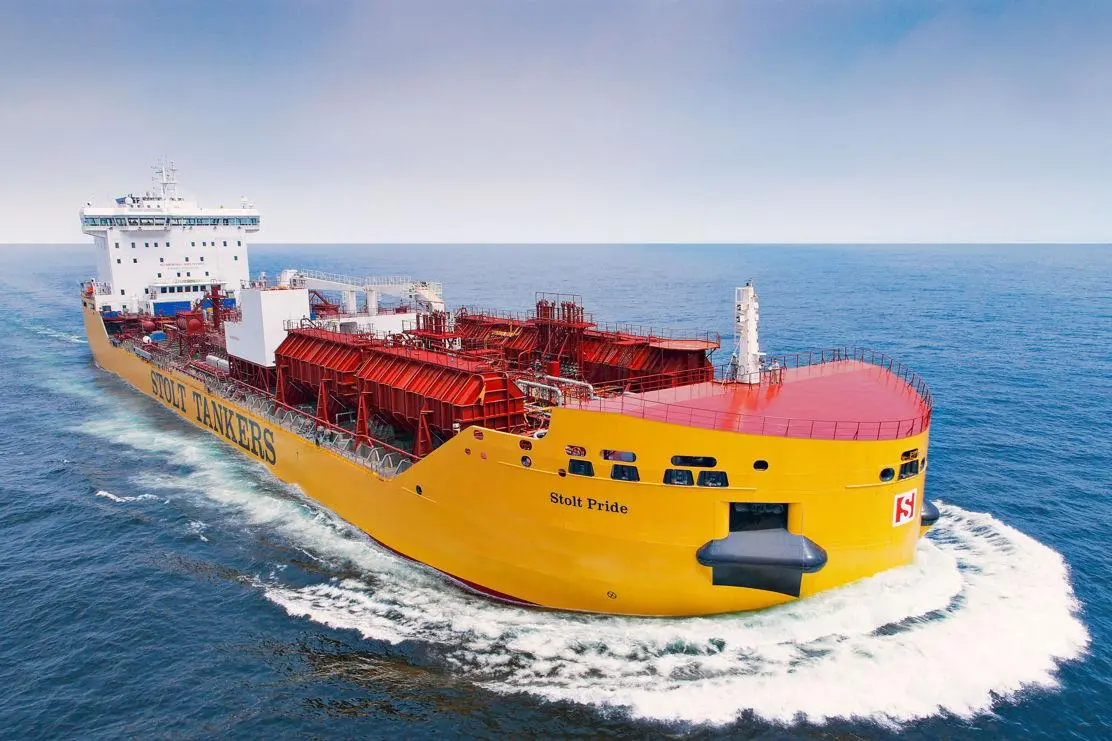
The CII is a yearly measure of overall ship efficiency while in operation. Every ship receives an energy rating based on their efficiency ratio, which measures distance travelled and speed as well as the intensity of the use of the vessel. Ratings are given on a scale of A to E, whereby D and E ships are considered non-compliant by the IMO and are only allowed to be operational for a short period (three years for D or one year for E), before they must be corrected to a midpoint C rating.
“It’s important to note that the CII rating is not about absolute emissions or efficiency. It relates to the nautical miles sailed and varies with the operating and trade pattern of each ship,” says Gabriel Poritz, Business Partner Sustainability and Decarbonisation, Stolt Tankers. “So, ballast voyages, sailing time, slow speed and optimising hull, propeller and engine conditions all help achieve a good rating, whereas long port stays have a negative effect.”
In short, thinking in terms of ‘more miles, less fuel’ will improve a ship’s CII rating. Performance is also measured according to deadweight – ships of a certain size are compared with others in the same deadweight category in the same segment.
“This seems to be fairly straightforward and works for most of the main ship types,” says Maren Schroeder, Managing Director of Stolt Tankers. “However, the sailing pattern of a chemical parcel tanker is far more complex compared to product or oil tankers, and this has not been accounted for in the current CII regulations.”
Due to their complex nature (on average, 10 to 12 different cargoes can be carried on more complex ships), chemical parcel tankers may spend up to 55% of their time in port, shifting from terminal to terminal to load and discharge the various products. Standard oil or product tankers usually fully discharge or load cargo in a single port visit, which amounts to just a few days.
“Even within our own fleet, if we compare the same size and specification of ships, the CII rating may vary,” says Schroeder. “A ship that sails in the acid trade, for example (which has similar trade patterns to product tankers), will get a B rating, whereas its twin that sails in the parcel trade, with multiple port transitions, will get a D rating.”
The CII regulations, in their current form, do not include adjustments to data for events that are outside of an owners’ control, such as inclement weather or a force majeure.
“Closure of the Suez Canal in 2021 affected global shipping lanes for a week, and the resulting port congestion issues continued for months afterwards,” says Poritz. “The Port of Houston regularly shuts down its shipping channel due to dense fog and ships are still being quarantined due to Covid, especially in China. In all these cases, ship operators and owners can do nothing to prevent their CII ratings plummeting.”
The industry is awaiting the IMO’s final wording of the CII – despite the regulations coming into force in less than a month’s time – but Schroeder believes the options for achieving compliance in the chemical tanker sector will remain limited.
“We can create unnecessary additional GHG emissions by swapping out our B and D rated ships annually and adding a ballast leg. Or we can use newer, more energy-efficient ships in trades with long port stays and older ones in trades with long voyages and ballast legs. We do the opposite now to reduce emissions.
“Stolt Tankers is committed to our own decarbonisation ambitions to reduce carbon intensity by 50% by 2030, relative to 2008 levels, and to achieve carbon neutrality by 2050. And we welcome and do everything to support industry-wide carbon reduction measures and targets. But it cannot be right that, to comply with the proposed CII regulations, we are forced to consume more fuel and emit more CO2.”
Stolt Tankers’ recommendations to improve the accuracy of the CII regulations:
- Clearly define if biofuels can be used and how their emissions should be measured, for example, using a well-to-wake approach. Retrofitting ships to run using alternative fuels is a significant undertaking and not realistic with current technology.
- For ships with a low ratings, such as chemical tankers, give more consideration to corrective actions per market segment because one size most certainly does not fit all. Allowing the Flag States some degree of discretion to apply real-world solutions that makes sense in their segment and offer the most benefit to the environment – rather than merely following a pre-determined, untested set of regulations – will help to move the whole industry towards our collective aim of reducing global emissions as soon as possible.
- Agree a definition of force majeure and other events that are outside the control of operators and define a process for any ship affected to submit a request for an element of its reporting period to be omitted from its CII rating.
Related Articles
 METHANOL
 MONITORING, CONTROL & DIGITALISATION
 MONITORING, CONTROL & DIGITALISATION