



ClassNK to launch composite propeller guidelines
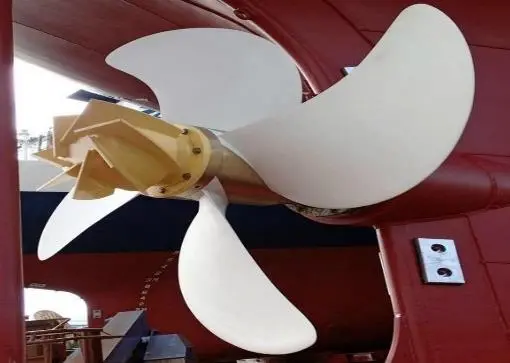
ClassNK’s Guidelines on Composite Propellers (Part on Manufacturing/Product Inspection) will be published on 31 August. The publication follows the design and manufacture of a carbon fibre reinforced plastic (CFRP) propeller, and its installation on a merchant vessel – a world first – as part of ClassNK’s Joint R&D for Industry programme last year.
CFRP weighs around one fifth of aluminium-bronze but exhibits the same or greater strength compared to the aluminium-bronze composite materials used in conventional propellers. The lighter material means that CFRP propeller shafts can be manufactured with smaller diameters, reducing costs. It is also possible to produce thinner propellers with smaller blade areas, potentially increasing efficiency.
ClassNK noted: “In order to apply a composite propeller to ships, the material must have the required performance at least equal to existing aluminium-bronze composite materials, and it is necessary to confirm in advance that the composite propeller as an industrial product can be manufactured with uniform quality.”
Based on the knowledge obtained through the project, ClassNK has summarised the requirements for manufacturing process approval, testing and inspection for composite propellers, to assist in their effective use on ships.
Related Articles
 PROPULSION
 GENERAL NEWS
 GENERAL NEWS