



Combined coupling and composite shaft
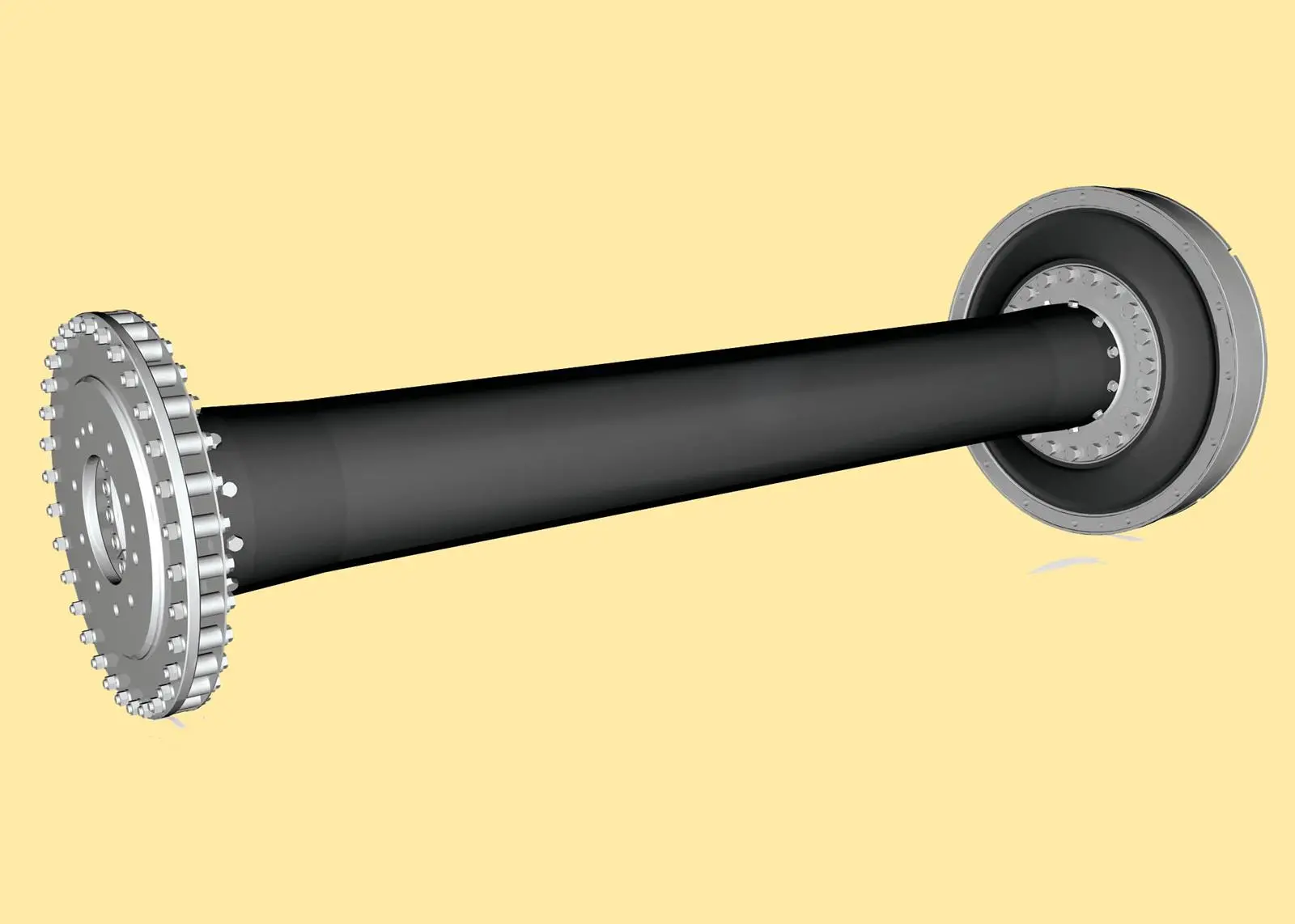
The company says that the high radial stiffness and low axial and bending stiffness of the Rato DS means that, as well as its normal application as a torsional coupling, it can compensate for misalignment when rigidly connected to an intermediate shaft, with a secondary torsionally stiff coupling at the rear end of the shaft. The second coupling, either a steel membrane or a Metaflex coupling, creates a second bending flexible pivot, providing a double cardanic design. The new combination is known as the Vulkan integrated shaft coupling (ISC).
Vulkan says that the angular deflection of the Rato DS causes – even at high misalignment levels – a low strain level compared to the torque load and thus a low power loss. The claimed advantages of the ISC design are a significant reduction of parts, leading to lighter weight, and the ability to handle misalignment means lower installation cost. Because, thanks to the Rato DS rubber element, there is no noise transmission path over metallic or bearing parts between the engine and gearbox, the assembly provides good isolation against structure borne noise.
Depending on the shaft speed the ISC design can be offered with composite shafts up to 7m length, and with the full range of single- or dual-element Rato DS couplings.
Related Articles
 ALTERNATIVE FUELS & LUBRICANTS
 GENERAL NEWS
 GENERAL NEWS